All comparisons
An alternative to B2SellAI enrichment tools

Anglera vs B2Sell

The bottom line

Buy B2Sell if you want PIM, storefront, and enrichment from one vendor wired into Epicor P21. Buy Anglera if you already run a PIM and need enrichment that mines supplier PDFs, proposes new attributes, and tailors specs to your buyers.

Both claim to enrich product data. This page is about where that claim stops.

The frame for this comparison

Product data is a practice, not a project.

B2Sell Central holds the product record and lists AI Product Enrichment among its features; this comparison is about the second pass and the fiftieth — who owns the value that came back plausible but wrong, and the spec the supplier revised last week.

01

Ground it

Mine every spec from every source.

Every value traced to a document you can open. The catalog is only as honest as what it was built from.

02

Align it

Aim the catalog at the buyer who actually buys.

Grounded data still loses if it answers questions nobody asked. Alignment is what turns specs into conversion.

03

Keep it alive

Product data is a practice, not a project.

Markets move, suppliers reissue, buyers change what they ask for. A catalog that is right in March is wrong by August unless something is watching.
Capability by capability

Where B2Sell stops.

Scored against public documentation. Grouped by the three acts — so you can see which ones B2Sell leaves on your desk.

01

Ground it

Mine every spec from every source.
Source mining
Where does it get specs from?
B2SellLimited

Supplier feeds, spec documents, PDFs, external manufacturer catalogs

AngleraYes

PDFs, spec tables, drawings, manuals, images, sites

Schema discovery
Does it find attributes that aren't in your schema yet?
B2SellNo

Fills and infers within existing schema; no new attribute proposals

AngleraYes

Proposes fields your schema never had

Governed vocabulary
Does it turn messy free-text into a governed pick list?
B2SellLimited

Normalizes units and synonyms; governed versioned pick lists unclear

AngleraYes

Normalizes and governs allowed values, versioned

Taxonomy & classification
Can it classify every SKU into your hierarchy?
B2SellYes

Auto-maps to category hierarchies; channel-specific publishing

AngleraYes

Auto-classifies; channel and marketplace mapping

Citations & provenance
Can you see where any given value came from?
B2SellYes

Source references and confidence scores on each enriched field

AngleraYes

Every value cites its source doc and page

02

Align it

Aim the catalog at the buyer who actually buys.
Buyer personas
Is the content written for your buyer, or generically?
B2SellNo

No B2B/B2C persona-tailored attributes or language documented

AngleraYes

B2B specifier and B2C shopper enriched differently

Review, search & social signals
Does it learn what buyers ask from the live market?
B2SellNo

Search self-learns from clicks; signals don't drive enrichment

AngleraYes

Reviews, search, competitor rails, social — fed back

Copy & SEO
Does it write original, channel-ready copy?
B2SellLimited

Enhances descriptions; original copy generation not detailed

AngleraYes

Original copy per persona and channel

Product imagery
Can it produce usable images for SKUs that lack them?
B2SellNo

Matches and imports manufacturer photography; no image generation

AngleraYes

Generates studio-grade imagery for photoless SKUs

03

Keep it alive

Product data is a practice, not a project.
Continuous re-enrichment
What happens when the market moves after go-live?
B2SellLimited

Auto-enriches newly added SKUs; re-enrichment of existing records unclear

AngleraYes

Re-enriches on its own after go-live

Quality scoring
Does it score its own output and track catalog health?
B2SellYes

Completeness scoring plus PIM data quality validation

AngleraYes

Scored against your standards; nothing publishes below bar

Write-back
Does enriched data land back in your system of record?
B2SellYes

Writes to P21, SAP B1, NetSuite, third-party PIMs

AngleraYes

Writes back to PIM, ERP, warehouse, commerce

API, MCP & webhooks
Can your own tools and agents drive it headlessly?
B2SellLimited

REST/SOAP API, real-time sync; no public webhooks or MCP

AngleraYes

API, webhooks, and MCP servers

Who does the work
Does it do the work, or help your team do it?
B2SellLimited

AI automates enrichment; flags gaps for customer team review

AngleraYes

Anglera owns the work; review is a guardrail

KeyYesships itLimitedlimited or gatedYour teamyour team still does itNodoesn't do itAnglera differentiator
What “buyer signals” actually means

Six signals sitting in your market right now.

“Buyer signals” is the emptiest phrase in this category, so here is the literal thing. Each of these is an observation from a live market, the gap it exposes, and the field that gets created as a result.

Search signal·Site-search queries on a distributor's eSeller storefront that come back empty

Searches for "cmp cat6" and "plenum rated cat6 1000ft" return nothing, and the same session falls back to a category page and pages through 40 SKUs by hand.

Jacket rating exists only as prose inside the long description — "plenum-rated for use in air-handling spaces" — so it is readable but not filterable. The pass that wrote the sentence never produced a value anything downstream can match on.

Field createdcable_jacket_flame_ratingCMP (plenum) | CMR (riser) | CM (general purpose) | CMX (limited use) | LSZH, per NEC Article 800 markings; sentence-level phrasings map to the code, not the reverse
Marketplace signal·Item-feed rejections coming back through the Amazon and Walmart marketplace integrations

An outdoor disconnect switch is rejected on the enclosure-type attribute. The feed carried a bullet reading "rugged weatherproof housing for outdoor installations" and left the enumerated field empty.

The pass that wrote the bullet produced a marketing claim rather than a governed value. Weatherproof spans NEMA 3R through 4X, and the difference — hosedown, corrosion, indoor-only — is the difference between a fitted product and a returned one. The enclosure type is a spec on the manufacturer's cut sheet; it has to be read from there, not written from the title.

Field createdenclosure_environmental_ratingNEMA 1 | 3R | 4 | 4X | 12 | 13, each with its IP equivalent held as a derived field; free-text claims like "weatherproof" or "outdoor rated" are unresolved until mapped
Supplier signal·Revised manufacturer datasheet PDFs arriving for extraction

A centrifugal pump datasheet is reissued and now lists max fluid temperature as 180°F with EPDM seals and 250°F with FKM — one SKU family, two numbers, on the same page.

The record holds a single max-temp value with no seal material beside it, so whichever number was extracted first is published without the condition that makes it true. Conditional specs are where a flat extraction quietly loses meaning, and the loss stays invisible until an application engineer catches it.

Field createdelastomer_seal_material + max_fluid_temperature_f (value bound to the seal option, not to the SKU)EPDM | FKM | NBR | PTFE | perfluoroelastomer; trade names such as Viton or Buna-N are recorded as synonyms of the governed material, never as the value
Why catalogs rot

Rot starts the day the fill rate goes green

B2Sell Central is a PIM module: a centralized data repository with bulk import/export, version control and data validation, and it lists AI Product Enrichment and AI Document Processing among its features. The record it holds is a moving object. A blank field announces itself; a plausible one does not. "Weatherproof," inferred from a product name, sits in the record looking exactly like "NEMA 4X" read off a datasheet — and once it's in Central, Multi-Channel Publishing and Automated Content Syndication carry it outward, and Output prints it into the catalog. Meanwhile a supplier reissues a datasheet with a new seal option, a channel adds a required field, a buying group changes the selling UOM. Completion is standing work — provenance, review, re-run — that happens alongside the repository, not once inside it.

Messy in, governed out.

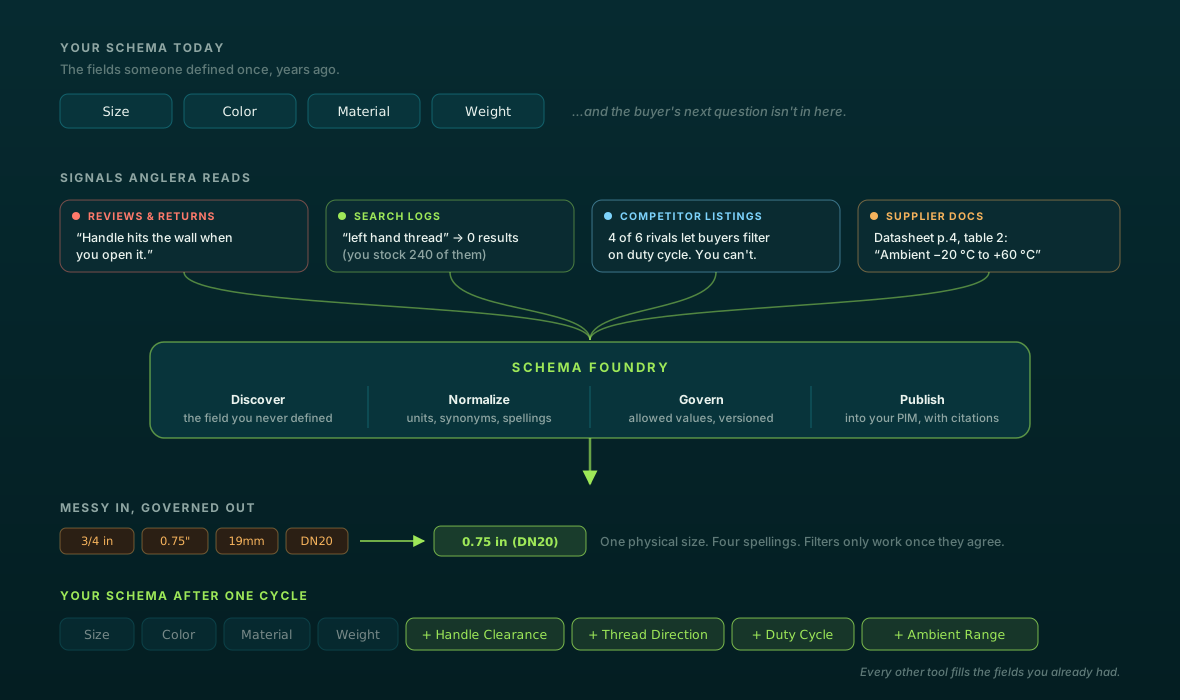
Values are normalized into a governed, versioned set of allowed values — so a filter works, and keeps working after the next import.

Nominal Size
3/4 in0.75"3/4"19mm3/4 inchDN20
0.75 in (DN20)

Six suppliers, six spellings, one physical size. Filters only work once they agree.

Finish
BlkblackBLACK MATTEMatte BlkRAL 9005
Black — Matte

Free text makes a colour filter useless. A governed value makes it a facet.

Material
SS316316 StainlessStainless Steel 316A4 Stainless
Stainless Steel — 316 / A4

Same alloy, four vocabularies, plus a trade name. Buyers search all of them.

And the part nobody else does

We don't just fill the template you handed us.

Filling the fields you defined has an invisible ceiling: a catalog can hit 100% complete and still miss the attribute that loses the sale, because completeness is measured against a schema someone drew years ago. Schema Foundry reads competitor listings, buyer searches, review complaints and your supplier docs, and proposes the fields you never defined — which is where B2Sell stops.

How Schema Foundry works
Schema Foundry: signals from reviews, search logs, competitor listings and supplier documents reveal attributes missing from your schema; the Foundry discovers, normalizes and governs them, so your schema ends the cycle with more fields than it started with.

What B2Sell does

B2Sell is a full-stack B2B platform for distributors and manufacturers that bundles a PIM, B2B eCommerce storefront, and AI-powered product data enrichment into one suite, with deep integrations into ERP systems like Epicor P21.

Pricing: No public pricing; no free version. Free trial offered. Custom quote required.

B2Sell website

When B2Sell is the right call

Distributors with no PIM yet who want catalog, B2B storefront, and supplier-feed enrichment from one vendor — with ERP writeback, category auto-mapping, source citations, and completeness scoring.

We'd rather tell you here than in month three of an implementation.

Capability verdicts reviewed against B2Sell's public documentation on July 14, 2026. Vendors ship quickly — if something here is out of date, tell us and we'll correct it.

See it on your own SKUs.

Bring one category and your supplier files. In 30 minutes you'll see it enriched — complete, structured, and consistent enough to launch on — plus the attributes your schema didn't have yet.

Book a demo