All comparisons
Works with Base.comPIM platforms

Anglera + Base.com

The bottom line

Keep Base.com as the operations hub that lists, syncs, ships and reprices across your marketplaces and shops. Add Anglera to complete each record before it lists, mining specs from supplier documents, citing every value and writing back through Base.com's API.

Base.com and Anglera solve different halves of the problem — this page is about the seam between them.
The frame for this comparison

Product data is a practice, not a project.

Base.com and Anglera work on the same product at different moments: Base.com takes the record to every channel the instant it lands, and Anglera is the standing practice that makes sure the record is worth taking.

01

Ground it

Mine every spec from every source.

Every value traced to a document you can open. The catalog is only as honest as what it was built from.

02

Align it

Aim the catalog at the buyer who actually buys.

Grounded data still loses if it answers questions nobody asked. Alignment is what turns specs into conversion.

03

Keep it alive

Product data is a practice, not a project.

Markets move, suppliers reissue, buyers change what they ask for. A catalog that is right in March is wrong by August unless something is watching.

Capability by capability

Where Base.com stops.

Scored against public documentation. Grouped by the three acts — so you can see which ones Base.com leaves on your desk.

01

Ground it

Mine every spec from every source.
Source mining
Where does it get specs from?
Base.comLimited

Imports wholesaler XML, CSV, API feeds; PDF mining not documented

AngleraYes

PDFs, spec tables, drawings, manuals, images, sites

Schema discovery
Does it find attributes that aren't in your schema yet?
Base.comYour team

Predefined parameters and additional fields; team defines new ones

AngleraYes

Proposes fields your schema never had

Governed vocabulary
Does it turn messy free-text into a governed pick list?
Base.comLimited

Predefined parameters with set format and group

AngleraYes

Normalizes and governs allowed values, versioned

Taxonomy & classification
Can it classify every SKU into your hierarchy?
Base.comYes

AI marketplace category matching plus bulk categorise

AngleraYes

Auto-classifies; channel and marketplace mapping

Citations & provenance
Can you see where any given value came from?
Base.comYour team

Per-value source citation not documented; team tracks sources

AngleraYes

Every value cites its source doc and page

02

Align it

Aim the catalog at the buyer who actually buys.
Buyer personas
Is the content written for your buyer, or generically?
Base.comLimited

AI copy by style, length, language; personas not documented

AngleraYes

B2B specifier and B2C shopper enriched differently

Review, search & social signals
Does it learn what buyers ask from the live market?
Base.comYour team

Repricer tracks prices; review and search loop not documented

AngleraYes

Reviews, search, competitor rails, social — fed back

Copy & SEO
Does it write original, channel-ready copy?
Base.comYes

AI names, descriptions, parameters and Amazon bullet points

AngleraYes

Original copy per persona and channel

Product imagery
Can it produce usable images for SKUs that lack them?
Base.comLimited

AI background removal, channel image versions; generation not documented

AngleraYes

Generates studio-grade imagery for photoless SKUs

03

Keep it alive

Product data is a practice, not a project.
Continuous re-enrichment
What happens when the market moves after go-live?
Base.comLimited

Scheduled bulk operations and auto-listing rules the team sets

AngleraYes

Re-enriches on its own after go-live

Quality scoring
Does it score its own output and track catalog health?
Base.comLimited

Flags gaps and duplicates; quality scoring not documented

AngleraYes

Scored against your standards; nothing publishes below bar

Write-back
Does enriched data land back in your system of record?
Base.comYes

Syncs offers, stock and prices to marketplaces and shops

AngleraYes

Writes back to PIM, ERP, warehouse, commerce

API, MCP & webhooks
Can your own tools and agents drive it headlessly?
Base.comYes

JSON API with product write methods; no vendor MCP documented

AngleraYes

API, webhooks, and MCP servers

Who does the work
Does it do the work, or help your team do it?
Base.comYour team

Software platform; seller's team owns product content work

AngleraYes

Anglera owns the work; review is a guardrail

KeyYesships itLimitedlimited or gatedYour teamyour team still does itNodoesn't do itAnglera differentiator
What “buyer signals” actually means

Six signals sitting in your market right now.

“Buyer signals” is the emptiest phrase in this category, so here is the literal thing. Each of these is an observation from a live market, the gap it exposes, and the field that gets created as a result.

Review signal·Marketplace product reviews (auto parts)

"Front pads fit the caliper fine, but there was no wear sensor in the box and the dash light came straight on. Had to order the sensor separately."

The listing carries axle position, vehicle fitment and pad compound, but says nothing about whether the electronic wear sensor is included. Buyers whose car needs one find out after the old pads are off, and the return reads as a fit problem.

Field createdwear_sensor_included, plus wear_sensor_required_by_fitmentIncluded | Not included, sold separately | Not applicable (no sensor on this application). Taken from the manufacturer's application catalog and the box contents list, not the feed description.
Search signal·Internal site search on a seller's own shop (consumer electronics accessories)

Queries like "65w gan charger pps" and "usb c charger 45w samsung super fast" return every wall charger in stock, because charging protocols only appear inside the product title.

Output wattage per port and supported charging protocols live in title strings and the manufacturer's datasheet, so there is no field to filter on and no parameter for a marketplace to map. Buyers who know exactly what their phone needs get an unsorted list.

Field createdcharging_protocols (multi-select), plus max_output_w_per_portUSB PD 3.0 | USB PD 3.1 EPR | PPS (with voltage range) | Qualcomm Quick Charge 4+ | none. Watts as integers per port, taken from the output table on the manufacturer datasheet.
Marketplace signal·Marketplace listing feed (home and kitchen required fields)

A run of stainless frying pans is held back on a required compatible-heat-source field. The record says "suitable for all hobs"; the packaging insert lists gas, electric and ceramic, with induction marked separately on only two of the five sizes.

Hob compatibility exists as one line of marketing prose, so the channel's required field has nothing structured to receive, and a blanket answer would be wrong for three sizes. The listings wait while someone reads boxes by hand.

Field createdcompatible_heat_sources (multi-select, per size variant), plus oven_safe_max_temp_cGas | Electric coil | Ceramic / glass | Induction | Halogen. Oven-safe temperature as an integer in °C. System of record is the manufacturer care sheet and packaging insert, per size.
Why catalogs rot

Listed everywhere, filled from the feed

Base.com is built for speed to channel. Wholesaler feeds bring in descriptions and images daily, the auto-listing module creates marketplace offers as soon as new products reach inventory, and AI parameter matching auto-fills fields by reading the descriptions and attributes already in the record. That is the right design for a seller who needs thousands of SKUs live quickly. It also means the feed sets the ceiling. If the wholesaler's description never mentions a connector type or a compatible cooktop, there is nothing for the parameter matcher to read, and the gap goes out to every marketplace at once. Raising the ceiling is weekly work outside the feed: open the supplier's spec sheet, fill the field with a cited value, push it back into the catalog before the next listing run.

Messy in, governed out.

Values are normalized into a governed, versioned set of allowed values — so a filter works, and keeps working after the next import.

Nominal Size
3/4 in0.75"3/4"19mm3/4 inchDN20
0.75 in (DN20)

Six suppliers, six spellings, one physical size. Filters only work once they agree.

Finish
BlkblackBLACK MATTEMatte BlkRAL 9005
Black — Matte

Free text makes a colour filter useless. A governed value makes it a facet.

Material
SS316316 StainlessStainless Steel 316A4 Stainless
Stainless Steel — 316 / A4

Same alloy, four vocabularies, plus a trade name. Buyers search all of them.

And the part nobody else does

We don't just fill the template you handed us.

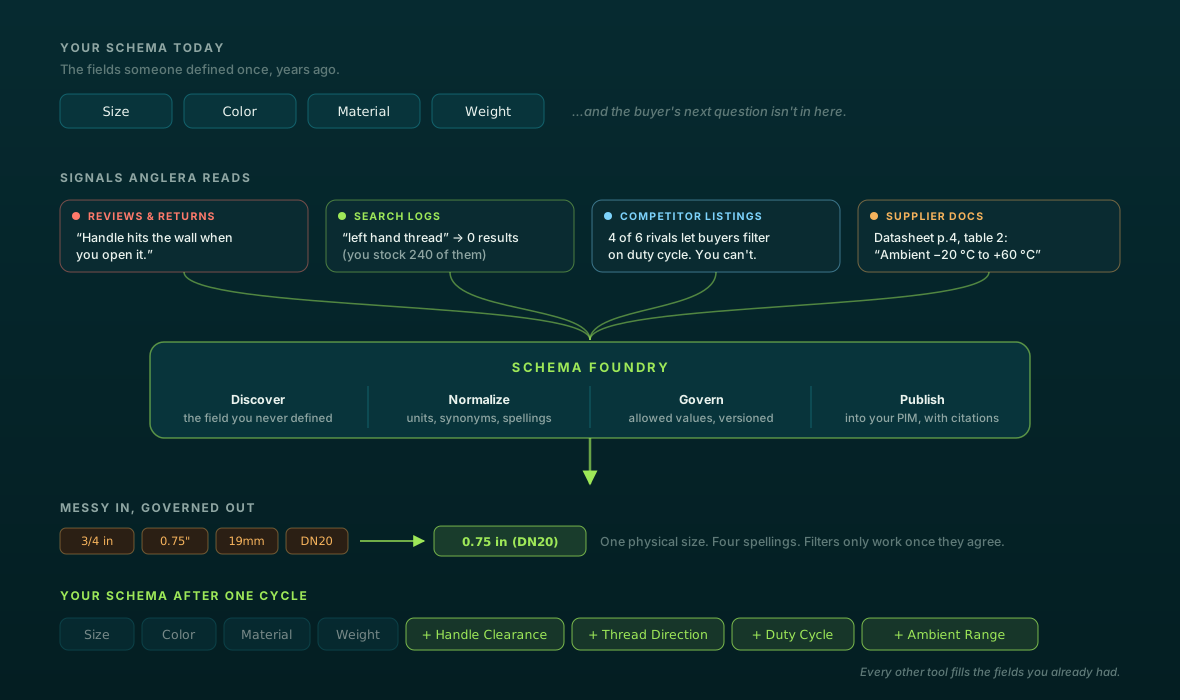
Filling the fields you defined has an invisible ceiling: a catalog can hit 100% complete and still miss the attribute that loses the sale, because completeness is measured against a schema someone drew years ago. Schema Foundry reads competitor listings, buyer searches, review complaints and your supplier docs, and proposes the fields you never defined — which is where Base.com stops.

How Schema Foundry works
Schema Foundry: signals from reviews, search logs, competitor listings and supplier documents reveal attributes missing from your schema; the Foundry discovers, normalizes and governs them, so your schema ends the cycle with more fields than it started with.

What Base.com does

Base.com, formerly BaseLinker and based in Wrocław, Poland, is a multichannel commerce operations platform. It connects marketplaces, online shops, carriers and accounting systems so sellers can run orders, listings, stock, shipping and repricing from one panel, with a product catalog and AI listing tools built in.

Pricing: Freemium at $0/month up to 100 orders and 1,000 products; Business at $99/month for 1,000 orders plus $0.49 per additional order; Enterprise priced individually above 5,000 orders or $300K GMV per month. 14-day free trial.

Base.com website

When Base.com is the right call

Small and growing multichannel sellers who sell across marketplaces like Amazon, eBay and Allegro alongside their own shop, and want orders, listings, stock sync, shipping labels and repricing in one panel with pricing that scales by monthly order volume.

We'd rather tell you here than in month three of an implementation.

Capability verdicts reviewed against Base.com's public documentation on October 16, 2026. Vendors ship quickly — if something here is out of date, tell us and we'll correct it.

See it on your own SKUs.

Bring one category and your supplier files. In 30 minutes you'll see it enriched — complete, structured, and consistent enough to launch on — plus the attributes your schema didn't have yet.

Book a demo