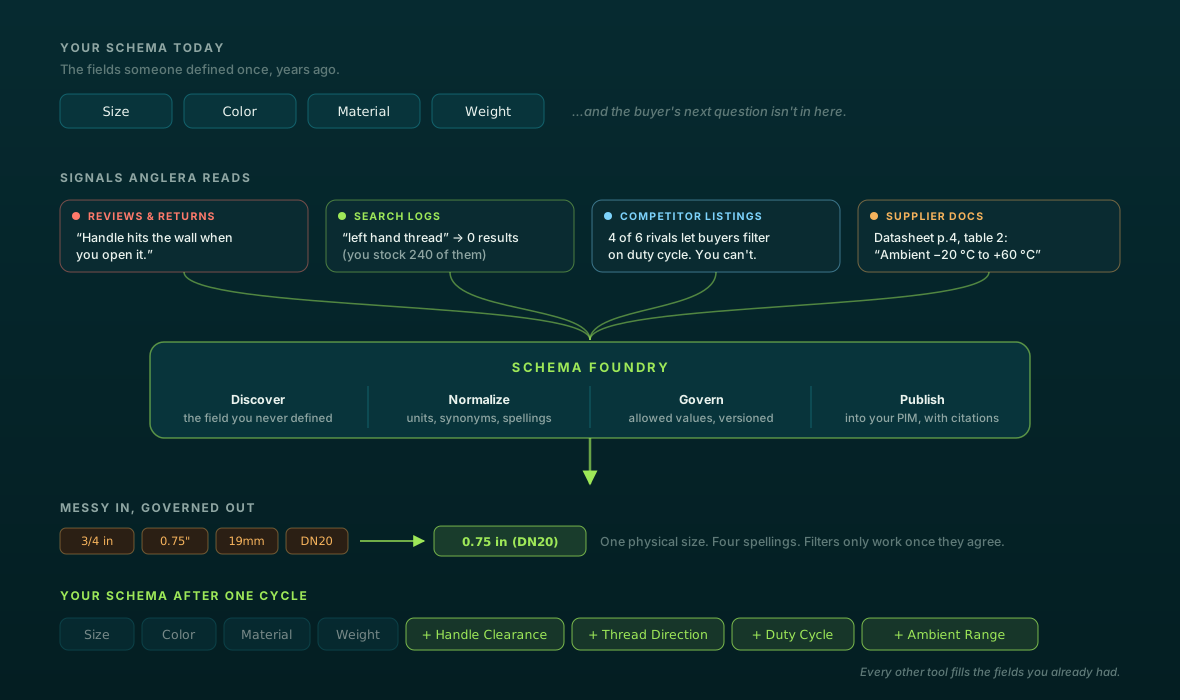
Keep Bluestone PIM as your system of record, DAM, and syndication engine. Add Anglera to mine supplier PDFs, propose the attributes your schema is missing, and enrich against live buyer and market signals before data lands.
Bluestone PIM and Anglera solve different halves of the problem — this page is about the seam between them.
The frame for this comparison
Product data is a practice, not a project.
With a PIM the question was never who owns the model — Bluestone owns that, publishes it over its own APIs, and scores completeness against each channel — it's who does the work of filling the fields, every week, as suppliers ship revisions and channels change their rules.
01
Ground it
Mine every spec from every source.
Every value traced to a document you can open. The catalog is only as honest as what it was built from.
02
Align it
Aim the catalog at the buyer who actually buys.
Grounded data still loses if it answers questions nobody asked. Alignment is what turns specs into conversion.
03
Keep it alive
Product data is a practice, not a project.
Markets move, suppliers reissue, buyers change what they ask for. A catalog that is right in March is wrong by August unless something is watching.
Capability by capability
Where Bluestone PIM stops.
Scored against public documentation. Grouped by the three acts — so you can see which ones Bluestone PIM leaves on your desk.
01
Ground it
Mine every spec from every source.
CapabilityBluestone PIMAnglera
Source mining
Where does it get specs from?
Bluestone PIMLimited
AI reads product images; imports Excel/CSV; no PDF mining
Does it find attributes that aren't in your schema yet?
Bluestone PIMNo
Enrich targets predefined attributes; no new field proposals
AngleraYes
Proposes fields your schema never had
Governed vocabulary
Does it turn messy free-text into a governed pick list?
Bluestone PIMLimited
Validation rules, list attributes; AI Analyst suggests consistency fixes
AngleraYes
Normalizes and governs allowed values, versioned
Taxonomy & classification
Can it classify every SKU into your hierarchy?
Bluestone PIMLimited
Hierarchies built manually; AI Analyst flags miscategorised, suggests fixes
AngleraYes
Auto-classifies; channel and marketplace mapping
Citations & provenance
Can you see where any given value came from?
Bluestone PIMLimited
Value origin and change history; no source-document citations
AngleraYes
Every value cites its source doc and page
02
Align it
Aim the catalog at the buyer who actually buys.
CapabilityBluestone PIMAnglera
Buyer personas
Is the content written for your buyer, or generically?
Bluestone PIMNo
Per-market tone via prompts; no persona-tailored enrichment
AngleraYes
B2B specifier and B2C shopper enriched differently
Review, search & social signals
Does it learn what buyers ask from the live market?
Bluestone PIMNo
No review, search-query, or competitor-listing signal ingestion
AngleraYes
Reviews, search, competitor rails, social — fed back
Copy & SEO
Does it write original, channel-ready copy?
Bluestone PIMYes
AI Enrich drafts descriptions; AI Linguist handles translations
AngleraYes
Original copy per persona and channel
Product imagery
Can it produce usable images for SKUs that lack them?
Bluestone PIMYes
AI DAM generates studio-grade visuals, virtual staging from prompts
AngleraYes
Generates studio-grade imagery for photoless SKUs
03
Keep it alive
Product data is a practice, not a project.
CapabilityBluestone PIMAnglera
Continuous re-enrichment
What happens when the market moves after go-live?
Bluestone PIMYour team
AI Enrich runs user-triggered batches; templates enable repeats
AngleraYes
Re-enriches on its own after go-live
Quality scoring
Does it score its own output and track catalog health?
Bluestone PIMYes
Completeness scoring plus AI Analyst quality detection, alerts
AngleraYes
Scored against your standards; nothing publishes below bar
Write-back
Does enriched data land back in your system of record?
Bluestone PIMYes
System of record itself; syndicates via 700+ endpoints
AngleraYes
Writes back to PIM, ERP, warehouse, commerce
API, MCP & webhooks
Can your own tools and agents drive it headlessly?
Bluestone PIMYes
700+ API endpoints, webhooks; MCP listed as roadmap
AngleraYes
API, webhooks, and MCP servers
Who does the work
Does it do the work, or help your team do it?
Bluestone PIMYour team
Software; customer's team reviews and approves AI output
AngleraYes
Anglera owns the work; review is a guardrail
KeyYesships itLimitedlimited or gatedYour teamyour team still does itNodoesn't do itAnglera differentiator
What “buyer signals” actually means
Six signals sitting in your market right now.
“Buyer signals” is the emptiest phrase in this category, so here is the literal thing. Each of these is an observation from a live market, the gap it exposes, and the field that gets created as a result.
Marketplace signal·Rejection report from a marketplace feed, read the morning after a seasonal push
Forty-one styles bounced with "material composition invalid." The values were there: "95% Cotton / 5% Elastane" on one, "Cotton 95 Elastane 5" on the next, "Baumwolle 95%, Elasthan 5%" on a German-sourced record, and one shell/lining garment carrying two compositions crammed into a single text field.
Composition was modelled as free text on the variant, so nothing checks that the percentages sum to 100, that the fibre names are the ones the channel accepts, or that a lined garment gets one composition per component. Every rejection is a person opening a spec sheet.
Field createdfibre_composition — repeating group of {component, fibre_name, percentage}, validated to sum to 100 per componentGeneric fibre names per ISO 2076 (cotton, elastane, viscose, polyamide…), English canonical with locale labels mapped underneath; component from a governed list: shell, lining, filling, trim, rib.
Search signal·On-site search logs for a distributor's electrical catalog
"ip67 junction box" and "ip 67 enclosure" both return three results and a high exit rate. The catalog carries roughly two hundred enclosures rated IP67 or better; the rating is printed in the supplier PDF and repeated in the marketing description as "weatherproof," "suitable for outdoor use," or "IP-67 rated."
Ingress protection was never modelled as an attribute — it lives in prose, so it isn't faceted, filtered on, or checked. The buyer types the exact code from the spec they were handed and the catalog doesn't recognise it.
Field createdingress_protection_rating — enumerated code, one value per SKU, sourced from the supplier datasheet rather than the descriptionIEC 60529 IP codes (IP54, IP65, IP66, IP67, IP68, IP69K), normalised from "IP-67", "IP 67", "ip67"; "weatherproof" and "outdoor rated" are not values and route to review.
Supplier signal·Spec sheets landing in the supplier portal ahead of a range refresh
A castor manufacturer's price list gives "220 lb" for the same part number whose PDF datasheet says "100 kg per castor, dynamic, 4 km/h." Two other suppliers in the same category submit a single "load capacity" number with no unit and no indication of whether it's per castor or per set of four.
Both numbers are true and they mean different things — a static rating and a dynamic one, per-unit and per-set. Whichever arrives first wins the field, and a merchandiser comparing two castors is comparing two different measurements presented as one column.
Field createddynamic_load_capacity_kg and static_load_capacity_kg — separate numeric fields, per single castor, each carrying its test-speed basisKilograms as the stored unit (pounds converted on ingest, not stored as text); basis from a governed set: dynamic_4kmh, dynamic_1_1kmh, static; scope fixed to per_castor, with per_set submissions divided and flagged.
Why catalogs rot
The model is clean. The values are thin.
A PIM makes the shape of your catalog explicit, and that is what exposes the rot. Bluestone ships completeness scoring — "know when your products are ready to publish across every channel" — so the day you add a fibre-composition field, the SKUs without one become countable. Nothing broke; the gap just became a number. Then the score stops moving. Attributes get added faster than values arrive, because adding a field takes a minute and finding the value takes a supplier email, a datasheet, and a judgment about which of two numbers is right. Bluestone advertises 700+ task-level endpoints and full UI/API parity, so the record is addressable from anywhere — an empty fibre_composition travels as readily as a filled one. The rot isn't mess. It's a clean model, thinly populated, decaying as suppliers ship revisions.
Messy in, governed out.
Values are normalized into a governed, versioned set of allowed values — so a filter works, and keeps working after the next import.
Nominal Size
3/4 in0.75"3/4"19mm3/4 inchDN20
0.75 in (DN20)
Six suppliers, six spellings, one physical size. Filters only work once they agree.
Finish
BlkblackBLACK MATTEMatte BlkRAL 9005
Black — Matte
Free text makes a colour filter useless. A governed value makes it a facet.
Material
SS316316 StainlessStainless Steel 316A4 Stainless
Stainless Steel — 316 / A4
Same alloy, four vocabularies, plus a trade name. Buyers search all of them.
And the part nobody else does
We don't just fill the template you handed us.
Filling the fields you defined has an invisible ceiling: a catalog can hit 100% complete and still miss the attribute that loses the sale, because completeness is measured against a schema someone drew years ago. Schema Foundry reads competitor listings, buyer searches, review complaints and your supplier docs, and proposes the fields you never defined — which is where Bluestone PIM stops.
Bluestone PIM is a composable, MACH-certified Product Information Management platform that centralises product data storage, enrichment workflows, digital asset management, and multi-channel syndication for mid-market and enterprise brands across retail, automotive, and professional services.
Pricing: Custom/usage-based (number of users, SKUs, languages, API throughput, apps). No public list price; enterprise contracts typically run from £15k/yr upward.
Mid-market and enterprise brands that need a composable, MACH-certified PIM: 700+ API endpoints and webhooks, a DAM with AI-generated visuals, completeness scoring, and multi-channel syndication.
We'd rather tell you here than in month three of an implementation.
Capability verdicts reviewed against Bluestone PIM's public documentation on July 20, 2026. Vendors ship quickly — if something here is out of date, tell us and we'll correct it.
See it on your own SKUs.
Bring one category and your supplier files. In 30 minutes you'll see it enriched — complete, structured, and consistent enough to launch on — plus the attributes your schema didn't have yet.