All comparisons
Works with Commport CommunicationsSyndication & feeds

Anglera + Commport Communications

The bottom line

Keep Commport for GDSN syndication and EDI to your retail trading partners; it distributes whatever you give it. Add Anglera to enrich, source-cite and score SKUs before they enter the pipe, so thin records don't reach every retailer.

Commport Communications and Anglera solve different halves of the problem — this page is about the seam between them.

The frame for this comparison

Product data is a practice, not a project.

Commport has run B2B EDI, VAN, and GDSN data pool services out of Ontario since 1985, and its datapool bundles GDSN, a PIM, and Commport Product Syndication to publish your item record to subscribing retailers and onward to marketplaces — this comparison is about the ongoing practice of keeping that record worth publishing, because the questions buyers ask of a SKU change faster than the standard that transports it.

01

Ground it

Mine every spec from every source.

Every value traced to a document you can open. The catalog is only as honest as what it was built from.

02

Align it

Aim the catalog at the buyer who actually buys.

Grounded data still loses if it answers questions nobody asked. Alignment is what turns specs into conversion.

03

Keep it alive

Product data is a practice, not a project.

Markets move, suppliers reissue, buyers change what they ask for. A catalog that is right in March is wrong by August unless something is watching.
Capability by capability

Where Commport Communications stops.

Scored against public documentation. Grouped by the three acts — so you can see which ones Commport Communications leaves on your desk.

01

Ground it

Mine every spec from every source.
Source mining
Where does it get specs from?
Commport CommunicationsLimited

Supplier feeds and GDSN; OCR limited to EDI documents

AngleraYes

PDFs, spec tables, drawings, manuals, images, sites

Schema discovery
Does it find attributes that aren't in your schema yet?
Commport CommunicationsNo

GDSN standard attributes; no new-field discovery

AngleraYes

Proposes fields your schema never had

Governed vocabulary
Does it turn messy free-text into a governed pick list?
Commport CommunicationsLimited

Validation rules and GDSN standards; limited value normalization

AngleraYes

Normalizes and governs allowed values, versioned

Taxonomy & classification
Can it classify every SKU into your hierarchy?
Commport CommunicationsYour team

GPC codes and channel mapping; assigned by customer

AngleraYes

Auto-classifies; channel and marketplace mapping

Citations & provenance
Can you see where any given value came from?
Commport CommunicationsLimited

Versioning and audit trails; no value-level source citations

AngleraYes

Every value cites its source doc and page

02

Align it

Aim the catalog at the buyer who actually buys.
Buyer personas
Is the content written for your buyer, or generically?
Commport CommunicationsNo

No persona-tailored attributes or language variants

AngleraYes

B2B specifier and B2C shopper enriched differently

Review, search & social signals
Does it learn what buyers ask from the live market?
Commport CommunicationsNo

Channel and data-quality analytics; no buyer-demand signals

AngleraYes

Reviews, search, competitor rails, social — fed back

Copy & SEO
Does it write original, channel-ready copy?
Commport CommunicationsYour team

Marketing copy and translations authored by customer's team

AngleraYes

Original copy per persona and channel

Product imagery
Can it produce usable images for SKUs that lack them?
Commport CommunicationsNo

DAM stores images and video; no generation

AngleraYes

Generates studio-grade imagery for photoless SKUs

03

Keep it alive

Product data is a practice, not a project.
Continuous re-enrichment
What happens when the market moves after go-live?
Commport CommunicationsLimited

Real-time sync propagates changes; no autonomous re-enrichment

AngleraYes

Re-enriches on its own after go-live

Quality scoring
Does it score its own output and track catalog health?
Commport CommunicationsLimited

Data-quality checks and reporting; scoring depth unclear

AngleraYes

Scored against your standards; nothing publishes below bar

Write-back
Does enriched data land back in your system of record?
Commport CommunicationsYes

ERP, PIM and back-office integrations via APIs

AngleraYes

Writes back to PIM, ERP, warehouse, commerce

API, MCP & webhooks
Can your own tools and agents drive it headlessly?
Commport CommunicationsLimited

APIs offered; no public docs, webhooks, or MCP

AngleraYes

API, webhooks, and MCP servers

Who does the work
Does it do the work, or help your team do it?
Commport CommunicationsYour team

Software platform; managed services cover EDI, not catalog

AngleraYes

Anglera owns the work; review is a guardrail

KeyYesships itLimitedlimited or gatedYour teamyour team still does itNodoesn't do itAnglera differentiator
What “buyer signals” actually means

Six signals sitting in your market right now.

“Buyer signals” is the emptiest phrase in this category, so here is the literal thing. Each of these is an observation from a live market, the gap it exposes, and the field that gets created as a result.

Review signal·Customer reviews on a grocery retailer's product page

"Ordered the 12-pack of the grapefruit sparkling water and twelve loose cans turned up rattling in a box. I wanted the fridge pack that fits the shelf."

The GDSN packaging hierarchy is complete and correct — case, inner pack, each, with dimensions and GTINs at every level. What the shopper is buying on is the consumer-facing pack format, which the hierarchy describes structurally but never names. Two SKUs with identical hierarchies sell as different products.

Field createdconsumer_pack_formatFridge Pack | Shrink-Wrapped Multipack | Paperboard Carton | Loose Case | Single Unit
Search signal·Internal site-search logs on a medical-surgical distributor's catalog

A single query string, repeated across a week: "nitrile exam gloves powder free chemo rated 3.5 mil"

Latex content and powder status are published fields. Chemotherapy drug permeation testing — the ASTM D6978 claim that decides whether an oncology pharmacy can stock the glove — lives in a PDF test summary linked from the product page, so it is unsearchable and unfilterable, and the buyer leaves.

Field createdchemo_drug_permeation_testedTested to ASTM D6978 | Tested to ASTM F739 Only | Not Tested | Not Stated by Manufacturer
Marketplace signal·Category filter rail on a marketplace listing for whole-bean and ground coffee

Shoppers narrow by Grind Size before anything else; the brand's twelve-ounce bags all fall into the "Other" bucket, below the fold, while the pack description on each one reads "medium grind for drip" in free text.

The value exists, as prose, in the marketing copy that syndicates cleanly to every channel. The marketplace wants it as a governed enum mapped to its own taxonomy, so the record arrives faithful to what was loaded and still unfilterable on the shelf that matters.

Field createdcoffee_grind_sizeWhole Bean | Turkish (Extra Fine) | Espresso (Fine) | Drip (Medium) | Pour Over (Medium-Fine) | Percolator (Coarse) | French Press (Extra Coarse)
Why catalogs rot

Synchronization is a fidelity guarantee

Commport states it received GS1 GDSN certification in 2005 and that certification standards must be upheld throughout its operation of the data pool. It describes GDSN as the accurate and consistent electronic exchange of product information — descriptions, packaging details, nutritional information, pricing, regulatory data. Fidelity is the point, and fidelity is also how catalogs rot quietly. Commport PIM offers data quality checks and validation rules; a rule can confirm net content is populated and well formed, not that 355 mL is still true of the can shipping today. An attribute nobody filled publishes as empty, on schedule, to every subscriber at once. CPS then carries that same record onward to marketplaces and online platforms whose filters ask for fields in their own taxonomy. You find out from a category manager, or from a filter your SKU never appears in.

Messy in, governed out.

Values are normalized into a governed, versioned set of allowed values — so a filter works, and keeps working after the next import.

Nominal Size
3/4 in0.75"3/4"19mm3/4 inchDN20
0.75 in (DN20)

Six suppliers, six spellings, one physical size. Filters only work once they agree.

Finish
BlkblackBLACK MATTEMatte BlkRAL 9005
Black — Matte

Free text makes a colour filter useless. A governed value makes it a facet.

Material
SS316316 StainlessStainless Steel 316A4 Stainless
Stainless Steel — 316 / A4

Same alloy, four vocabularies, plus a trade name. Buyers search all of them.

And the part nobody else does

We don't just fill the template you handed us.

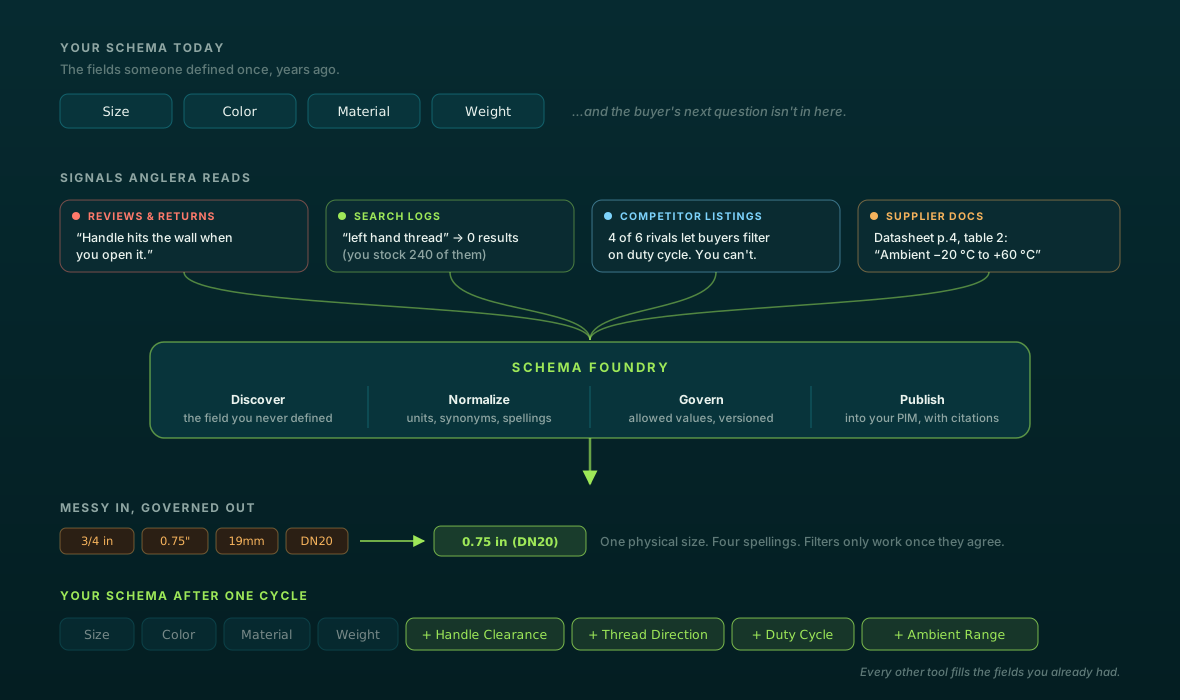
Filling the fields you defined has an invisible ceiling: a catalog can hit 100% complete and still miss the attribute that loses the sale, because completeness is measured against a schema someone drew years ago. Schema Foundry reads competitor listings, buyer searches, review complaints and your supplier docs, and proposes the fields you never defined — which is where Commport Communications stops.

How Schema Foundry works
Schema Foundry: signals from reviews, search logs, competitor listings and supplier documents reveal attributes missing from your schema; the Foundry discovers, normalizes and governs them, so your schema ends the cycle with more fields than it started with.

What Commport Communications does

Commport Communications (founded 1985, Aurora, Ontario) is a GS1-certified GDSN datapool provider and EDI/VAN solutions company that helps suppliers and retailers synchronize product data across trading networks. Their Commport Product Syndication (CPS) platform combines GDSN and basic PIM capabilities to distribute product records to retail trading partners.

Commport Communications website

When Commport Communications is the right call

Suppliers and retailers who need GS1-certified GDSN and EDI/VAN connectivity to retail partners, with validation rules, GPC mapping, real-time sync and API writeback to ERP and PIM.

We'd rather tell you here than in month three of an implementation.

Capability verdicts reviewed against Commport Communications's public documentation on July 14, 2026. Vendors ship quickly — if something here is out of date, tell us and we'll correct it.

See it on your own SKUs.

Bring one category and your supplier files. In 30 minutes you'll see it enriched — complete, structured, and consistent enough to launch on — plus the attributes your schema didn't have yet.

Book a demo