All comparisons
An alternative to Damco SolutionsOffshore & BPO services

Anglera vs Damco Solutions

The bottom line

Buy Damco if you need people to key data into back-offices and write SEO copy on request; buy Anglera if you need enrichment that discovers attributes, cites sources, and re-runs itself without a project queue.

Both claim to enrich product data. This page is about where that claim stops.

The frame for this comparison

Product data is a practice, not a project.

Damco's data services practice staffs FTE teams that key product details into merchant platforms like Amazon, Shopify and Magento, so this comparison isn't people versus software — it's about where the definition of "complete" lives when a supplier revises a plating spec mid-season.

01

Ground it

Mine every spec from every source.

Every value traced to a document you can open. The catalog is only as honest as what it was built from.

02

Align it

Aim the catalog at the buyer who actually buys.

Grounded data still loses if it answers questions nobody asked. Alignment is what turns specs into conversion.

03

Keep it alive

Product data is a practice, not a project.

Markets move, suppliers reissue, buyers change what they ask for. A catalog that is right in March is wrong by August unless something is watching.
Capability by capability

Where Damco Solutions stops.

Scored against public documentation. Grouped by the three acts — so you can see which ones Damco Solutions leaves on your desk.

01

Ground it

Mine every spec from every source.
Source mining
Where does it get specs from?
Damco SolutionsYes

Manual keying from catalogs, invoices, forms, scanned docs

AngleraYes

PDFs, spec tables, drawings, manuals, images, sites

Schema discovery
Does it find attributes that aren't in your schema yet?
Damco SolutionsNo

No attribute discovery; works within client-defined fields

AngleraYes

Proposes fields your schema never had

Governed vocabulary
Does it turn messy free-text into a governed pick list?
Damco SolutionsLimited

Standardization service harmonizes terminology; no versioned pick list

AngleraYes

Normalizes and governs allowed values, versioned

Taxonomy & classification
Can it classify every SKU into your hierarchy?
Damco SolutionsYes

Manual category indexing, tags, marketplace-specific data entry

AngleraYes

Auto-classifies; channel and marketplace mapping

Citations & provenance
Can you see where any given value came from?
Damco SolutionsNo

No value-level source citations described

AngleraYes

Every value cites its source doc and page

02

Align it

Aim the catalog at the buyer who actually buys.
Buyer personas
Is the content written for your buyer, or generically?
Damco SolutionsNo

No persona-tailored attributes or language variation described

AngleraYes

B2B specifier and B2C shopper enriched differently

Review, search & social signals
Does it learn what buyers ask from the live market?
Damco SolutionsLimited

Collects competitor, review, social data as separate datasets

AngleraYes

Reviews, search, competitor rails, social — fed back

Copy & SEO
Does it write original, channel-ready copy?
Damco SolutionsYes

Team writes SEO product descriptions and titles

AngleraYes

Original copy per persona and channel

Product imagery
Can it produce usable images for SKUs that lack them?
Damco SolutionsLimited

Photoshop retouching, clipping, resizing; no image generation

AngleraYes

Generates studio-grade imagery for photoless SKUs

03

Keep it alive

Product data is a practice, not a project.
Continuous re-enrichment
What happens when the market moves after go-live?
Damco SolutionsYour team

Ongoing FTE teams work on request; no autonomous re-enrichment

AngleraYes

Re-enriches on its own after go-live

Quality scoring
Does it score its own output and track catalog health?
Damco SolutionsLimited

Multi-level QC accuracy checks; no catalog health scoring

AngleraYes

Scored against your standards; nothing publishes below bar

Write-back
Does enriched data land back in your system of record?
Damco SolutionsYes

Teams key directly into Shopify, Magento, Amazon back-offices

AngleraYes

Writes back to PIM, ERP, warehouse, commerce

API, MCP & webhooks
Can your own tools and agents drive it headlessly?
Damco SolutionsLimited

CRM-enrichment API cited; no product API, webhooks, or MCP

AngleraYes

API, webhooks, and MCP servers

Who does the work
Does it do the work, or help your team do it?
Damco SolutionsYes

500+ FTEs execute end-to-end; people, not software

AngleraYes

Anglera owns the work; review is a guardrail

KeyYesships itLimitedlimited or gatedYour teamyour team still does itNodoesn't do itAnglera differentiator
What “buyer signals” actually means

Six signals sitting in your market right now.

“Buyer signals” is the emptiest phrase in this category, so here is the literal thing. Each of these is an observation from a live market, the gap it exposes, and the field that gets created as a result.

Marketplace signal·Amazon listing quality dashboard, variation and suppression errors

Ring listings carry metal as `14K`, `14kt`, `585`, and `14K Gold Plated` — the last one is brass with a few microns on it, sitting in the same value set as solid gold.

Purity and construction are collapsed into one free-text metal field, so plated stock rolls up under the solid-gold filter and lands in front of buyers who filtered specifically to avoid it. Each value matches what the line sheet said; the field just never distinguished the two things it was carrying.

Field createdmetal_purity_karat + metal_construction (two fields, never one)metal_purity_karat: 9K | 10K | 14K | 18K | 22K | 24K, normalised from millesimal marks (375/417/585/750/916/999). metal_construction: solid | filled | vermeil | plated | bonded.
Review signal·PDP questions and return-reason notes on a Shopify storefront

Recurring question on a cabin air filter: "does this fit a 2016 Civic with the 1.5T?" Return notes on the same SKU read "too thick, cover wouldn't latch."

Fitment lives inside the title string — "Cabin Air Filter for Honda Civic 2016-2021" — and housing depth was never captured as a field. The 20mm and 30mm variants of the same part number come off the same supplier page and read identically to a buyer, so the wrong one ships and comes back.

Field createdfilter_depth_mm, plus structured fitment: fit_year_start, fit_year_end, fit_make, fit_model, fit_engine_codefilter_depth_mm: numeric, millimetres, one decimal. fit_engine_code: OEM designation from the manufacturer's own list (L15B7, K20C2), not marketing names like "1.5 Turbo".
Supplier signal·new-season line sheets and spec PDFs from three hotel-linen vendors

The same 300-count sheeting arrives as `T-300 60/40`, `300 thread count, cotton rich`, and `300TC CVC 60% Cotton 40% Poly` — one per vendor, all in the same intake week.

Thread count and fibre blend travel together in a single notation that changes vendor by vendor, and "cotton rich" carries no number at all. Each is recorded faithfully as written, and the storefront still ends up unable to sort its own linen by fibre content.

Field createdthread_count + fiber_composition (repeating fibre/percentage pairs) + weave_typethread_count: integer. fiber_composition: percentages summing to 100, fibre names from a governed list (cotton, polyester, linen, viscose, modal, lyocell) — trade shorthand like CVC, PC or "cotton rich" resolves to explicit percentages or is held for the vendor to confirm. weave_type: percale | sateen | jersey | flannel | twill.
Why catalogs rot

Where the definition of done lives

Damco's product data entry page describes 500+ FTEs across geographies, 24x7, keying descriptions, SKUs, attributes, titles, prices, tax and shipping details into platforms including Amazon, eBay, Shopify and Magento. It also lists data cleansing, standardization and enrichment as service lines. That's real capacity, and the unit of delivery is people-hours against a queue. Our argument isn't about the people. It's about where correctness is written down. When the rule lives in an SOP and in whoever worked the shift, `14K`, `14kt` and `585` can each pass review — three readings of one instruction, none of them wrong. Anglera keeps the rule outside the shift: `metal_purity_karat` is an enum, `585` normalises to `14K`, and a SKU is re-read when the supplier changes the spec, not when the next batch is scoped.

Messy in, governed out.

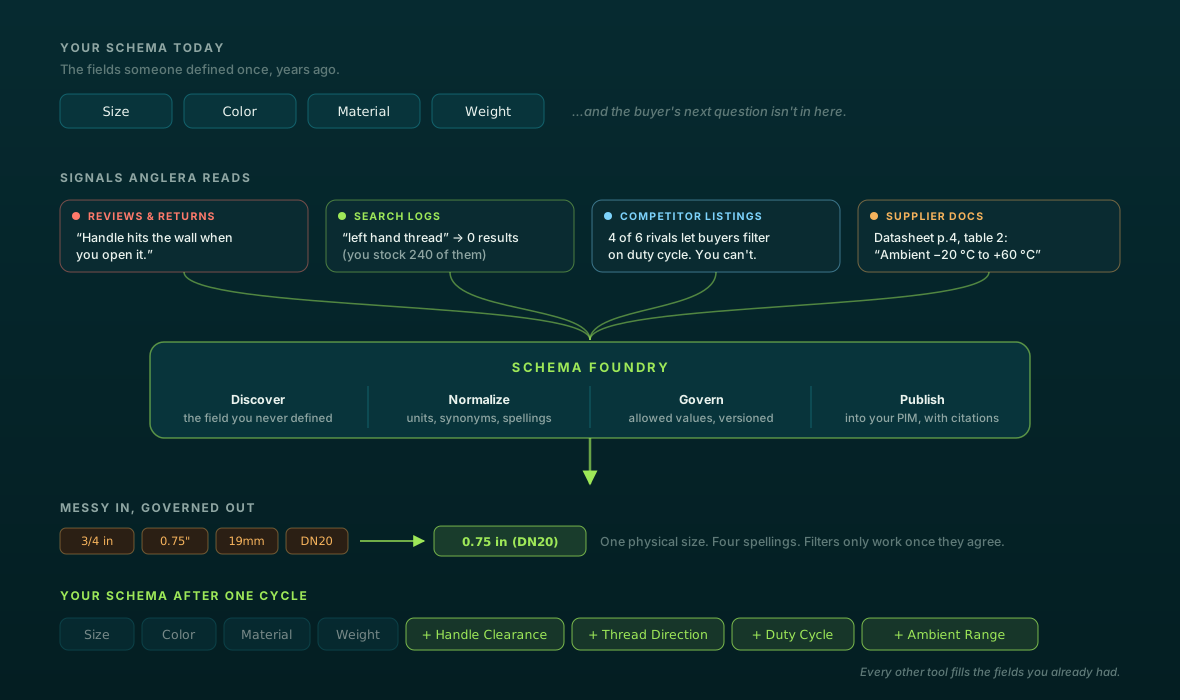
Values are normalized into a governed, versioned set of allowed values — so a filter works, and keeps working after the next import.

Nominal Size
3/4 in0.75"3/4"19mm3/4 inchDN20
0.75 in (DN20)

Six suppliers, six spellings, one physical size. Filters only work once they agree.

Finish
BlkblackBLACK MATTEMatte BlkRAL 9005
Black — Matte

Free text makes a colour filter useless. A governed value makes it a facet.

Material
SS316316 StainlessStainless Steel 316A4 Stainless
Stainless Steel — 316 / A4

Same alloy, four vocabularies, plus a trade name. Buyers search all of them.

And the part nobody else does

We don't just fill the template you handed us.

Filling the fields you defined has an invisible ceiling: a catalog can hit 100% complete and still miss the attribute that loses the sale, because completeness is measured against a schema someone drew years ago. Schema Foundry reads competitor listings, buyer searches, review complaints and your supplier docs, and proposes the fields you never defined — which is where Damco Solutions stops.

How Schema Foundry works
Schema Foundry: signals from reviews, search logs, competitor listings and supplier documents reveal attributes missing from your schema; the Foundry discovers, normalizes and governs them, so your schema ends the cycle with more fields than it started with.

What Damco Solutions does

Damco Solutions is a US-based IT and BPO services firm with 27+ years of experience offering manual product data entry, ecommerce catalog management, and data enrichment services. Their product-data work is delivered by offshore teams who key in, clean, and write SEO descriptions for SKUs across retail, fashion, and distribution verticals. Damco's broader Data Services line now also markets AI/ML, automation, and data-science capability, though its dedicated product-data-entry service page still describes the same people-driven keying and QC work.

Damco Solutions website

When Damco Solutions is the right call

Teams who want an FTE pod to handle manual keying, category indexing, image retouching, and direct entry into Shopify, Magento, or Amazon back-offices.

We'd rather tell you here than in month three of an implementation.

Capability verdicts reviewed against Damco Solutions's public documentation on July 27, 2026. Vendors ship quickly — if something here is out of date, tell us and we'll correct it.

See it on your own SKUs.

Bring one category and your supplier files. In 30 minutes you'll see it enriched — complete, structured, and consistent enough to launch on — plus the attributes your schema didn't have yet.

Book a demo