All comparisons
An alternative to dataX.aiOffshore & BPO services

Anglera vs dataX.ai

The bottom line

Buy dataX.ai if you need a services team to fill a SKU backlog against manufacturer spec sheets at ~$0.98/SKU. Buy Anglera if you want enrichment scored against buyer signals, cited to source, and re-run continuously without a new quote.

Both claim to enrich product data. This page is about where that claim stops.

The frame for this comparison

Product data is a practice, not a project.

dataX.ai is built to translate supplier and manufacturer data into your target format at volume, priced per SKU; this comparison is about what happens to the catalog in the months after a given file lands, because product data is a practice, not a project.

01

Ground it

Mine every spec from every source.

Every value traced to a document you can open. The catalog is only as honest as what it was built from.

02

Align it

Aim the catalog at the buyer who actually buys.

Grounded data still loses if it answers questions nobody asked. Alignment is what turns specs into conversion.

03

Keep it alive

Product data is a practice, not a project.

Markets move, suppliers reissue, buyers change what they ask for. A catalog that is right in March is wrong by August unless something is watching.
Capability by capability

Where dataX.ai stops.

Scored against public documentation. Grouped by the three acts — so you can see which ones dataX.ai leaves on your desk.

01

Ground it

Mine every spec from every source.
Source mining
Where does it get specs from?
dataX.aiYes

Mines manufacturer sites, PDFs, SDS/MTR, invoices, spec tables

AngleraYes

PDFs, spec tables, drawings, manuals, images, sites

Schema discovery
Does it find attributes that aren't in your schema yet?
dataX.aiNo

Gap analysis finds missing SKUs, not new attributes

AngleraYes

Proposes fields your schema never had

Governed vocabulary
Does it turn messy free-text into a governed pick list?
dataX.aiLimited

Normalizes supplier data to standards; versioned pick lists unevidenced

AngleraYes

Normalizes and governs allowed values, versioned

Taxonomy & classification
Can it classify every SKU into your hierarchy?
dataX.aiYes

Auto-classification to any hierarchy, plus tariff codes

AngleraYes

Auto-classifies; channel and marketplace mapping

Citations & provenance
Can you see where any given value came from?
dataX.aiNo

Sources manufacturer sites; no per-value citations shown

AngleraYes

Every value cites its source doc and page

02

Align it

Aim the catalog at the buyer who actually buys.
Buyer personas
Is the content written for your buyer, or generically?
dataX.aiNo

No persona-tailored B2B versus B2C enrichment found

AngleraYes

B2B specifier and B2C shopper enriched differently

Review, search & social signals
Does it learn what buyers ask from the live market?
dataX.aiLimited

Reads competitor listings; reports gaps to humans

AngleraYes

Reviews, search, competitor rails, social — fed back

Copy & SEO
Does it write original, channel-ready copy?
dataX.aiYes

Builds titles, descriptions, features from manufacturer content

AngleraYes

Original copy per persona and channel

Product imagery
Can it produce usable images for SKUs that lack them?
dataX.aiNo

Scrapes and serves existing images; no generation

AngleraYes

Generates studio-grade imagery for photoless SKUs

03

Keep it alive

Product data is a practice, not a project.
Continuous re-enrichment
What happens when the market moves after go-live?
dataX.aiLimited

Monitors supplier sites for changes; re-enrichment unclear

AngleraYes

Re-enriches on its own after go-live

Quality scoring
Does it score its own output and track catalog health?
dataX.aiYes

Catalog Health Check: weighted fill-rates, continuous checks

AngleraYes

Scored against your standards; nothing publishes below bar

Write-back
Does enriched data land back in your system of record?
dataX.aiYes

Syncs enriched data to PIMs, ERPs, ecommerce

AngleraYes

Writes back to PIM, ERP, warehouse, commerce

API, MCP & webhooks
Can your own tools and agents drive it headlessly?
dataX.aiLimited

PIM/ERP integrations; no public API docs, no MCP

AngleraYes

API, webhooks, and MCP servers

Who does the work
Does it do the work, or help your team do it?
dataX.aiYes

Delivers enriched SKUs priced per SKU; AI plus their reviewers

AngleraYes

Anglera owns the work; review is a guardrail

KeyYesships itLimitedlimited or gatedYour teamyour team still does itNodoesn't do itAnglera differentiator
What “buyer signals” actually means

Six signals sitting in your market right now.

“Buyer signals” is the emptiest phrase in this category, so here is the literal thing. Each of these is an observation from a live market, the gap it exposes, and the field that gets created as a result.

Search signal·internal site search logs on your own webstore

"cut level a4 gloves" and "ansi a4 nitrile palm" sit near the top of the no-result and zero-click queries. The gloves are in the catalog. Their records say "cut-resistant"; the A4 rating appears only in a table inside the manufacturer's datasheet PDF.

The rating the buyer is shopping on is the one that decides the purchase, and it lives in an attachment rather than a field, so it cannot filter, cannot rank, and cannot appear in a comparison table.

Field createdcut_resistance_ansi_isea_105A1 | A2 | A3 | A4 | A5 | A6 | A7 | A8 | A9 (ANSI/ISEA 105). EN 388 blade-cut letters are captured in a separate field and never merged into this one.
Review signal·the questions tab on your conduit fittings pages

Under a 2 in. EMT compression coupling: "Is this the raintight one or the standard indoor one? I ordered a box of set-screws by mistake last time." Of the six couplings on that page, three answer it only in a line of the installation sheet.

Wet-location listing is what separates two fittings that are indistinguishable in a photograph and differ in price. With no field for it, the page has nothing to argue on but brand, and the wrong box ships.

Field createdlocation_ratingDry location | Damp location | Wet location (raintight) | Concrete-tight | Concrete-tight and raintight
Supplier signal·the quarterly price file and new-item workbook from a filter manufacturer

The efficiency column arrives as "MERV 8" one quarter and bare "8" the next. A pleated subline uses "M8-pleat", and two tabs down the private-label SKUs read "MERV 8 (equiv.)".

Normalisation done once, against the column as it read last quarter, does not survive the column being renamed. The next load reintroduces four spellings of one value, and the MERV facet splits into buckets that each hold a fraction of the range.

Field createdmerv_ratingIntegers 1-16. MERV-A variants go to a separate merv_a_rating field; "equivalent" and "comparable to" claims are held out of the governed field and kept in marketing copy.
Why catalogs rot

The file gets translated. Then the file changes.

dataX.ai describes itself as a product data translation engine: get data from many supplier formats into one custom target standard, using what its FAQ calls "AI models with a human-in-the-loop," priced per SKU with a credit-based annual plan, and synced into the PIM, ERP or eCommerce platform you already run rather than becoming the system of record itself. That is an accurate description of conversion work, and conversion is scoped to the file in front of it. Then the catalog moves. A supplier reissues a price file with the efficiency column renamed. A manufacturer pushes a spec off the web page into a PDF. Buyers start searching on a rating nobody modelled. None of it announces itself; it surfaces later as a facet with four spellings in it and a category page that ranks on brand. Anglera treats completion as standing work: one schema under continuous check, results written back into your PIM.

Messy in, governed out.

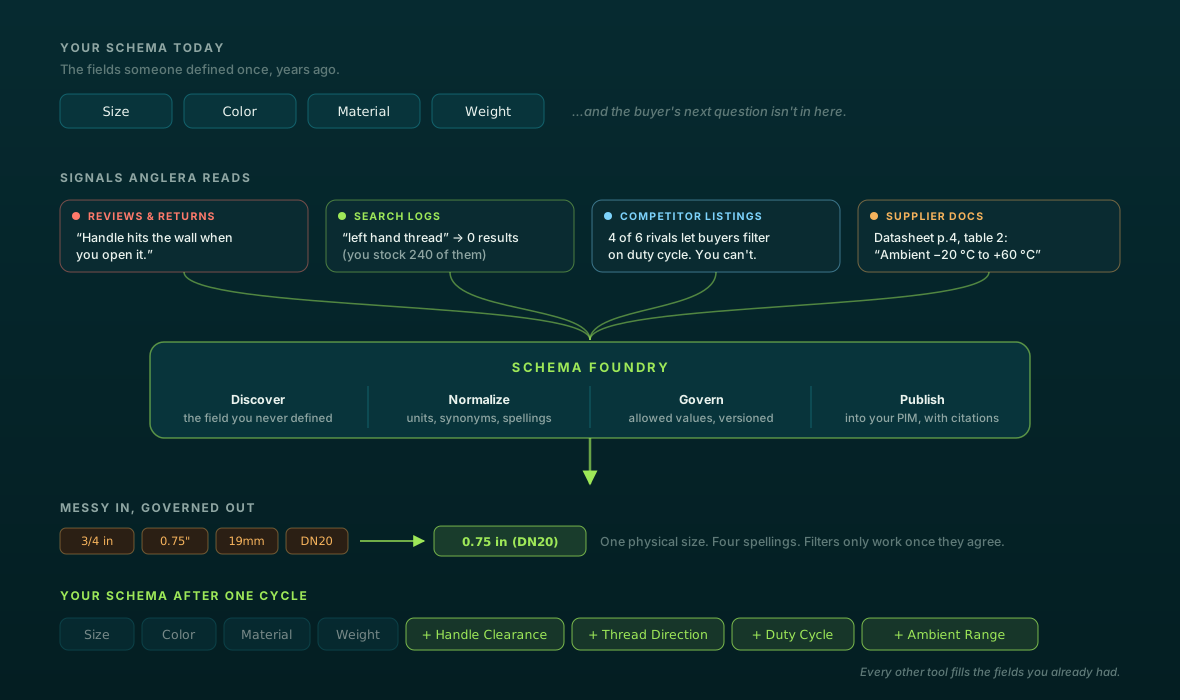
Values are normalized into a governed, versioned set of allowed values — so a filter works, and keeps working after the next import.

Nominal Size
3/4 in0.75"3/4"19mm3/4 inchDN20
0.75 in (DN20)

Six suppliers, six spellings, one physical size. Filters only work once they agree.

Finish
BlkblackBLACK MATTEMatte BlkRAL 9005
Black — Matte

Free text makes a colour filter useless. A governed value makes it a facet.

Material
SS316316 StainlessStainless Steel 316A4 Stainless
Stainless Steel — 316 / A4

Same alloy, four vocabularies, plus a trade name. Buyers search all of them.

And the part nobody else does

We don't just fill the template you handed us.

Filling the fields you defined has an invisible ceiling: a catalog can hit 100% complete and still miss the attribute that loses the sale, because completeness is measured against a schema someone drew years ago. Schema Foundry reads competitor listings, buyer searches, review complaints and your supplier docs, and proposes the fields you never defined — which is where dataX.ai stops.

How Schema Foundry works
Schema Foundry: signals from reviews, search logs, competitor listings and supplier documents reveal attributes missing from your schema; the Foundry discovers, normalizes and governs them, so your schema ends the cycle with more fields than it started with.

What dataX.ai does

dataX.ai (HQ in Plano, TX, with delivery offices in India and Japan) is an AI-plus-human product data service for B2B distributors, manufacturers, and retailers. It scrapes content from manufacturer and supplier sources to build SKUs (titles, descriptions, attributes, spec tables, warranties, images, PDFs), auto-classifies products into custom taxonomies, maps and normalizes supplier files to distributor formats, and offers price-file mapping, product matching, ERP/WMS data cleanup, and competitor price monitoring. It claims 900M+ SKUs processed and 1,000+ distributor/manufacturer clients, combining web-scraping and ML with human review for accuracy.

Pricing: Primarily per-SKU/pay-per-use (around $0.98/SKU for full enrichment, $0.04/SKU for monitoring), with a subscription option (~$6,000/year including processing credits and 5 user licenses) and custom/high-volume pricing.

dataX.ai website

When dataX.ai is the right call

Distributors with a finite catalog backlog who want humans in the loop: scraped manufacturer content, auto-classification into a custom taxonomy, and supplier price-file mapping, billed per SKU.

We'd rather tell you here than in month three of an implementation.

Capability verdicts reviewed against dataX.ai's public documentation on July 14, 2026. Vendors ship quickly — if something here is out of date, tell us and we'll correct it.

See it on your own SKUs.

Bring one category and your supplier files. In 30 minutes you'll see it enriched — complete, structured, and consistent enough to launch on — plus the attributes your schema didn't have yet.

Book a demo