All comparisons
Works with DemoUp CliplisterSyndication & feeds

Anglera + DemoUp Cliplister

The bottom line

Keep DemoUp Cliplister to push video, 3D and AR to 450+ retailer PDPs — nothing in Anglera does that. Add Anglera to fix the product data those PDPs sit on: mined specs, cited values, buyer-tuned copy before syndication runs.

DemoUp Cliplister and Anglera solve different halves of the problem — this page is about the seam between them.
The frame for this comparison

Product data is a practice, not a project.

With a media syndicator the question was never whether the video reaches the PDP — it does, on the EAN it's tagged with, to the retailers selected, for as long as the validity dates allow — but whether the spec table it lands above is still true, and keeping that true is a practice, not a project.

01

Ground it

Mine every spec from every source.

Every value traced to a document you can open. The catalog is only as honest as what it was built from.

02

Align it

Aim the catalog at the buyer who actually buys.

Grounded data still loses if it answers questions nobody asked. Alignment is what turns specs into conversion.

03

Keep it alive

Product data is a practice, not a project.

Markets move, suppliers reissue, buyers change what they ask for. A catalog that is right in March is wrong by August unless something is watching.

Capability by capability

Where DemoUp Cliplister stops.

Scored against public documentation. Grouped by the three acts — so you can see which ones DemoUp Cliplister leaves on your desk.

01

Ground it

Mine every spec from every source.
Source mining
Where does it get specs from?
DemoUp CliplisterNo

Sources media assets from brand network; no spec mining

AngleraYes

PDFs, spec tables, drawings, manuals, images, sites

Schema discovery
Does it find attributes that aren't in your schema yet?
DemoUp CliplisterNo

No attribute discovery; scope is media, not data model

AngleraYes

Proposes fields your schema never had

Governed vocabulary
Does it turn messy free-text into a governed pick list?
DemoUp CliplisterNo

Asset metadata and tags; no attribute value normalization

AngleraYes

Normalizes and governs allowed values, versioned

Taxonomy & classification
Can it classify every SKU into your hierarchy?
DemoUp CliplisterNo

AI matches assets to PDPs; no SKU classification

AngleraYes

Auto-classifies; channel and marketplace mapping

Citations & provenance
Can you see where any given value came from?
DemoUp CliplisterLimited

Asset origin and usage rights tracked; no value citations

AngleraYes

Every value cites its source doc and page

02

Align it

Aim the catalog at the buyer who actually buys.
Buyer personas
Is the content written for your buyer, or generically?
DemoUp CliplisterNo

No persona-tailored variants; same assets across channels

AngleraYes

B2B specifier and B2C shopper enriched differently

Review, search & social signals
Does it learn what buyers ask from the live market?
DemoUp CliplisterLimited

Views, clicks, add-to-cart reported; no feedback into content

AngleraYes

Reviews, search, competitor rails, social — fed back

Copy & SEO
Does it write original, channel-ready copy?
DemoUp CliplisterLimited

AI alt text for images; no descriptions or bullets

AngleraYes

Original copy per persona and channel

Product imagery
Can it produce usable images for SKUs that lack them?
DemoUp CliplisterLimited

Template variants, editor, 3D/AR creation; no image generation

AngleraYes

Generates studio-grade imagery for photoless SKUs

03

Keep it alive

Product data is a practice, not a project.
Continuous re-enrichment
What happens when the market moves after go-live?
DemoUp CliplisterLimited

Auto-pushes updated assets to retailers; no re-enrichment

AngleraYes

Re-enriches on its own after go-live

Quality scoring
Does it score its own output and track catalog health?
DemoUp CliplisterLimited

Accessibility scans and asset analytics; not data completeness

AngleraYes

Scored against your standards; nothing publishes below bar

Write-back
Does enriched data land back in your system of record?
DemoUp CliplisterLimited

Stibo STEP and PIM integrations sync assets, not attributes

AngleraYes

Writes back to PIM, ERP, warehouse, commerce

API, MCP & webhooks
Can your own tools and agents drive it headlessly?
DemoUp CliplisterYes

REST API and webhooks; headless DAM; no MCP server

AngleraYes

API, webhooks, and MCP servers

Who does the work
Does it do the work, or help your team do it?
DemoUp CliplisterYour team

Customer teams manage content; some 3D/video creation as service

AngleraYes

Anglera owns the work; review is a guardrail

KeyYesships itLimitedlimited or gatedYour teamyour team still does itNodoesn't do itAnglera differentiator
What “buyer signals” actually means

Six signals sitting in your market right now.

“Buyer signals” is the emptiest phrase in this category, so here is the literal thing. Each of these is an observation from a live market, the gap it exposes, and the field that gets created as a result.

Marketplace signal·Marketplace listing feedback and category filter placement

A run of built-in dishwashers keeps landing in the "freestanding" filter on two marketplaces. The words "fully integrated, requires custom door panel" appear only inside the description paragraph.

Installation type is the first filter a kitchen buyer touches, and it exists as prose, not as a value.

Field createdInstallation TypeFreestanding · Built-under · Semi-integrated · Fully integrated
Supplier signal·Supplier datasheets and revision PDFs

Two datasheets for the same USB-C dock: one says "100W power supply", the other says "Power Delivery 3.0 — 96W to host, 20W across downstream ports".

The number a buyer needs is the wattage delivered to the laptop, not the wattage of the brick. Both live in PDFs; neither is a field.

Field createdHost Power DeliveryWatts to host device, integer; adapter rating recorded separately
Review signal·One- and two-star review text on cordless garden tools

"Arrived without a battery" dominates the low reviews on a hedge trimmer. Some sibling SKUs carry "Bare Tool" in the title; most carry nothing at all.

What's in the box is encoded in a title convention that only half the range follows, so it can't be filtered, syndicated, or trusted.

Field createdPack ContentsBare tool (no battery) · Battery only · Battery and charger · Kit with case
Why catalogs rot

The clip is current. The spec table under it isn't.

Syndication is continuous by design. A brand uploads an asset, enters the product's EAN, sets validity dates and publishes, and the network carries it to the selected retailers, where it is matched to the product by identifier and embedded in the gallery. The attributes beneath that gallery move on a different clock: they move when someone edits them. Catalogs rot at that seam. A supplier revises a cordless drill from 4.0Ah to 5.0Ah cells; the new demo clip goes live that week, the spec row still reads 4.0Ah. Bundle the drill as a three-pack and it gets a new EAN, a new identifier with its own attributes to fill. DemoUp Cliplister says its solution complements PIM and DAM. The complement that seam needs is somebody keeping the fields under the player honest, SKU by SKU, week after week.

Messy in, governed out.

Values are normalized into a governed, versioned set of allowed values — so a filter works, and keeps working after the next import.

Nominal Size
3/4 in0.75"3/4"19mm3/4 inchDN20
0.75 in (DN20)

Six suppliers, six spellings, one physical size. Filters only work once they agree.

Finish
BlkblackBLACK MATTEMatte BlkRAL 9005
Black — Matte

Free text makes a colour filter useless. A governed value makes it a facet.

Material
SS316316 StainlessStainless Steel 316A4 Stainless
Stainless Steel — 316 / A4

Same alloy, four vocabularies, plus a trade name. Buyers search all of them.

And the part nobody else does

We don't just fill the template you handed us.

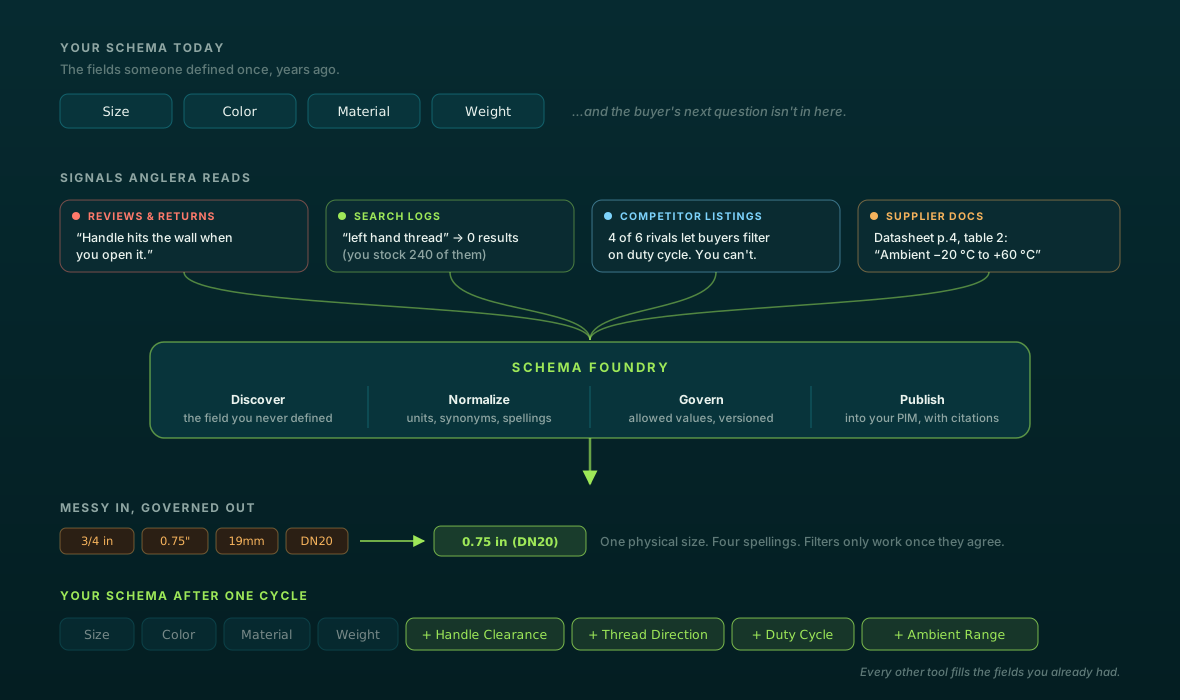
Filling the fields you defined has an invisible ceiling: a catalog can hit 100% complete and still miss the attribute that loses the sale, because completeness is measured against a schema someone drew years ago. Schema Foundry reads competitor listings, buyer searches, review complaints and your supplier docs, and proposes the fields you never defined — which is where DemoUp Cliplister stops.

How Schema Foundry works
Schema Foundry: signals from reviews, search logs, competitor listings and supplier documents reveal attributes missing from your schema; the Foundry discovers, normalizes and governs them, so your schema ends the cycle with more fields than it started with.

What DemoUp Cliplister does

DemoUp Cliplister is a content syndication and digital asset management platform that distributes rich media — product videos, images, 3D models, and AR experiences — from brands to 450+ online retailers automatically. Their core value is getting the right visual assets onto the right product detail pages (PDPs) at scale.

Pricing: Not publicly disclosed; custom plans available. Supports monthly, annual, and perpetual license models. No free version; free trial offered.

DemoUp Cliplister website

When DemoUp Cliplister is the right call

Brands with finished rich media and a long retailer list — DemoUp Cliplister handles asset matching to PDPs, usage rights, 3D/AR creation, and auto-pushes updated assets downstream.

We'd rather tell you here than in month three of an implementation.

Capability verdicts reviewed against DemoUp Cliplister's public documentation on July 14, 2026. Vendors ship quickly — if something here is out of date, tell us and we'll correct it.

See it on your own SKUs.

Bring one category and your supplier files. In 30 minutes you'll see it enriched — complete, structured, and consistent enough to launch on — plus the attributes your schema didn't have yet.

Book a demo