All comparisons
Works with EquadisPIM platforms

Anglera + Equadis

The bottom line

Keep Equadis as the PIM and GS1-certified data pool that validates your records and syndicates them to every retailer and marketplace. Add Anglera to complete those records from supplier documents, cite each value, and write the results back into Equadis.

Equadis and Anglera solve different halves of the problem — this page is about the seam between them.
The frame for this comparison

Product data is a practice, not a project.

Equadis and Anglera work on the same record at different moments: Equadis checks that it is complete and compliant before it leaves for each retailer, and Anglera is the standing practice that fills it from the source documents and keeps it current as those documents change.

01

Ground it

Mine every spec from every source.

Every value traced to a document you can open. The catalog is only as honest as what it was built from.

02

Align it

Aim the catalog at the buyer who actually buys.

Grounded data still loses if it answers questions nobody asked. Alignment is what turns specs into conversion.

03

Keep it alive

Product data is a practice, not a project.

Markets move, suppliers reissue, buyers change what they ask for. A catalog that is right in March is wrong by August unless something is watching.

Capability by capability

Where Equadis stops.

Scored against public documentation. Grouped by the three acts — so you can see which ones Equadis leaves on your desk.

01

Ground it

Mine every spec from every source.
Source mining
Where does it get specs from?
EquadisYes

DocExtract reads artworks, packaging, PDFs and images

AngleraYes

PDFs, spec tables, drawings, manuals, images, sites

Schema discovery
Does it find attributes that aren't in your schema yet?
EquadisYour team

Customizable data model; team decides which attributes to add

AngleraYes

Proposes fields your schema never had

Governed vocabulary
Does it turn messy free-text into a governed pick list?
EquadisLimited

GS1 and ETIM standards; recipient rules enforced on publish

AngleraYes

Normalizes and governs allowed values, versioned

Taxonomy & classification
Can it classify every SKU into your hierarchy?
EquadisLimited

GDSN and ETIM certified; per-recipient formats in syndication

AngleraYes

Auto-classifies; channel and marketplace mapping

Citations & provenance
Can you see where any given value came from?
EquadisLimited

Grounded in PIM data; per-value citation not documented

AngleraYes

Every value cites its source doc and page

02

Align it

Aim the catalog at the buyer who actually buys.
Buyer personas
Is the content written for your buyer, or generically?
EquadisLimited

ACE tailors messages to target audiences and channels

AngleraYes

B2B specifier and B2C shopper enriched differently

Review, search & social signals
Does it learn what buyers ask from the live market?
EquadisLimited

DSA tracks reviews and search visibility; gaps return to PIM

AngleraYes

Reviews, search, competitor rails, social — fed back

Copy & SEO
Does it write original, channel-ready copy?
EquadisYes

ACE generates GEO-ready copy, translates into 20+ languages

AngleraYes

Original copy per persona and channel

Product imagery
Can it produce usable images for SKUs that lack them?
EquadisYour team

Image links via associated DAM; generation not documented

AngleraYes

Generates studio-grade imagery for photoless SKUs

03

Keep it alive

Product data is a practice, not a project.
Continuous re-enrichment
What happens when the market moves after go-live?
EquadisLimited

Closed loop: shelf gaps flow back to PIM for correction

AngleraYes

Re-enriches on its own after go-live

Quality scoring
Does it score its own output and track catalog health?
EquadisYes

Validation engine, quality dashboards, recipient rule checks

AngleraYes

Scored against your standards; nothing publishes below bar

Write-back
Does enriched data land back in your system of record?
EquadisYes

System of record; syndicates via GDSN and 950+ connectors

AngleraYes

Writes back to PIM, ERP, warehouse, commerce

API, MCP & webhooks
Can your own tools and agents drive it headlessly?
EquadisLimited

API connectors referenced; public API docs and MCP not documented

AngleraYes

API, webhooks, and MCP servers

Who does the work
Does it do the work, or help your team do it?
EquadisYour team

Software platform; team validates AI suggestions before publishing

AngleraYes

Anglera owns the work; review is a guardrail

KeyYesships itLimitedlimited or gatedYour teamyour team still does itNodoesn't do itAnglera differentiator
What “buyer signals” actually means

Six signals sitting in your market right now.

“Buyer signals” is the emptiest phrase in this category, so here is the literal thing. Each of these is an observation from a live market, the gap it exposes, and the field that gets created as a result.

Review signal·Product reviews on an online grocer's site

"Bought these crackers because nothing on the listing mentioned sesame. The back of the pack says 'may contain sesame'. My son is allergic, so they went straight in the bin."

The record carries the declared allergens from the ingredient list but has nowhere to put the precautionary statement printed separately on the pack. The listing reads as sesame-safe when the packaging says otherwise.

Field createdallergen_status per regulated allergen (contains vs may contain, kept as separate values)The 14 allergens in EU FIC Annex II, each tagged Contains | May contain | Not declared, read from the ingredient list and the precautionary line on the back-of-pack artwork.
Search signal·Internal site search on a health and wellness retailer's storefront

Queries like "gelatin free gummies" and "vegan vitamin gummies" return the whole gummy supplement range, because the gelling agent only appears inside the ingredient declaration.

Gelling agent is buried in free-text ingredients, so there is nothing to facet or filter on. Shoppers who avoid gelatin for dietary or religious reasons scroll and read labels themselves.

Field createdgelling_agent, plus gelatin_source when gelatin is presentPectin | Agar | Modified starch | Carrageenan | Gelatin; gelatin_source: Bovine | Porcine | Fish. Taken from the ingredient declaration on the label artwork, not the marketing copy.
Marketplace signal·Marketplace listing feed (beauty category required fields)

A batch of face creams is held back on a required shelf-life-after-opening field. The record has nothing; the jar artwork shows the open-jar symbol marked 12M.

The value exists only as a pictogram on packaging, so the channel's field has nothing to receive and the listings wait while someone reads artwork files by hand.

Field createdperiod_after_opening_months (integer), with best_before_date used instead where the product requires oneInteger months from the open-jar symbol (for example 6, 12, 24), per EU Cosmetics Regulation 1223/2009 Article 19; source of record is the final packaging artwork, not the brief.
Why catalogs rot

Compliant against the rules in force

Equadis's validation engine checks the completeness and compliance of every product sheet before publication, and its syndication layer applies each recipient's rules before sending. Those checks are real. But they measure the record against the data model and recipient requirements as they stand today. A supplier reformulates and the new artwork adds a precautionary allergen line. A retailer starts requiring a field it never asked for. Shoppers begin searching for a property that lives only in the ingredient list. The record still passes, because it is complete against the model the team agreed on. Catalogs drift next to a well-run PIM not because the data is wrong on day one, but because the questions keep changing while the model stays put. Keeping up is weekly work: re-read the reissued artwork, propose the new fields, fill them with a citation, push the values back.

Messy in, governed out.

Values are normalized into a governed, versioned set of allowed values — so a filter works, and keeps working after the next import.

Nominal Size
3/4 in0.75"3/4"19mm3/4 inchDN20
0.75 in (DN20)

Six suppliers, six spellings, one physical size. Filters only work once they agree.

Finish
BlkblackBLACK MATTEMatte BlkRAL 9005
Black — Matte

Free text makes a colour filter useless. A governed value makes it a facet.

Material
SS316316 StainlessStainless Steel 316A4 Stainless
Stainless Steel — 316 / A4

Same alloy, four vocabularies, plus a trade name. Buyers search all of them.

And the part nobody else does

We don't just fill the template you handed us.

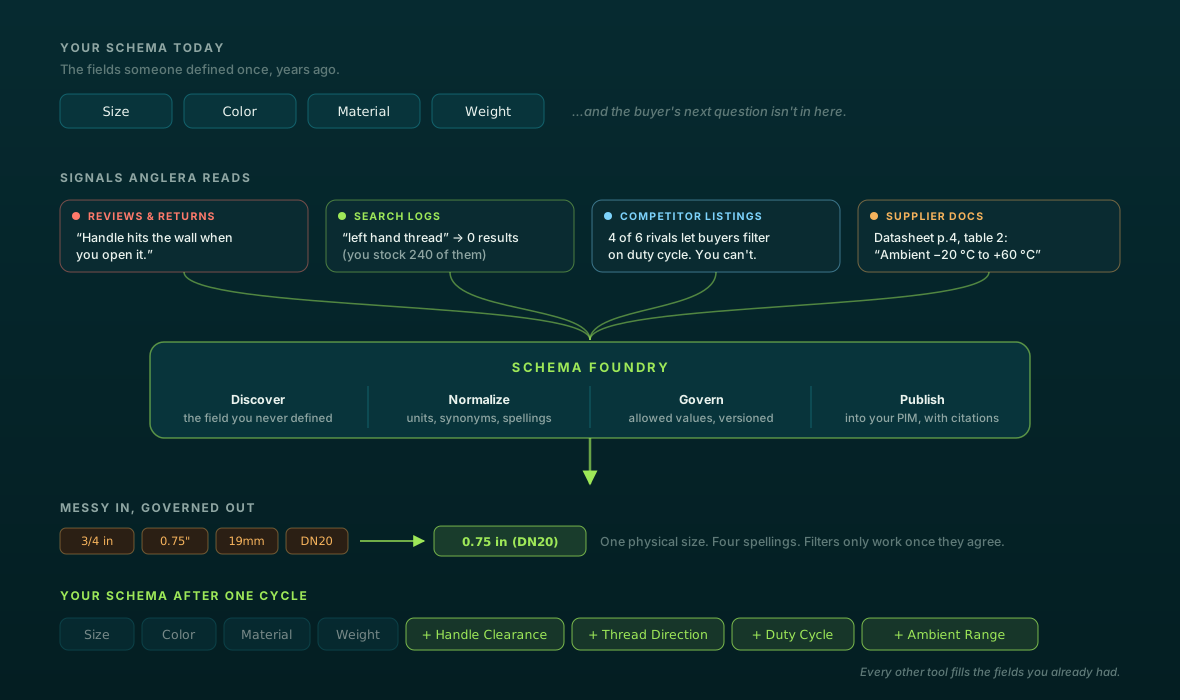
Filling the fields you defined has an invisible ceiling: a catalog can hit 100% complete and still miss the attribute that loses the sale, because completeness is measured against a schema someone drew years ago. Schema Foundry reads competitor listings, buyer searches, review complaints and your supplier docs, and proposes the fields you never defined — which is where Equadis stops.

How Schema Foundry works
Schema Foundry: signals from reviews, search logs, competitor listings and supplier documents reveal attributes missing from your schema; the Foundry discovers, normalizes and governs them, so your schema ends the cycle with more fields than it started with.

What Equadis does

Equadis is a Swiss SaaS product data suite for brands and retailers in food and beverage, beauty, health and personal care, and CPG. It combines a PIM, an AI Content Engine (ACE), product data syndication through its own GS1-certified GDSN data pool and 950+ connectors, and digital shelf analytics. More than 600 companies use it across 20+ countries.

Pricing: Annual SaaS subscription with deployment support; priced by SKU count, users, modules and distribution channels. Quote-based, no public tiers.

Equadis website

When Equadis is the right call

Food, beauty, health and CPG brands and retailers, especially in France, Switzerland and Benelux, that must publish through GDSN to large retailers and want PIM, data pool, syndication and digital shelf monitoring from one vendor.

We'd rather tell you here than in month three of an implementation.

Capability verdicts reviewed against Equadis's public documentation on October 16, 2026. Vendors ship quickly — if something here is out of date, tell us and we'll correct it.

See it on your own SKUs.

Bring one category and your supplier files. In 30 minutes you'll see it enriched — complete, structured, and consistent enough to launch on — plus the attributes your schema didn't have yet.

Book a demo