All comparisons
Works with Flair AIAI enrichment tools

Anglera + Flair AI

The bottom line

Both, and they barely overlap: Flair generates the photography, Anglera generates the attribute data behind the PDP. Flair does nothing with specs, taxonomy, or your PIM — it's a creative studio, not an enrichment layer.

Flair AI and Anglera solve different halves of the problem — this page is about the seam between them.

The frame for this comparison

Product data is a practice, not a project.

Flair's bar is visual fidelity — that a button, a port, or a material renders right in the generated image — and this comparison is about the other half of the SKU: the fields underneath that image, which no single pass finishes and which go stale on a schedule a photoshoot never has.

01

Ground it

Mine every spec from every source.

Every value traced to a document you can open. The catalog is only as honest as what it was built from.

02

Align it

Aim the catalog at the buyer who actually buys.

Grounded data still loses if it answers questions nobody asked. Alignment is what turns specs into conversion.

03

Keep it alive

Product data is a practice, not a project.

Markets move, suppliers reissue, buyers change what they ask for. A catalog that is right in March is wrong by August unless something is watching.
Capability by capability

Where Flair AI stops.

Scored against public documentation. Grouped by the three acts — so you can see which ones Flair AI leaves on your desk.

01

Ground it

Mine every spec from every source.
Source mining
Where does it get specs from?
Flair AIN/A

Ingests product photos for generation; no spec mining

AngleraYes

PDFs, spec tables, drawings, manuals, images, sites

Schema discovery
Does it find attributes that aren't in your schema yet?
Flair AIN/A

No attribute schema concept; imagery tool only

AngleraYes

Proposes fields your schema never had

Governed vocabulary
Does it turn messy free-text into a governed pick list?
Flair AIN/A

No attribute values to normalize or govern

AngleraYes

Normalizes and governs allowed values, versioned

Taxonomy & classification
Can it classify every SKU into your hierarchy?
Flair AIN/A

No SKU classification or channel category mapping

AngleraYes

Auto-classifies; channel and marketplace mapping

Citations & provenance
Can you see where any given value came from?
Flair AIN/A

No enriched field values to cite sources for

AngleraYes

Every value cites its source doc and page

02

Align it

Aim the catalog at the buyer who actually buys.
Buyer personas
Is the content written for your buyer, or generically?
Flair AILimited

Markets audience-targeted imagery variants; no attribute-level personas

AngleraYes

B2B specifier and B2C shopper enriched differently

Review, search & social signals
Does it learn what buyers ask from the live market?
Flair AINo

No review, search-query, or competitor-listing inputs found

AngleraYes

Reviews, search, competitor rails, social — fed back

Copy & SEO
Does it write original, channel-ready copy?
Flair AINo

Generates images and video, not product text

AngleraYes

Original copy per persona and channel

Product imagery
Can it produce usable images for SKUs that lack them?
Flair AIYes

Core product: studio, on-model, and video generation

AngleraYes

Generates studio-grade imagery for photoless SKUs

03

Keep it alive

Product data is a practice, not a project.
Continuous re-enrichment
What happens when the market moves after go-live?
Flair AIYour team

Users generate on demand; no autonomous re-runs

AngleraYes

Re-enriches on its own after go-live

Quality scoring
Does it score its own output and track catalog health?
Flair AINo

No completeness or catalog health scoring

AngleraYes

Scored against your standards; nothing publishes below bar

Write-back
Does enriched data land back in your system of record?
Flair AINo

API returns assets; no native PIM connector

AngleraYes

Writes back to PIM, ERP, warehouse, commerce

API, MCP & webhooks
Can your own tools and agents drive it headlessly?
Flair AILimited

REST API on paid tiers; polling, no MCP

AngleraYes

API, webhooks, and MCP servers

Who does the work
Does it do the work, or help your team do it?
Flair AIYour team

Self-serve software; your team generates each asset

AngleraYes

Anglera owns the work; review is a guardrail

KeyYesships itLimitedlimited or gatedYour teamyour team still does itNodoesn't do itAnglera differentiator
What “buyer signals” actually means

Six signals sitting in your market right now.

“Buyer signals” is the emptiest phrase in this category, so here is the literal thing. Each of these is an observation from a live market, the gap it exposes, and the field that gets created as a result.

Review signal·Q&A thread on the brand's own product page for a liquid foundation

"Swatch photo looked warm in every shot and it pulled pink on me — third shade I've sent back. Is 240 neutral or cool?"

Shade is carried as a name and a number, and the undertone lives only in the imagery. Nothing tells a shade finder, a filter, or a returns analyst what 240 actually is.

Field createdshade_undertoneCool | Neutral | Neutral-cool | Neutral-warm | Warm | Olive — one value per shade, applied across the whole shade ladder rather than per-launch
Search signal·Internal site-search logs, zero-result and low-click queries

"100w usb c charger" and "pd 3.1 65w" both return the whole charger grid, unranked; the 100W SKU's wattage appears in the hero graphic and one line of marketing copy

Power delivery is the way the customer shops the category, and it sits in prose and art rather than a field — so it can't be searched, faceted, or fed to a shopping surface.

Field createdusb_pd_max_output_wInteger watts per port (18, 30, 45, 65, 100, 140), plus pd_profile_version as PD 2.0 | PD 3.0 | PD 3.1; total device wattage recorded separately from per-port
Marketplace signal·Merchant feed diagnostics and the category facet rail on a large home marketplace

Dining chairs drop out of the "counter height" and "seat height 17-19 in" filters; the listing carries a full set of lifestyle scenes and a dimensions blob reading "H 38\" x W 19\" x D 21\""

Overall height is stored; seat height — the dimension that decides whether the chair fits the table — was never separated out, so the SKU is invisible in the filter customers actually use.

Field createdseat_height_inDecimal inches to one place, measured floor to seat front edge; paired with seat_height_class as Dining (17-19) | Counter (24-27) | Bar (28-33), derived from the numeric value, never hand-entered
Why catalogs rot

The image is finished. The field isn't.

Flair's tech page frames accuracy as visual accuracy: its AI "can accurately render detailed tech product features like buttons, ports, textures, and materials for photorealistic product imagery." That is a real bar, and it belongs to the creative side of a catalog — the founder places Flair's users "at the intersection of ecommerce and creativity." Rendering the port is a different job from recording that the port is USB-C Power Delivery rated at 100W, in a field a facet can filter on. The Flair API is described as a way to "generate thousands of product images, videos, and marketing assets programmatically at scale"; the unit of work there is an asset. On the data side the unit is a field, and fields go stale on their own schedule: a supplier revises a spec sheet, a marketplace adds a required attribute. Six months on, the PDP can look finished and still not be filterable.

Messy in, governed out.

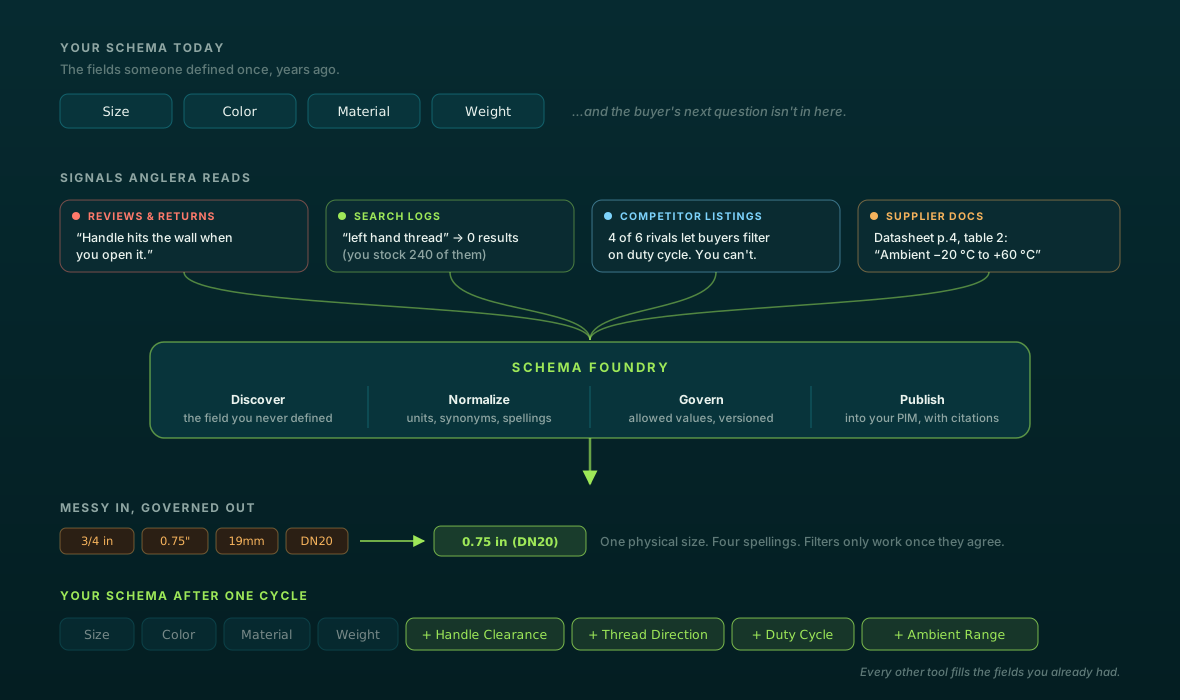
Values are normalized into a governed, versioned set of allowed values — so a filter works, and keeps working after the next import.

Nominal Size
3/4 in0.75"3/4"19mm3/4 inchDN20
0.75 in (DN20)

Six suppliers, six spellings, one physical size. Filters only work once they agree.

Finish
BlkblackBLACK MATTEMatte BlkRAL 9005
Black — Matte

Free text makes a colour filter useless. A governed value makes it a facet.

Material
SS316316 StainlessStainless Steel 316A4 Stainless
Stainless Steel — 316 / A4

Same alloy, four vocabularies, plus a trade name. Buyers search all of them.

And the part nobody else does

We don't just fill the template you handed us.

Filling the fields you defined has an invisible ceiling: a catalog can hit 100% complete and still miss the attribute that loses the sale, because completeness is measured against a schema someone drew years ago. Schema Foundry reads competitor listings, buyer searches, review complaints and your supplier docs, and proposes the fields you never defined — which is where Flair AI stops.

How Schema Foundry works
Schema Foundry: signals from reviews, search logs, competitor listings and supplier documents reveal attributes missing from your schema; the Foundry discovers, normalizes and governs them, so your schema ends the cycle with more fields than it started with.

What Flair AI does

Flair AI is an AI design tool for e-commerce product photoshoots. Teams upload a product photo and stage it on a drag-and-drop canvas — props, scenes, lighting, camera angles — to generate studio shots, on-model imagery, and product video without a physical shoot. It also trains custom AI human models and generates ad creative, with real-time team collaboration and a REST API for bulk generation. Founded in 2022 by Mickey Friedman; raised a $5M seed in May 2024. Named customers on their site include Shein, Amazon, Samsonite, Bonobos, and JLo Beauty.

Pricing: Publicly listed and self-serve. Free ($0: 1 custom model, 5 generated images, 1 video). Pro $8/mo. Pro+ $26/mo (80 images, 3 videos, commercial license). Scale from $38/mo (150 images, 5 videos, API early access). Enterprise is custom-quoted and undisclosed — it's the tier carrying unlimited API access. Instant image and ad generation consume 4x the image quota.

Flair AI website

When Flair AI is the right call

Brands whose bottleneck is campaign and on-model photography — fashion, beauty, furniture — and who want a collaborative canvas their creative team drives shot by shot.

We'd rather tell you here than in month three of an implementation.

Capability verdicts reviewed against Flair AI's public documentation on July 14, 2026. Vendors ship quickly — if something here is out of date, tell us and we'll correct it.

See it on your own SKUs.

Bring one category and your supplier files. In 30 minutes you'll see it enriched — complete, structured, and consistent enough to launch on — plus the attributes your schema didn't have yet.

Book a demo