All comparisons
An alternative to HabileDataOffshore & BPO services

Anglera vs HabileData

The bottom line

Buy HabileData if you need trained operators to clean, classify and upload a catalog at ~$5/hour. Buy Anglera if enrichment has to reflect how buyers actually search, cite every value to a source, and run continuously.

Both claim to enrich product data. This page is about where that claim stops.
The frame for this comparison

Product data is a practice, not a project.

With an offshore catalog team the question was never whether the batch gets keyed — it's what happens between batches, when the spec you handed over in March stops matching what buyers are asking in August.

01

Ground it

Mine every spec from every source.

Every value traced to a document you can open. The catalog is only as honest as what it was built from.

02

Align it

Aim the catalog at the buyer who actually buys.

Grounded data still loses if it answers questions nobody asked. Alignment is what turns specs into conversion.

03

Keep it alive

Product data is a practice, not a project.

Markets move, suppliers reissue, buyers change what they ask for. A catalog that is right in March is wrong by August unless something is watching.

Capability by capability

Where HabileData stops.

Scored against public documentation. Grouped by the three acts — so you can see which ones HabileData leaves on your desk.

01

Ground it

Mine every spec from every source.
Source mining
Where does it get specs from?
HabileDataYes

Staff key from PDFs, scanned catalogs, spec sheets, scraped sites

AngleraYes

PDFs, spec tables, drawings, manuals, images, sites

Schema discovery
Does it find attributes that aren't in your schema yet?
HabileDataNo

Fills client-defined fields; does not propose new attributes

AngleraYes

Proposes fields your schema never had

Governed vocabulary
Does it turn messy free-text into a governed pick list?
HabileDataLimited

Normalizes attributes to client spec; no versioned pick lists

AngleraYes

Normalizes and governs allowed values, versioned

Taxonomy & classification
Can it classify every SKU into your hierarchy?
HabileDataYes

Product classification plus Amazon/Shopify category mapping, staffed

AngleraYes

Auto-classifies; channel and marketplace mapping

Citations & provenance
Can you see where any given value came from?
HabileDataNo

Multi-stage QA review; no value-level source citations

AngleraYes

Every value cites its source doc and page

02

Align it

Aim the catalog at the buyer who actually buys.
Buyer personas
Is the content written for your buyer, or generically?
HabileDataNo

No B2B versus B2C persona tailoring in materials

AngleraYes

B2B specifier and B2C shopper enriched differently

Review, search & social signals
Does it learn what buyers ask from the live market?
HabileDataLimited

Scrapes competitor prices and listings; delivered as separate datasets

AngleraYes

Reviews, search, competitor rails, social — fed back

Copy & SEO
Does it write original, channel-ready copy?
HabileDataYes

Writes keyword-rich product titles and descriptions for listings

AngleraYes

Original copy per persona and channel

Product imagery
Can it produce usable images for SKUs that lack them?
HabileDataLimited

Background removal, retouching, ghost mannequin; no image generation

AngleraYes

Generates studio-grade imagery for photoless SKUs

03

Keep it alive

Product data is a practice, not a project.
Continuous re-enrichment
What happens when the market moves after go-live?
HabileDataLimited

Retained teams run scheduled catalog updates, not autonomous re-enrichment

AngleraYes

Re-enriches on its own after go-live

Quality scoring
Does it score its own output and track catalog health?
HabileDataLimited

Accuracy claims and catalog audits; no ongoing health dashboard

AngleraYes

Scored against your standards; nothing publishes below bar

Write-back
Does enriched data land back in your system of record?
HabileDataYes

Teams upload into Shopify, Amazon, Magento, client systems

AngleraYes

Writes back to PIM, ERP, warehouse, commerce

API, MCP & webhooks
Can your own tools and agents drive it headlessly?
HabileDataLimited

API offered as scraping delivery option; no webhooks, no MCP

AngleraYes

API, webhooks, and MCP servers

Who does the work
Does it do the work, or help your team do it?
HabileDataYes

Their offshore staff do the work end-to-end; people, not software

AngleraYes

Anglera owns the work; review is a guardrail

KeyYesships itLimitedlimited or gatedYour teamyour team still does itNodoesn't do itAnglera differentiator
What “buyer signals” actually means

Six signals sitting in your market right now.

“Buyer signals” is the emptiest phrase in this category, so here is the literal thing. Each of these is an observation from a live market, the gap it exposes, and the field that gets created as a result.

Review signal·Q&A thread under a marketplace listing for a 24V under-cabinet LED strip

Buyer questions keep landing on the same thing — whether it works with a Lutron Caséta dimmer — and reviews report the strip strobing at low output on the dimmer already in the wall.

Dimming behaviour is decided by the driver's phase-control type, but the listing carries only wattage, colour temperature and length. The answer is sitting in the spec sheet — there's nowhere to put it.

Field createddimming_protocolTRIAC (forward phase) | ELV (reverse phase) | 0-10V | DALI | PWM | Non-dimmable
Search signal·On-site search logs for a foodservice distributor's cutting board category

Shoppers pair the query with "nsf" and "hdpe", get the unfiltered category back, retype the pair with the terms reversed, and leave. The certification is named in description copy on some SKUs and nowhere on others.

Certification lives as prose on the PDP, not a governed value, so it can't be faceted, filtered, or checked for consistency across the line. Buyers are typing the field name they wish existed.

Field createdsanitation_certificationNSF/ANSI 2 (food equipment) | NSF/ANSI 51 (food-zone materials) | NSF/ANSI 4 | Not certified
Marketplace signal·Item feed rejection queue after a bulk upload of restaurant table bases

Rows bounce with "invalid value" on assembled height. The supplier's sheet reads 28-1/4", the template wants decimal inches, and the same line went through last quarter because someone converted it by hand in the staging file.

The fix lived in one person's head for one batch, not in the schema. Fractional inches, unit suffixes and range values all arrive from suppliers as free text, and each upload re-litigates the conversion instead of inheriting a rule.

Field createdassembled_height_inDecimal inches, numeric only, two decimal places; fractional-inch and metric source strings normalised on ingest (28-1/4" → 28.25; 718 mm → 28.27)
Why catalogs rot

The batch is only as good as the spec you wrote

HabileData is an outsourcing firm. Its catalog management page describes per-SKU or hourly engagements with dedicated catalog managers — keying product data, mapping categories, tagging attributes into the template you supply — delivered through online tools into your ecommerce system or back as offline documents. That is capacity to execute a spec, faithfully, at volume. The spec is the perishable part. A batch of hospitality SKUs gets keyed against the fields named at kickoff. Six months on, buyers are asking about NSF category, dimming protocol, whether the caster locks. No column exists for any of it. Nothing keyed is wrong — the attribute that would answer the question was never requested, so it was never keyed. Catalogs go stale at the schema, not the cell. Deciding which attributes a category now needs, and filling them, is the work Anglera does alongside whoever keys the batch.

Messy in, governed out.

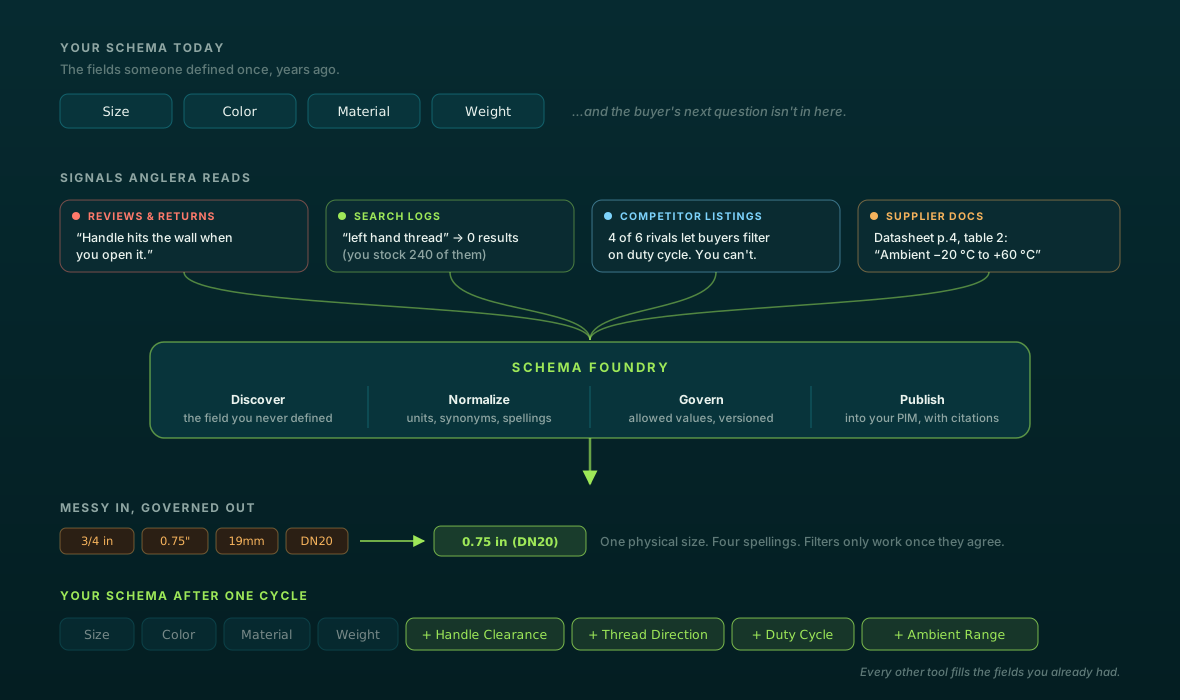
Values are normalized into a governed, versioned set of allowed values — so a filter works, and keeps working after the next import.

Nominal Size
3/4 in0.75"3/4"19mm3/4 inchDN20
0.75 in (DN20)

Six suppliers, six spellings, one physical size. Filters only work once they agree.

Finish
BlkblackBLACK MATTEMatte BlkRAL 9005
Black — Matte

Free text makes a colour filter useless. A governed value makes it a facet.

Material
SS316316 StainlessStainless Steel 316A4 Stainless
Stainless Steel — 316 / A4

Same alloy, four vocabularies, plus a trade name. Buyers search all of them.

And the part nobody else does

We don't just fill the template you handed us.

Filling the fields you defined has an invisible ceiling: a catalog can hit 100% complete and still miss the attribute that loses the sale, because completeness is measured against a schema someone drew years ago. Schema Foundry reads competitor listings, buyer searches, review complaints and your supplier docs, and proposes the fields you never defined — which is where HabileData stops.

How Schema Foundry works
Schema Foundry: signals from reviews, search logs, competitor listings and supplier documents reveal attributes missing from your schema; the Foundry discovers, normalizes and governs them, so your schema ends the cycle with more fields than it started with.

What HabileData does

HabileData is an India-based BPO and data services company that provides manual offshore product data entry, catalog management, data enrichment, classification, and cleansing services for eCommerce retailers, manufacturers, and distributors. Teams of human operators process and standardize SKU data at per-hour or per-SKU rates.

Pricing: From ~$5/hour for data entry; also per-SKU and per-project rates for catalog uploads and multi-channel listing. No public list pricing — custom quotes based on volume and complexity. Free trial offered.

HabileData website

When HabileData is the right call

Teams that want people to own the whole job: keying specs out of scanned catalogs and spec sheets, mapping to Amazon/Shopify categories, and uploading listings, at a per-hour or per-SKU rate.

We'd rather tell you here than in month three of an implementation.

Capability verdicts reviewed against HabileData's public documentation on July 14, 2026. Vendors ship quickly — if something here is out of date, tell us and we'll correct it.

See it on your own SKUs.

Bring one category and your supplier files. In 30 minutes you'll see it enriched — complete, structured, and consistent enough to launch on — plus the attributes your schema didn't have yet.

Book a demo