Buy Iksula if you want a staffed team to run cataloging, copy, and imagery as a managed service across marketplaces; buy Anglera if you want automated enrichment with cited values and API writeback into your PIM in ~30 days.
Both claim to enrich product data. This page is about where that claim stops.
The frame for this comparison
Product data is a practice, not a project.
Iksula ships both the people and the tooling — PC2 for capture, Athena for data quality and governance rules — so the honest comparison here isn't capability, it's cadence: who is holding the catalog on day 41, when a supplier re-issues the spec sheet under the same part number.
01
Ground it
Mine every spec from every source.
Every value traced to a document you can open. The catalog is only as honest as what it was built from.
02
Align it
Aim the catalog at the buyer who actually buys.
Grounded data still loses if it answers questions nobody asked. Alignment is what turns specs into conversion.
03
Keep it alive
Product data is a practice, not a project.
Markets move, suppliers reissue, buyers change what they ask for. A catalog that is right in March is wrong by August unless something is watching.
Capability by capability
Where Iksula stops.
Scored against public documentation. Grouped by the three acts — so you can see which ones Iksula leaves on your desk.
Can it produce usable images for SKUs that lack them?
IksulaYes
iProd generates photoreal models, lifestyle imagery, 3D views
AngleraYes
Generates studio-grade imagery for photoless SKUs
03
Keep it alive
Product data is a practice, not a project.
CapabilityIksulaAnglera
Continuous re-enrichment
What happens when the market moves after go-live?
IksulaLimited
Ongoing managed catalog retainers; staffed, not autonomous re-enrichment
AngleraYes
Re-enriches on its own after go-live
Quality scoring
Does it score its own output and track catalog health?
IksulaYes
Athena scores completeness, accuracy; tracks catalog quality over time
AngleraYes
Scored against your standards; nothing publishes below bar
Write-back
Does enriched data land back in your system of record?
IksulaLimited
Delivers into PIMs and marketplaces via service engagements
AngleraYes
Writes back to PIM, ERP, warehouse, commerce
API, MCP & webhooks
Can your own tools and agents drive it headlessly?
IksulaNo
No public API, webhook, or MCP documentation found
AngleraYes
API, webhooks, and MCP servers
Who does the work
Does it do the work, or help your team do it?
IksulaYes
Services firm; ~400 staff do the work, not software
AngleraYes
Anglera owns the work; review is a guardrail
KeyYesships itLimitedlimited or gatedYour teamyour team still does itNodoesn't do itAnglera differentiator
What “buyer signals” actually means
Six signals sitting in your market right now.
“Buyer signals” is the emptiest phrase in this category, so here is the literal thing. Each of these is an observation from a live market, the gap it exposes, and the field that gets created as a result.
Supplier signal·A revised PDF cut sheet dropped into the vendor portal, rev letter bumped from C to D, no changelog
The rev D sheet lists the 20 A miniature breaker at 22 kA interrupting, where rev C said 10 kA. The catalog copy, the filter, and the spec tab all still read 10 kA — and the 10 kA line is what a panel schedule gets built against.
Ratings a spec writer relies on are captured once, at extraction time, and never re-read when the source document is republished under the same part number.
Field createdinterrupting_rating_ka (held with source_doc_rev and rated_voltage_v)Governed kA values from the manufacturer's published series — 10, 14, 18, 22, 25, 35, 65 — each bound to the voltage it is rated at. Never a free-text "high AIC".
Review signal·Three-star reviews on a solid-oak dining chair, sorted most recent
"Chair is lovely. The bare wood feet chewed a line across our engineered floors the first week — nothing on the bottom, and no pads in the box."
The listing describes the leg material but never says what sits between the leg and the floor. Buyers with hard floors can't filter for it, and the returns come back logged as damage rather than as a missing spec.
Field createdfloor_glide_type, with glides_included as a separate booleanfelt_pad | plastic_glide | nylon_glide | rubber_foot | metal_ferrule | none_supplied — kept apart from glides_included, because "has a glide" and "ships with the glide" are different promises.
Search signal·Internal site search log on a lawn and outdoor supply catalog, spring, zero-result queries
A long tail of "blades for 42 in deck", "42\" mower blade set", "high lift blade 42 inch" returning nothing — while the matching SKUs sit in the catalog titled by OEM blade part number, with the deck size buried in a fitment paragraph.
Fitment lives in prose, not in a field. Search can't match on it, the deck-size facet can't exist, and the customer goes to whoever does expose it.
Field createdfits_deck_width_in (multi-valued), plus blade_profileDeck widths as governed numeric inch values — 21, 30, 32, 36, 42, 46, 48, 54, 60, 61, 72 — normalized from "42\"", "42 in", "42-inch", and the metric equivalents printed on imported units. blade_profile from standard | high_lift | mulching | gator.
Why catalogs rot
Athena holds the rules. The catalog still moves on day 41.
Iksula sells data operations as engagement models — Onsite, Offshore, Hybrid, ODD, and T&M — staffed with certified data engineers, analysts, and architects, and layered with accelerators: PC2, which extracts and normalizes product data from websites, PDFs, spec sheets and images into your PIM, ERP, or ML pipelines via Excel/CSV/JSON or APIs, and Athena, its AI data quality and governance engine, which detects duplicates, fills gaps, standardizes formats and enforces rules through a no-code rule builder. The tooling is real. The variable is the engagement around it.
Drift is what tests that. A vendor re-issues a spec sheet with a revised interrupting rating. A marketplace adds a required field. Sixty SKUs arrive from a line extension. Each is small enough to wait, so they pool. Anglera runs the rules, the vocabularies, and the fill continuously, so there is no batch to schedule.
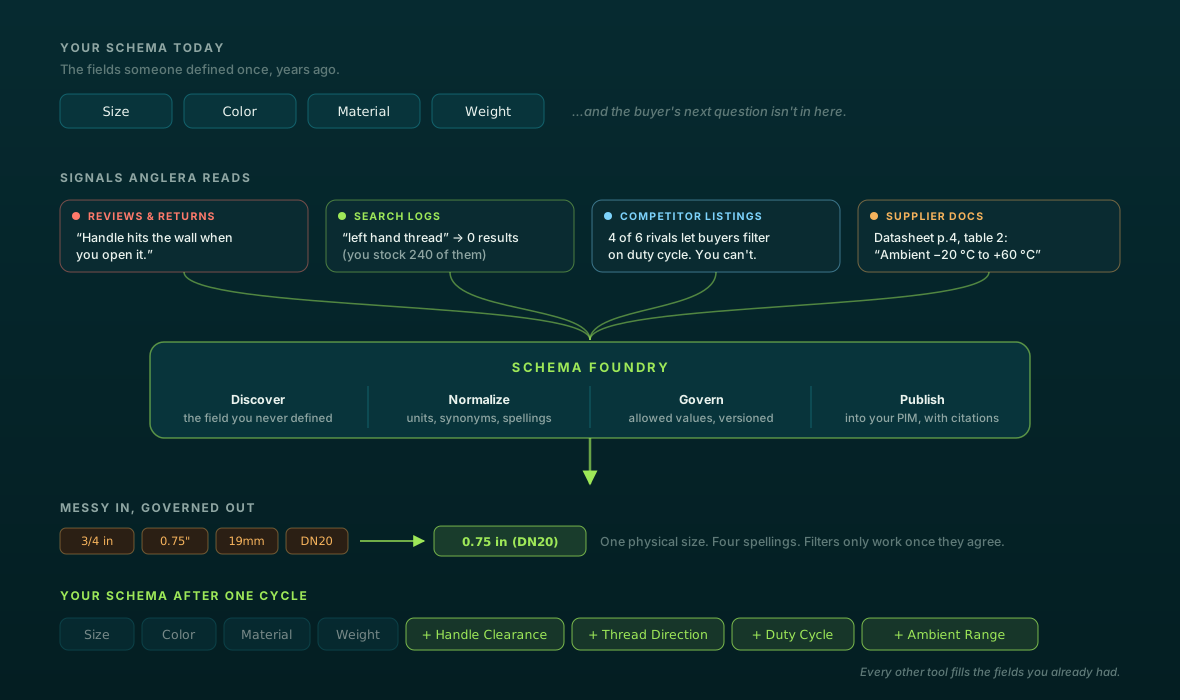
Messy in, governed out.
Values are normalized into a governed, versioned set of allowed values — so a filter works, and keeps working after the next import.
Nominal Size
3/4 in0.75"3/4"19mm3/4 inchDN20
0.75 in (DN20)
Six suppliers, six spellings, one physical size. Filters only work once they agree.
Finish
BlkblackBLACK MATTEMatte BlkRAL 9005
Black — Matte
Free text makes a colour filter useless. A governed value makes it a facet.
Material
SS316316 StainlessStainless Steel 316A4 Stainless
Stainless Steel — 316 / A4
Same alloy, four vocabularies, plus a trade name. Buyers search all of them.
And the part nobody else does
We don't just fill the template you handed us.
Filling the fields you defined has an invisible ceiling: a catalog can hit 100% complete and still miss the attribute that loses the sale, because completeness is measured against a schema someone drew years ago. Schema Foundry reads competitor listings, buyer searches, review complaints and your supplier docs, and proposes the fields you never defined — which is where Iksula stops.
Iksula is an India-based eCommerce services company (founded 2007, headquartered in Mumbai with a US presence in Oakland) that provides managed product cataloging, content operations, and data enrichment for retailers, brands, and marketplaces. Its teams extract, normalize, and enrich product data from websites, PDFs, images, and supplier catalogs, handling SKU preprocessing, attribution, taxonomy alignment, content writing, image optimization, and content moderation. Delivery combines large offshore operations teams with a GenAI content layer and a human editorial review step. Iksula also offers broader retail/eCommerce consulting, merchandising, marketing automation, and a Drupal-based digital asset management product.
Pricing: Not publicly listed; project- and managed-services based, scoped per engagement and catalog size (typical of staffed offshore eCommerce services).
Retailers and marketplace sellers who want an outsourced catalog team: SKU preprocessing, taxonomy and Amazon/Noon category mapping, GPT descriptions in 133 languages, and generated product imagery.
We'd rather tell you here than in month three of an implementation.
Capability verdicts reviewed against Iksula's public documentation on July 14, 2026. Vendors ship quickly — if something here is out of date, tell us and we'll correct it.
See it on your own SKUs.
Bring one category and your supplier files. In 30 minutes you'll see it enriched — complete, structured, and consistent enough to launch on — plus the attributes your schema didn't have yet.