Buy Jasper if the bottleneck is on-brand copy and imagery at scale for a marketing team; buy Anglera if the bottleneck is the catalog underneath: attributes extracted, taxonomy fixed, structured values written back to your PIM.
Both claim to enrich product data. This page is about where that claim stops.
The frame for this comparison
Product data is a practice, not a project.
Product data is a practice, not a project — and against a marketing-AI platform that argument only lands after the first pass, when the descriptions already read well and the live question is where the facts underneath them come from next quarter.
01
Ground it
Mine every spec from every source.
Every value traced to a document you can open. The catalog is only as honest as what it was built from.
02
Align it
Aim the catalog at the buyer who actually buys.
Grounded data still loses if it answers questions nobody asked. Alignment is what turns specs into conversion.
03
Keep it alive
Product data is a practice, not a project.
Markets move, suppliers reissue, buyers change what they ask for. A catalog that is right in March is wrong by August unless something is watching.
Capability by capability
Where Jasper stops.
Scored against public documentation. Grouped by the three acts — so you can see which ones Jasper leaves on your desk.
Can it produce usable images for SKUs that lack them?
JasperYes
Image Pipelines generate on-brand product imagery at scale
AngleraYes
Generates studio-grade imagery for photoless SKUs
03
Keep it alive
Product data is a practice, not a project.
CapabilityJasperAnglera
Continuous re-enrichment
What happens when the market moves after go-live?
JasperYour team
Workflows run on demand; knowledge base connectors auto-sync
AngleraYes
Re-enriches on its own after go-live
Quality scoring
Does it score its own output and track catalog health?
JasperLimited
Scores brand compliance and SEO; not catalog completeness
AngleraYes
Scored against your standards; nothing publishes below bar
Write-back
Does enriched data land back in your system of record?
JasperLimited
Delivers images to DAM/PIM; no attribute-level writeback
AngleraYes
Writes back to PIM, ERP, warehouse, commerce
API, MCP & webhooks
Can your own tools and agents drive it headlessly?
JasperYes
API on Business plan, hosted MCP server; webhooks undocumented
AngleraYes
API, webhooks, and MCP servers
Who does the work
Does it do the work, or help your team do it?
JasperYour team
Software agents assist marketers; customer team owns work
AngleraYes
Anglera owns the work; review is a guardrail
KeyYesships itLimitedlimited or gatedYour teamyour team still does itNodoesn't do itAnglera differentiator
What “buyer signals” actually means
Six signals sitting in your market right now.
“Buyer signals” is the emptiest phrase in this category, so here is the literal thing. Each of these is an observation from a live market, the gap it exposes, and the field that gets created as a result.
Search signal·On-site search logs and the questions AI answer engines get asked about the category
Repeated queries in the shape of "impact driver that takes my old 18V batteries" and "driver compatible with M18 packs" — they return the whole power-tool grid or nothing, because the platform is named in the marketing paragraph, if anywhere, and never in a field.
Battery platform is the first thing a tradesperson filters on and it exists nowhere as a field. Copy can mention it; a facet, a feed, or an answer engine needs it typed.
Field createdbattery_platformGoverned list of manufacturer battery systems (e.g. 18V ONE+, M18, 20V MAX, XR 18V, 18V LXT, PROCORE 18V), plus Corded and Non-removable battery
Marketplace signal·Listing quality report from a marketplace channel feed, LED troffers and panels
Rejections on a run of commercial fixtures: colour temperature supplied as "warm white" and "soft white / 3000" against a field that wants an integer Kelvin value. The PDP copy is correct and readable; the feed column is the one failing.
The spec was written as an adjective for a human reader and never resolved to the governed numeric the channel enforces — so the SKU is unlistable no matter how good the description is.
Field createdcct_kelvinInteger Kelvin from the governed set 2200 / 2700 / 3000 / 3500 / 4000 / 5000 / 6500, plus Tunable white with a declared range
Supplier signal·Engineering change notice attached to a distributor price file update, mid-year
A pump seal kit's elastomer changes from EPDM to FKM on a running change. Same SKU, same part number, same photo — the price file updates, the description does not, and the page still tells a specifying engineer it is EPDM.
The material is the whole buying decision for chemical compatibility, and it changed in a document nobody routed into the fact substrate the copy is generated from.
Field createdelastomer_materialEPDM / FKM / NBR / PTFE / Silicone / HNBR / Neoprene, with an effective-date stamp on the change
Why catalogs rot
The rot starts on the second pass
Jasper's Product Detail Page Agent "sources facts from your Jasper Knowledge Base," and for description work product data enters via Grid, one product per row. That is a coherent design for a marketing platform: it takes the facts you have assembled and shapes them into on-brand copy.
The rot starts after that. Regenerate on a brand refresh — Jasper's own framing is that a 500-product catalogue "runs in hours" — and every description reads better while the spec fields underneath sit where they were. A supplier moves a pump seal kit from EPDM to FKM on a running change; unless someone routes that into the knowledge base, the sentence still says EPDM. A fact that lives only in prose can't be filtered or fed: "warm white" reads fine and fails a marketplace check that wants 3000K.
Catalogues rot at the fact layer, not the sentence layer.
Messy in, governed out.
Values are normalized into a governed, versioned set of allowed values — so a filter works, and keeps working after the next import.
Nominal Size
3/4 in0.75"3/4"19mm3/4 inchDN20
0.75 in (DN20)
Six suppliers, six spellings, one physical size. Filters only work once they agree.
Finish
BlkblackBLACK MATTEMatte BlkRAL 9005
Black — Matte
Free text makes a colour filter useless. A governed value makes it a facet.
Material
SS316316 StainlessStainless Steel 316A4 Stainless
Stainless Steel — 316 / A4
Same alloy, four vocabularies, plus a trade name. Buyers search all of them.
And the part nobody else does
We don't just fill the template you handed us.
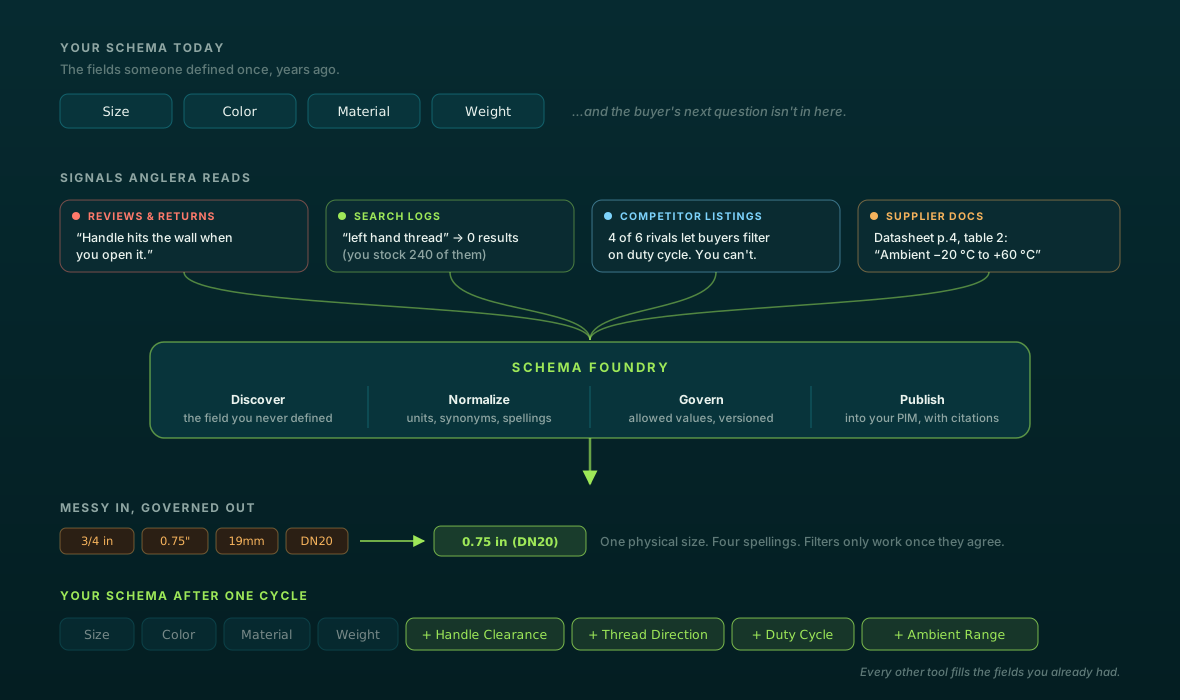
Filling the fields you defined has an invisible ceiling: a catalog can hit 100% complete and still miss the attribute that loses the sale, because completeness is measured against a schema someone drew years ago. Schema Foundry reads competitor listings, buyer searches, review complaints and your supplier docs, and proposes the fields you never defined — which is where Jasper stops.
Jasper is an AI marketing platform that orchestrates 100-plus purpose-built agents to run end-to-end marketing workflows, producing on-brand copy, campaigns, and imagery governed by its Jasper IQ brand-voice layer. For retail and consumer goods teams it offers dedicated Product Description and Product Detail Page agents plus Content Pipelines and Grid for rewriting listings across thousands of SKUs, citing work like 7,500 product descriptions generated for Adidas in under 24 hours. It sells per-seat to marketing teams at companies like Ulta Beauty, Anthropologie, and Cox Automotive, and integrates with Webflow, Google Docs and Sheets, Slack, Salesforce, Zapier, a Chrome extension, and its own APIs and MCP server.
Pricing: Public per-seat pricing. Pro is 69 dollars per seat per month, or 59 dollars per seat per month billed annually, with core marketing agents, 2 brand voices, and a 7-day free trial. Business is custom-priced with a 12-month minimum and adds advanced agents, the no-code agent builder, Grid, API access, and enterprise governance.
Marketing teams whose product data is already clean and who need on-brand copy, campaigns, and imagery at volume, governed by brand voice and tuned per persona across the channels they publish to.
We'd rather tell you here than in month three of an implementation.
Capability verdicts reviewed against Jasper's public documentation on July 14, 2026. Vendors ship quickly — if something here is out of date, tell us and we'll correct it.
See it on your own SKUs.
Bring one category and your supplier files. In 30 minutes you'll see it enriched — complete, structured, and consistent enough to launch on — plus the attributes your schema didn't have yet.