All comparisons
Works with LengowSyndication & feeds

Anglera + Lengow

The bottom line

Keep Lengow to push your catalogue to 1,600+ marketplaces and ad channels; add Anglera upstream to build the record it distributes — supplier PDFs mined, attributes discovered, every value cited and written back to your PIM.

Lengow and Anglera solve different halves of the problem — this page is about the seam between them.

The frame for this comparison

Product data is a practice, not a project.

Lengow moves the catalogue you already have onto 90+ marketplaces in each one's required shape, and Anglera works alongside it — this comparison is about the fields that were never in the catalogue to begin with, and about the new blanks that appear every time a channel changes what it requires or a supplier ships a range with a thinner spec sheet.

01

Ground it

Mine every spec from every source.

Every value traced to a document you can open. The catalog is only as honest as what it was built from.

02

Align it

Aim the catalog at the buyer who actually buys.

Grounded data still loses if it answers questions nobody asked. Alignment is what turns specs into conversion.

03

Keep it alive

Product data is a practice, not a project.

Markets move, suppliers reissue, buyers change what they ask for. A catalog that is right in March is wrong by August unless something is watching.
Capability by capability

Where Lengow stops.

Scored against public documentation. Grouped by the three acts — so you can see which ones Lengow leaves on your desk.

01

Ground it

Mine every spec from every source.
Source mining
Where does it get specs from?
LengowLimited

Imports CSV, XML, JSON, API feeds; no unstructured document mining

AngleraYes

PDFs, spec tables, drawings, manuals, images, sites

Schema discovery
Does it find attributes that aren't in your schema yet?
LengowNo

Maps catalog to channel specs; proposes no new attributes

AngleraYes

Proposes fields your schema never had

Governed vocabulary
Does it turn messy free-text into a governed pick list?
LengowLimited

Rule-based value transformation per channel; no versioned governed vocabulary

AngleraYes

Normalizes and governs allowed values, versioned

Taxonomy & classification
Can it classify every SKU into your hierarchy?
LengowYes

AI Category Mapping auto-suggests best-fit category per channel

AngleraYes

Auto-classifies; channel and marketplace mapping

Citations & provenance
Can you see where any given value came from?
LengowNo

Diffusion and feed error reports; no value-level source citation

AngleraYes

Every value cites its source doc and page

02

Align it

Aim the catalog at the buyer who actually buys.
Buyer personas
Is the content written for your buyer, or generically?
LengowNo

Tailors by channel and market language, not buyer persona

AngleraYes

B2B specifier and B2C shopper enriched differently

Review, search & social signals
Does it learn what buyers ask from the live market?
LengowLimited

NetRivals competitor pricing, reviews, returns feed inclusion and repricing rules

AngleraYes

Reviews, search, competitor rails, social — fed back

Copy & SEO
Does it write original, channel-ready copy?
LengowYes

AI Content Localisation generates titles, descriptions, attributes across 12 languages

AngleraYes

Original copy per persona and channel

Product imagery
Can it produce usable images for SKUs that lack them?
LengowLimited

AI Image Compliance edits backgrounds, framing, formats; does not generate

AngleraYes

Generates studio-grade imagery for photoless SKUs

03

Keep it alive

Product data is a practice, not a project.
Continuous re-enrichment
What happens when the market moves after go-live?
LengowLimited

Scheduled feed refresh and rules engine resync existing catalog data

AngleraYes

Re-enriches on its own after go-live

Quality scoring
Does it score its own output and track catalog health?
LengowLimited

Feed error reports and performance dashboards; no catalog completeness score

AngleraYes

Scored against your standards; nothing publishes below bar

Write-back
Does enriched data land back in your system of record?
LengowLimited

Order and stock sync to ERP, OMS, PIM; content exportable

AngleraYes

Writes back to PIM, ERP, warehouse, commerce

API, MCP & webhooks
Can your own tools and agents drive it headlessly?
LengowLimited

Public REST API and webhooks documented; no MCP server found

AngleraYes

API, webhooks, and MCP servers

Who does the work
Does it do the work, or help your team do it?
LengowYour team

SaaS platform; merchant team configures rules and reviews AI output

AngleraYes

Anglera owns the work; review is a guardrail

KeyYesships itLimitedlimited or gatedYour teamyour team still does itNodoesn't do itAnglera differentiator
What “buyer signals” actually means

Six signals sitting in your market right now.

“Buyer signals” is the emptiest phrase in this category, so here is the literal thing. Each of these is an observation from a live market, the gap it exposes, and the field that gets created as a result.

Marketplace signal·Marketplace feed validation report, women's outerwear

47 parkas held on a German-market upload with "required attribute missing: lining composition". Shell composition is populated on every SKU; the lining field is empty on everything from two suppliers.

The feed carried exactly what the catalogue held. Lining composition was never captured — it sits in the supplier's tech pack PDF, so there is no source field to extract from, merge, or reformat.

Field createdlining_compositionGeneric fibre names (polyamide, polyester, viscose, wool) with integer percentages summing to 100 — not "100% Nylon", not "Poly lining".
Review signal·Product reviews and returns comments, cantilever parasols

"Base hole is 48 mm, the pole on this one is 38 mm. Shimmed it with cardboard." Three versions of the same complaint across the parasol and parasol-base ranges, plus returns coded "wrong fit".

Pole diameter and base aperture are blank across both ranges, so a parasol and the base that fits it can't be matched on-site or on any channel. Shoppers are doing the fitment check in the review section, after purchase.

Field createdpole_diameter_mm / base_aperture_mmInteger millimetres, single unit. Reject "approx 48", "1.9 in", "48/38 mm adaptor incl.".
Search signal·On-site search logs and zero-result queries, sun care

"non nano zinc", "mineral only spf50" and "reef safe sunscreen" all trending in site search and all returning zero results, while the SKUs that satisfy them are in stock and syndicating fine.

Filter type exists only inside the INCI ingredient free-text blob. Present as prose, absent as an attribute — so it can't be faceted, can't be segmented on for a marketplace publish, and can't be matched to how buyers actually ask.

Field createduv_filter_typeMineral | Chemical | Hybrid, plus a separate non_nano boolean — derived from the INCI list, governed, not free text.
Why catalogs rot

Feed health is not shelf health

A syndicator's job is to get what's in the catalogue out the door in each channel's shape — Lengow's own framing of the problems it addresses is "format mismatches and upload failures" and "time-consuming mapping for every marketplace." Those are routing problems, and they are solvable. Completeness is a different failure. Rules reshape fields that already hold values: extract from one field to supplement another, merge sources, restandardise a title per channel. A blank stays blank in every channel it reaches. Where a channel makes the field mandatory, the upload rejects loudly; where it doesn't, the listing publishes and simply doesn't rank or convert. Then it compounds — a marketplace adds a required attribute, a supplier ships a range with a thinner spec sheet, a category tree splits. Lengow moves the feed and enforces each channel's format. Someone still has to fill the fields, and usually nobody owns that.

Messy in, governed out.

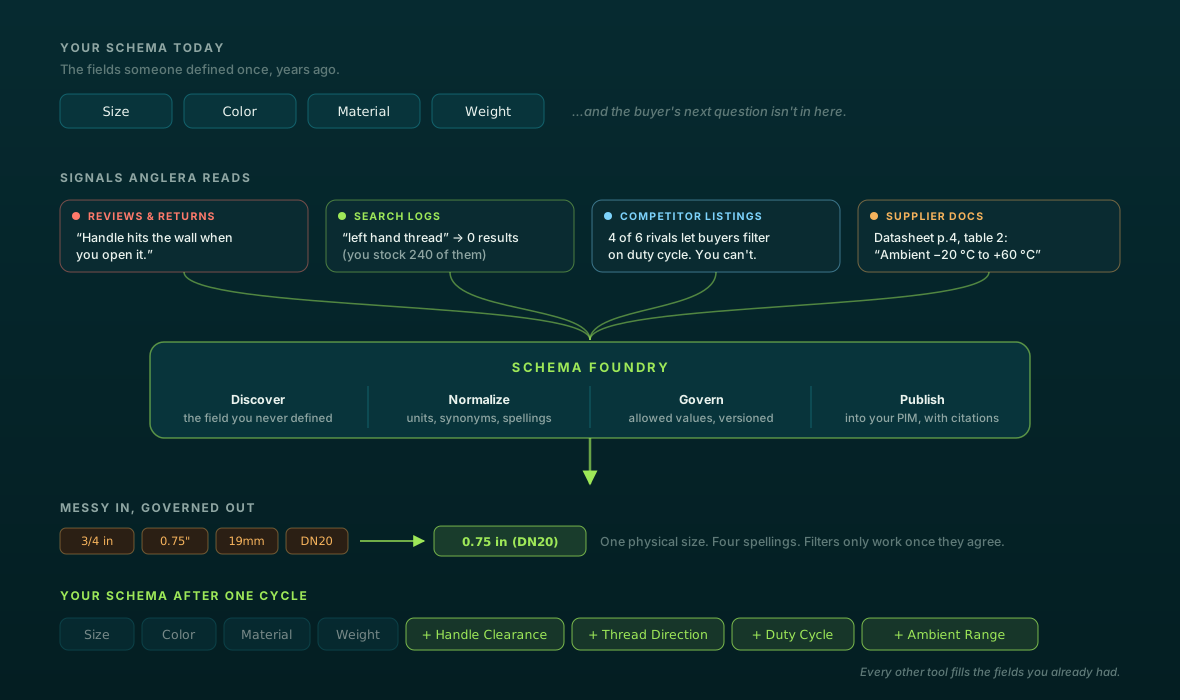
Values are normalized into a governed, versioned set of allowed values — so a filter works, and keeps working after the next import.

Nominal Size
3/4 in0.75"3/4"19mm3/4 inchDN20
0.75 in (DN20)

Six suppliers, six spellings, one physical size. Filters only work once they agree.

Finish
BlkblackBLACK MATTEMatte BlkRAL 9005
Black — Matte

Free text makes a colour filter useless. A governed value makes it a facet.

Material
SS316316 StainlessStainless Steel 316A4 Stainless
Stainless Steel — 316 / A4

Same alloy, four vocabularies, plus a trade name. Buyers search all of them.

And the part nobody else does

We don't just fill the template you handed us.

Filling the fields you defined has an invisible ceiling: a catalog can hit 100% complete and still miss the attribute that loses the sale, because completeness is measured against a schema someone drew years ago. Schema Foundry reads competitor listings, buyer searches, review complaints and your supplier docs, and proposes the fields you never defined — which is where Lengow stops.

How Schema Foundry works
Schema Foundry: signals from reviews, search logs, competitor listings and supplier documents reveal attributes missing from your schema; the Foundry discovers, normalizes and governs them, so your schema ends the cycle with more fields than it started with.

What Lengow does

Lengow is a multichannel e-commerce feed management and syndication platform that helps mid-to-large retailers and brands centralise product catalogues, optimise feeds, and distribute them to 1,600+ marketplaces and advertising channels (Amazon, Google Shopping, Meta, Zalando, and others). Their focus is channel-ready feed distribution, not intelligent content enrichment.

Pricing: Not publicly listed; gated by sales. Reported to be premium-priced and aimed at companies with €1M+ annual revenue; very small merchants are not served.

Lengow website

When Lengow is the right call

Mid-to-large retailers and brands selling across many marketplaces who need per-channel category mapping, feed rules, localised copy in 12 languages, and competitor repricing.

We'd rather tell you here than in month three of an implementation.

Capability verdicts reviewed against Lengow's public documentation on July 14, 2026. Vendors ship quickly — if something here is out of date, tell us and we'll correct it.

See it on your own SKUs.

Bring one category and your supplier files. In 30 minutes you'll see it enriched — complete, structured, and consistent enough to launch on — plus the attributes your schema didn't have yet.

Book a demo