Buy Modelia if apparel on-model imagery is the whole job — it is genuinely deep there and cheap to start. It does not touch product data, so pair it with Anglera, or use Anglera if imagery is one line item in a wider catalog problem.
Both claim to enrich product data. This page is about where that claim stops.
The frame for this comparison
Product data is a practice, not a project.
Modelia's unit of work is a picture of the garment; the practice question is what the row behind that picture says once it's live, and who changes it the next time the fabric, the grade, or the colourway does.
01
Ground it
Mine every spec from every source.
Every value traced to a document you can open. The catalog is only as honest as what it was built from.
02
Align it
Aim the catalog at the buyer who actually buys.
Grounded data still loses if it answers questions nobody asked. Alignment is what turns specs into conversion.
03
Keep it alive
Product data is a practice, not a project.
Markets move, suppliers reissue, buyers change what they ask for. A catalog that is right in March is wrong by August unless something is watching.
Capability by capability
Where Modelia stops.
Scored against public documentation. Grouped by the three acts — so you can see which ones Modelia leaves on your desk.
01
Ground it
Mine every spec from every source.
CapabilityModeliaAnglera
Source mining
Where does it get specs from?
ModeliaN/A
Imagery tool; ingests garment photos, not spec documents
Does it find attributes that aren't in your schema yet?
ModeliaN/A
No product data schema; image generation only
AngleraYes
Proposes fields your schema never had
Governed vocabulary
Does it turn messy free-text into a governed pick list?
ModeliaN/A
No attribute values to normalize; images only
AngleraYes
Normalizes and governs allowed values, versioned
Taxonomy & classification
Can it classify every SKU into your hierarchy?
ModeliaN/A
No SKU classification or channel category mapping
AngleraYes
Auto-classifies; channel and marketplace mapping
Citations & provenance
Can you see where any given value came from?
ModeliaN/A
No enriched data values requiring source citation
AngleraYes
Every value cites its source doc and page
02
Align it
Aim the catalog at the buyer who actually buys.
CapabilityModeliaAnglera
Buyer personas
Is the content written for your buyer, or generically?
ModeliaLimited
Model age, ethnicity, size selectable; no attribute tailoring
AngleraYes
B2B specifier and B2C shopper enriched differently
Review, search & social signals
Does it learn what buyers ask from the live market?
ModeliaNo
No review, search, or competitor signal ingestion found
AngleraYes
Reviews, search, competitor rails, social — fed back
Copy & SEO
Does it write original, channel-ready copy?
ModeliaNo
Generates images and video; no product text
AngleraYes
Original copy per persona and channel
Product imagery
Can it produce usable images for SKUs that lack them?
ModeliaYes
Core product: on-model, pose, background, video generation
AngleraYes
Generates studio-grade imagery for photoless SKUs
03
Keep it alive
Product data is a practice, not a project.
CapabilityModeliaAnglera
Continuous re-enrichment
What happens when the market moves after go-live?
ModeliaYour team
Generate on demand; no autonomous regeneration after launch
AngleraYes
Re-enriches on its own after go-live
Quality scoring
Does it score its own output and track catalog health?
ModeliaNo
No catalog quality or completeness scoring
AngleraYes
Scored against your standards; nothing publishes below bar
Write-back
Does enriched data land back in your system of record?
ModeliaLimited
Shopify app publishes images; no PIM or ERP
AngleraYes
Writes back to PIM, ERP, warehouse, commerce
API, MCP & webhooks
Can your own tools and agents drive it headlessly?
ModeliaYes
Public API from $35/mo plus webhooks; no MCP
AngleraYes
API, webhooks, and MCP servers
Who does the work
Does it do the work, or help your team do it?
ModeliaYour team
Self-serve software; your team runs the generations
AngleraYes
Anglera owns the work; review is a guardrail
KeyYesships itLimitedlimited or gatedYour teamyour team still does itNodoesn't do itAnglera differentiator
What “buyer signals” actually means
Six signals sitting in your market right now.
“Buyer signals” is the emptiest phrase in this category, so here is the literal thing. Each of these is an observation from a live market, the gap it exposes, and the field that gets created as a result.
Review signal·PDP reviews on one dress SKU, filtered to 1- and 2-star
"The model is clearly tall — at 5'2\" this midi is a maxi on me, it dragged. Returning." Three other reviews on the same SKU say a version of the same thing.
The listing shows the garment on a body but never states the body. Length is being inferred from the image, which means it is inferred wrong for anyone who isn't the model's height, and there is no field a shopper could have filtered on instead.
Field createdgarment_length_hps_to_hem_in, graded per size — plus model_height_cm and model_size_worn carried on the asset itselfInches to one decimal, measured high-point-shoulder to hem, one value per size in the grade. Silhouette label from a closed list: mini, above-knee, knee, midi, tea, maxi.
Search signal·Search Console queries landing on the eyewear collection, cross-read against the on-site search log
"nickel free glasses frames", "titanium frames sensitive skin", "monel vs acetate" — steady weekly volume, all landing on the collection page, because no product page contains the words.
Frame material lives in the supplier's spec sheet and, visually, in the photography. It isn't modelled as a field, so it can't be faceted, filtered, or answered by the page the query lands on.
Field createdframe_material, temple_material, nickel_release_compliant (with EN 1811 test reference)Closed list: acetate, TR-90, stainless steel, monel, titanium, beta-titanium, aluminium, wood. The nickel claim is a boolean backed by an EN 1811 report ID — not a phrase in the copy.
Marketplace signal·Overnight feed error report from an apparel marketplace integration
412 SKUs rejected — `material_composition: value "cotton/poly blend" not recognised; fibre percentages must total 100`. A further 90 rejected on `sleeve_length_type` empty.
Both values existed — as prose in the description ("soft cotton-poly blend, easy everyday tee") and as something plainly visible in the on-model shot. Neither is parseable. The marketplace parses fields, and rejects the SKU when the field is prose or blank.
Field createdmaterial_composition[] (fibre + integer percent, summing to 100), sleeve_length_type, neckline_typeFibre names to ISO 1833 generic terms — cotton, polyester, elastane, viscose, lyocell, wool — percent as integer, sum enforced at 100 before push. sleeve_length_type mapped to the marketplace's own enum: sleeveless, cap, short, elbow, three-quarter, long.
Why catalogs rot
The picture gets refreshed. The row doesn't.
Modelia is a visual production tool. Its own described workflow: drag in a garment photo, describe the model in text, press generate, download the result. Flatlay-to-model, repose, accessory try-on for shoes and glasses, background changing, stills into short video — the output is a picture. That is what it is built for, and it is a real job. Generating is a discrete act: you do it when you want imagery.
The attribute row behind the listing runs on a different clock. A mill substitutes a 4% elastane poplin for the 3% one mid-season. The grade moves half an inch at the hem. A colourway is added and the old one sells through. None of that shows in a photograph. Six months on, the imagery looks current and `material_composition` still reads "stretch cotton". Marketplace feeds, facets and site search read the field.
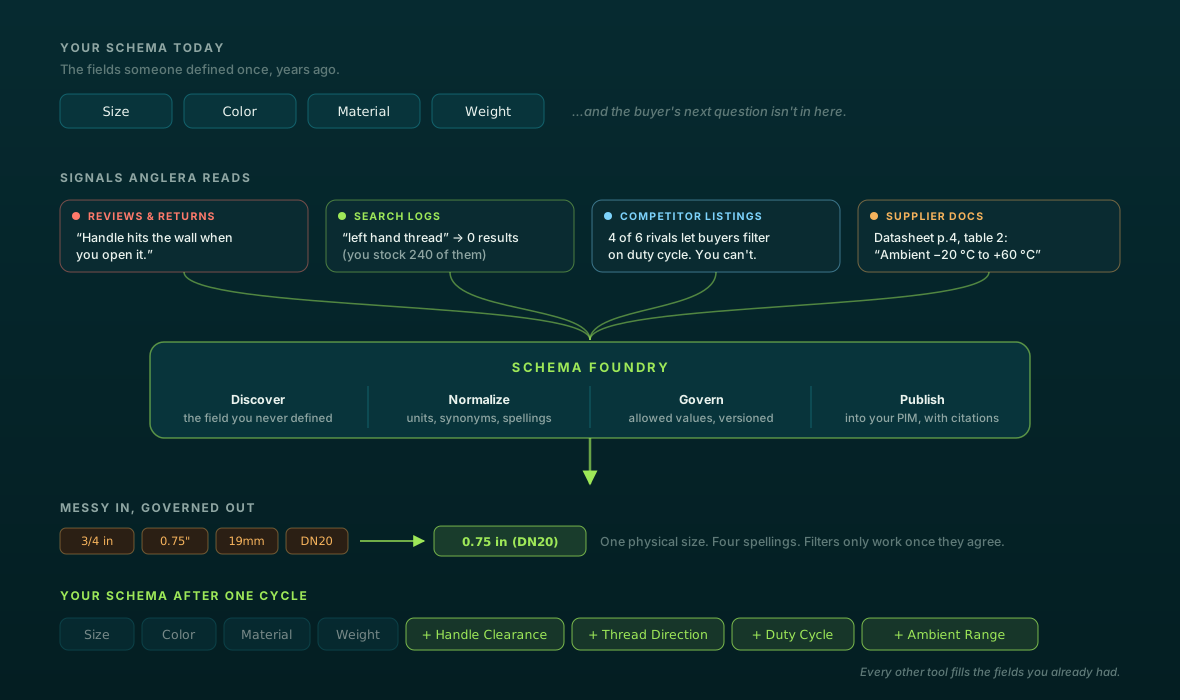
Messy in, governed out.
Values are normalized into a governed, versioned set of allowed values — so a filter works, and keeps working after the next import.
Nominal Size
3/4 in0.75"3/4"19mm3/4 inchDN20
0.75 in (DN20)
Six suppliers, six spellings, one physical size. Filters only work once they agree.
Finish
BlkblackBLACK MATTEMatte BlkRAL 9005
Black — Matte
Free text makes a colour filter useless. A governed value makes it a facet.
Material
SS316316 StainlessStainless Steel 316A4 Stainless
Stainless Steel — 316 / A4
Same alloy, four vocabularies, plus a trade name. Buyers search all of them.
And the part nobody else does
We don't just fill the template you handed us.
Filling the fields you defined has an invisible ceiling: a catalog can hit 100% complete and still miss the attribute that loses the sale, because completeness is measured against a schema someone drew years ago. Schema Foundry reads competitor listings, buyer searches, review complaints and your supplier docs, and proposes the fields you never defined — which is where Modelia stops.
Modelia is a Madrid-based AI platform that generates fashion product imagery and video without photoshoots. Its tools turn garment flatlays, mannequin shots, and existing model photos into on-model images, then extend them with pose variation, outfit styling, background generation, consistent characters, upscaling, and short video. It ships a Shopify app and a public REST API of six image endpoints. Founded in 2024 by Iván Rodríguez and René Haas; raised a €1.03M seed in June 2026 led by Next Tier, and reports processing 300,000+ SKUs in six months for brands including Desigual, AWWG, and Fútbol Emotion.
Pricing: Fully public and self-serve. Starter free (20 credits/mo, watermarked, non-commercial). Project $12 one-time (50 credits, commercial rights). Basic $35/mo (250 credits, public API, batch). Pro $85/mo (750). Business $300/mo (3,000). Credits roll over on paid tiers; costs are per-action (5s video 25 credits). No published enterprise tier: high-volume pricing and custom SLAs are contact-only.
Fashion and apparel brands whose bottleneck is photoshoot cost and speed, wanting deep on-model, pose, and video generation with fine model-demographic control at a $35-$300/mo self-serve price.
We'd rather tell you here than in month three of an implementation.
Capability verdicts reviewed against Modelia's public documentation on July 14, 2026. Vendors ship quickly — if something here is out of date, tell us and we'll correct it.
See it on your own SKUs.
Bring one category and your supplier files. In 30 minutes you'll see it enriched — complete, structured, and consistent enough to launch on — plus the attributes your schema didn't have yet.