All comparisons
Works with ProfiseePIM platforms

Anglera + Profisee

The bottom line

Keep Profisee as the governed source of truth across product, customer and supplier master data; add Anglera to mine supplier PDFs for the specs the golden record never had and write commerce-ready values back.

Profisee and Anglera solve different halves of the problem — this page is about the seam between them.

The frame for this comparison

Product data is a practice, not a project.

Profisee arbitrates between the product values your systems already hold; the practice is producing the values none of them hold — and producing them again each quarter, as categories add fields and suppliers revise specs.

01

Ground it

Mine every spec from every source.

Every value traced to a document you can open. The catalog is only as honest as what it was built from.

02

Align it

Aim the catalog at the buyer who actually buys.

Grounded data still loses if it answers questions nobody asked. Alignment is what turns specs into conversion.

03

Keep it alive

Product data is a practice, not a project.

Markets move, suppliers reissue, buyers change what they ask for. A catalog that is right in March is wrong by August unless something is watching.
Capability by capability

Where Profisee stops.

Scored against public documentation. Grouped by the three acts — so you can see which ones Profisee leaves on your desk.

01

Ground it

Mine every spec from every source.
Source mining
Where does it get specs from?
ProfiseeLimited

Structured source systems and feeds; no unstructured document mining

AngleraYes

PDFs, spec tables, drawings, manuals, images, sites

Schema discovery
Does it find attributes that aren't in your schema yet?
ProfiseeNo

Aisey assists attribute modeling; no external attribute discovery

AngleraYes

Proposes fields your schema never had

Governed vocabulary
Does it turn messy free-text into a governed pick list?
ProfiseeYes

Reference data management: governed code sets, domain-constrained values

AngleraYes

Normalizes and governs allowed values, versioned

Taxonomy & classification
Can it classify every SKU into your hierarchy?
ProfiseeYour team

Strong hierarchy modeling; stewards classify, no channel mapping

AngleraYes

Auto-classifies; channel and marketplace mapping

Citations & provenance
Can you see where any given value came from?
ProfiseeLimited

Survivorship shows source system; audit trails, not source documents

AngleraYes

Every value cites its source doc and page

02

Align it

Aim the catalog at the buyer who actually buys.
Buyer personas
Is the content written for your buyer, or generically?
ProfiseeNo

Single golden record; no persona-tailored enrichment

AngleraYes

B2B specifier and B2C shopper enriched differently

Review, search & social signals
Does it learn what buyers ask from the live market?
ProfiseeNo

No review, search-query, or competitor-listing inputs

AngleraYes

Reviews, search, competitor rails, social — fed back

Copy & SEO
Does it write original, channel-ready copy?
ProfiseeNo

No description, bullet, or marketing copy generation

AngleraYes

Original copy per persona and channel

Product imagery
Can it produce usable images for SKUs that lack them?
ProfiseeNo

No image generation; no DAM module

AngleraYes

Generates studio-grade imagery for photoless SKUs

03

Keep it alive

Product data is a practice, not a project.
Continuous re-enrichment
What happens when the market moves after go-live?
ProfiseeLimited

Rule-based agents run ongoing; no external re-mining

AngleraYes

Re-enriches on its own after go-live

Quality scoring
Does it score its own output and track catalog health?
ProfiseeYes

Data quality dashboards track validation and completeness over time

AngleraYes

Scored against your standards; nothing publishes below bar

Write-back
Does enriched data land back in your system of record?
ProfiseeYes

Core: publishes golden records to downstream systems

AngleraYes

Writes back to PIM, ERP, warehouse, commerce

API, MCP & webhooks
Can your own tools and agents drive it headlessly?
ProfiseeYes

REST API, webhooks, and a shipping MCP server

AngleraYes

API, webhooks, and MCP servers

Who does the work
Does it do the work, or help your team do it?
ProfiseeYour team

Software platform; customer's data stewards own the work

AngleraYes

Anglera owns the work; review is a guardrail

KeyYesships itLimitedlimited or gatedYour teamyour team still does itNodoesn't do itAnglera differentiator
What “buyer signals” actually means

Six signals sitting in your market right now.

“Buyer signals” is the emptiest phrase in this category, so here is the literal thing. Each of these is an observation from a live market, the gap it exposes, and the field that gets created as a result.

Search signal·Site search logs on the distributor's own catalog

"316L" returns four pumps. "316 stainless" returns none, and those sessions end there. The grade is in the attached datasheet PDF, never in a field.

Material grade lives in documents, so it can't be faceted or matched on. There is no value in any source system for survivorship to arbitrate — the attribute doesn't exist as data anywhere.

Field createdwetted_material_gradeUNS/ASTM grade list — 304, 304L, 316, 316L, 2205 duplex, Alloy 20, CD4MCu — with "SS316" and "1.4404" mapped in as synonyms rather than stored as distinct values.
Review signal·Buyer Q&A thread under a NEMA motor listing

"Is the 1-1/8 in. shaft keyed, and does the key ship with it?" Answered by other buyers, inconsistently. The spec table gives frame size 182T and stops.

Frame size implies shaft diameter but not shaft form or what's in the box. The answer sits in the manufacturer's dimension drawing, unread into any field — so there is no value in any system to reconcile, validate or sync.

Field createdshaft_typeKeyed / Smooth / Splined / Threaded / D-profile — with key_included carried as a separate boolean rather than folded into the description.
Marketplace signal·Feed rejection report from a hospital-supply marketplace

A run of instrument trays bounces with "sterilization_method: required." The field entered the category spec at the spring refresh.

The requirement is newer than the item master. ERP, PLM and the storefront were built before the field existed, so survivorship has no candidate value to select and a steward opening the record finds the same blank. The value has to be researched from the IFU and supplier documentation before there is anything to govern or distribute.

Field createdsterilization_methodSteam autoclave / Ethylene oxide / Gamma irradiation / Hydrogen peroxide plasma / Non-sterile — with supplied-sterile vs. field-sterilizable tracked as its own governed field.
Why catalogs rot

A golden record is only as complete as the systems feeding it

Survivorship answers a question of arbitration: two systems disagree on the drive size of a bit set, and a rule decides which value wins. Survivorship rules populate the golden record with information chosen across your source systems. That question only exists when at least one system holds a value. The rot in a governed catalog is the opposite case: the fields where ERP, PLM and e-commerce all agree because all three are blank. Nobody recorded the flange bolt pattern, so the golden record has nothing to select from. Categories keep adding fields — a plenum rating, a duty cycle, a sterilization method — that no source system was built to hold. A steward can be handed that record, but the value isn't in the queue; it's in a supplier drawing. Anglera does the sourcing; Profisee governs and distributes what comes back.

Messy in, governed out.

Values are normalized into a governed, versioned set of allowed values — so a filter works, and keeps working after the next import.

Nominal Size
3/4 in0.75"3/4"19mm3/4 inchDN20
0.75 in (DN20)

Six suppliers, six spellings, one physical size. Filters only work once they agree.

Finish
BlkblackBLACK MATTEMatte BlkRAL 9005
Black — Matte

Free text makes a colour filter useless. A governed value makes it a facet.

Material
SS316316 StainlessStainless Steel 316A4 Stainless
Stainless Steel — 316 / A4

Same alloy, four vocabularies, plus a trade name. Buyers search all of them.

And the part nobody else does

We don't just fill the template you handed us.

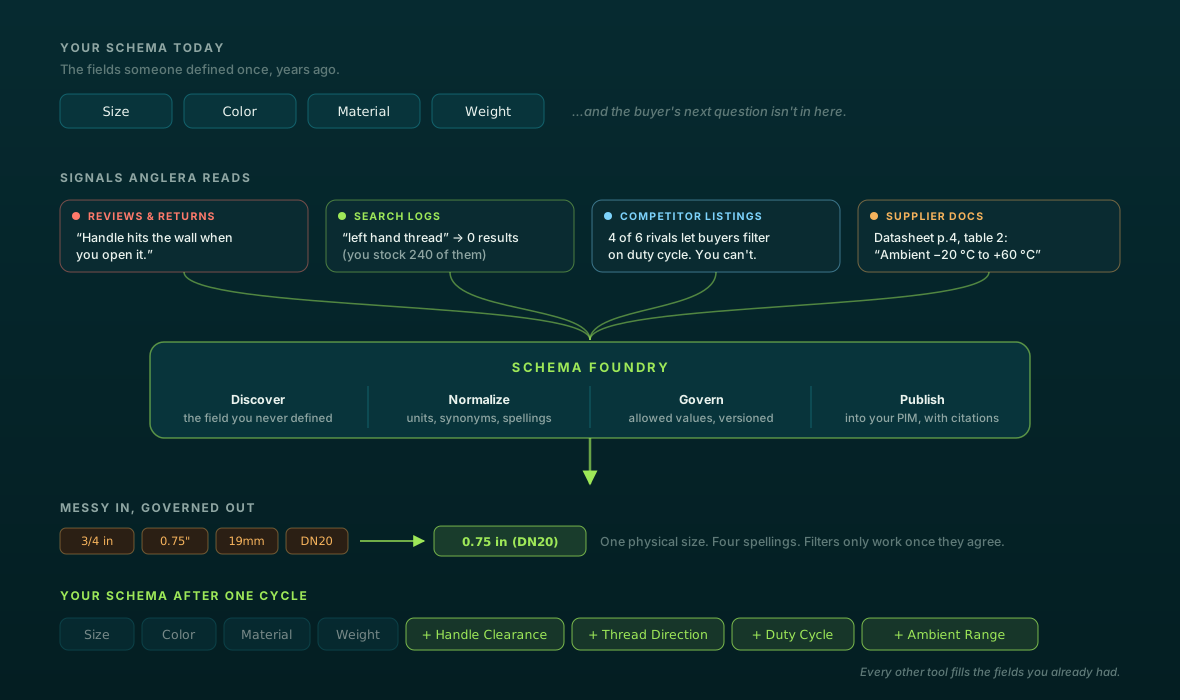
Filling the fields you defined has an invisible ceiling: a catalog can hit 100% complete and still miss the attribute that loses the sale, because completeness is measured against a schema someone drew years ago. Schema Foundry reads competitor listings, buyer searches, review complaints and your supplier docs, and proposes the fields you never defined — which is where Profisee stops.

How Schema Foundry works
Schema Foundry: signals from reviews, search logs, competitor listings and supplier documents reveal attributes missing from your schema; the Foundry discovers, normalizes and governs them, so your schema ends the cycle with more fields than it started with.

What Profisee does

Profisee is an enterprise multi-domain Master Data Management (MDM) platform that creates and governs golden records across product, customer, supplier, and reference data domains. It is built on Microsoft Azure and is recognized as a Gartner Magic Quadrant Leader for MDM.

Pricing: Subscription-based; priced by domain, users, and environments. No public list pricing — custom quotes only.

Profisee website

When Profisee is the right call

Enterprises needing one governed record across several data domains — reference code sets, survivorship, stewardship workflows, quality dashboards — on Azure, with stewards staffed to run it.

We'd rather tell you here than in month three of an implementation.

Capability verdicts reviewed against Profisee's public documentation on July 14, 2026. Vendors ship quickly — if something here is out of date, tell us and we'll correct it.

See it on your own SKUs.

Bring one category and your supplier files. In 30 minutes you'll see it enriched — complete, structured, and consistent enough to launch on — plus the attributes your schema didn't have yet.

Book a demo