All comparisons
An alternative to QuikTek InfoOffshore & BPO services

Anglera vs QuikTek Info

The bottom line

Buy QuikTek if you want people doing catalog data entry, taxonomy, and retouching on retainer. Buy Anglera if you want specs mined from PDFs, cited to source, and written back to your PIM in ~30 days, then kept current.

Both claim to enrich product data. This page is about where that claim stops.

The frame for this comparison

Product data is a practice, not a project.

QuikTek staffs a team that keys your catalog in from the sources you hand over — a supplier CSV, a PDF spec sheet, an Excel workbook — so this comparison is about those SKUs after the batch ships back: when a supplier reissues a datasheet, when a marketplace promotes an item specific from recommended to required, or when shoppers start filtering on a field nobody was asked to enter.

01

Ground it

Mine every spec from every source.

Every value traced to a document you can open. The catalog is only as honest as what it was built from.

02

Align it

Aim the catalog at the buyer who actually buys.

Grounded data still loses if it answers questions nobody asked. Alignment is what turns specs into conversion.

03

Keep it alive

Product data is a practice, not a project.

Markets move, suppliers reissue, buyers change what they ask for. A catalog that is right in March is wrong by August unless something is watching.
Capability by capability

Where QuikTek Info stops.

Scored against public documentation. Grouped by the three acts — so you can see which ones QuikTek Info leaves on your desk.

01

Ground it

Mine every spec from every source.
Source mining
Where does it get specs from?
QuikTek InfoYes

Mines PDFs, manuals, paper catalogs, manufacturer sites

AngleraYes

PDFs, spec tables, drawings, manuals, images, sites

Schema discovery
Does it find attributes that aren't in your schema yet?
QuikTek InfoNo

No new-attribute discovery; fills client's existing fields

AngleraYes

Proposes fields your schema never had

Governed vocabulary
Does it turn messy free-text into a governed pick list?
QuikTek InfoLimited

Manual standardization and unit fixes; no versioned pick lists

AngleraYes

Normalizes and governs allowed values, versioned

Taxonomy & classification
Can it classify every SKU into your hierarchy?
QuikTek InfoYes

Builds category trees; maps marketplace categories manually

AngleraYes

Auto-classifies; channel and marketplace mapping

Citations & provenance
Can you see where any given value came from?
QuikTek InfoNo

No per-value source citations published

AngleraYes

Every value cites its source doc and page

02

Align it

Aim the catalog at the buyer who actually buys.
Buyer personas
Is the content written for your buyer, or generically?
QuikTek InfoNo

No persona-specific attribute or language variants

AngleraYes

B2B specifier and B2C shopper enriched differently

Review, search & social signals
Does it learn what buyers ask from the live market?
QuikTek InfoLimited

SEO keyword work; no competitor or review mining

AngleraYes

Reviews, search, competitor rails, social — fed back

Copy & SEO
Does it write original, channel-ready copy?
QuikTek InfoYes

Writes descriptions, SEO copy, product reviews

AngleraYes

Original copy per persona and channel

Product imagery
Can it produce usable images for SKUs that lack them?
QuikTek InfoLimited

Photoshop retouching and background edits; no generation

AngleraYes

Generates studio-grade imagery for photoless SKUs

03

Keep it alive

Product data is a practice, not a project.
Continuous re-enrichment
What happens when the market moves after go-live?
QuikTek InfoYour team

Retainer staff update catalogs when directed

AngleraYes

Re-enriches on its own after go-live

Quality scoring
Does it score its own output and track catalog health?
QuikTek InfoLimited

Manual QC and gap audits; no health dashboards

AngleraYes

Scored against your standards; nothing publishes below bar

Write-back
Does enriched data land back in your system of record?
QuikTek InfoYes

Staff upload into Shopify, Magento, marketplaces

AngleraYes

Writes back to PIM, ERP, warehouse, commerce

API, MCP & webhooks
Can your own tools and agents drive it headlessly?
QuikTek InfoNo

No public API, webhooks, or MCP server

AngleraYes

API, webhooks, and MCP servers

Who does the work
Does it do the work, or help your team do it?
QuikTek InfoYes

Their staff do the work; people, not software

AngleraYes

Anglera owns the work; review is a guardrail

KeyYesships itLimitedlimited or gatedYour teamyour team still does itNodoesn't do itAnglera differentiator
What “buyer signals” actually means

Six signals sitting in your market right now.

“Buyer signals” is the emptiest phrase in this category, so here is the literal thing. Each of these is an observation from a live market, the gap it exposes, and the field that gets created as a result.

Review signal·One-star reviews and unanswered Q&A on the marketplace listing for a convertible car seat

Several recent one-star reviews make the same complaint in different words: the base is too wide to fit three across in a minivan bench. Two Q&A entries ask whether it clears a rear-facing install behind a six-foot-plus driver. Nobody answers, because answering means reopening the manufacturer's PDF.

Both measurements are printed in the manufacturer's spec sheet, but the catalog carries a single free-text dimensions string keyed from that sheet. A string can't be filtered, sorted, or fed to a marketplace facet.

Field createdbase_width_in and rear_facing_shell_depth_in — separate numeric fields, measured at the widest point of the base and from the seat back to the front edge of the shell in the rear-facing reclineInches to one decimal. Supplier sheets published in centimeters are converted on ingest, not stored in mixed units alongside inch values.
Search signal·Internal site search logs — zero-result queries and refine-twice-then-abandon sessions on a pet supplies store

"step in harness no pull" and "harness deep chest greyhound" both return the entire harness category, unranked. Session replay shows shoppers refining twice, then leaving. Chest girth exists only inside a size-chart JPEG.

How the dog gets into the harness, and whether it fits a barrel or a deep narrow chest, are the two things every buyer decides on. Both currently live in the image and the marketing copy, where the facet rail and the marketplace feed can't read them.

Field createdharness_entry_style and chest_girth_range_cm (min/max per size, as a range, not a single value)harness_entry_style governed to: step-in | over-the-head | dual-clip | vest-style. Supplier phrasings — "easy on", "quick-fit", "no-pull front clip" — map into that enum rather than becoming new values.
Marketplace signal·The buyer-facing filter rail on the marketplace's women's denim category, read against our own item specifics report

The rail leads with rise and inseam; shoppers narrow on those before price. Our listings carry rise inside the title only — "HR Mom Jean, 5-Pocket" — and inseam nowhere but the size chart.

The data exists as text typed from the supplier workbook, in whatever abbreviation the supplier used. As a title fragment it filters nothing: the item drops out of the shopper's first narrowing move.

Field createdrise_type and inseam_length_in, populated per variant rather than per stylerise_type governed to: low | mid | high | super-high, with a synonym table resolving HR, hi-rise, high-waist, and highwaisted into high. inseam_length_in in whole or half inches, per variant.
Why catalogs rot

A batch has an edge; the catalog doesn't

QuikTek's catalog processing page names the fields the work covers — product names/titles, brands/MFGs, SKUs, part numbers, description, quantity, colors, categories, shipping — and prices it unit-based, hourly, or lump-sum. Their enrichment page describes a team evaluating a catalog to identify gaps, pulling detail from PDFs, manuals, and manufacturer sites. That is staffed work, scoped and billed per engagement. The question a category manager should ask is what happens between engagements. A supplier reissues a datasheet and the 18-gauge becomes 20-gauge. A marketplace promotes an item specific from recommended to required. Shoppers start filtering denim by rise — a field nobody entered in March because nobody asked. None of that is a keying error. It's drift, and drift is continuous while a scoped batch is not. Anglera's argument: completing SKUs runs on the catalog's clock, not the statement of work's.

Messy in, governed out.

Values are normalized into a governed, versioned set of allowed values — so a filter works, and keeps working after the next import.

Nominal Size
3/4 in0.75"3/4"19mm3/4 inchDN20
0.75 in (DN20)

Six suppliers, six spellings, one physical size. Filters only work once they agree.

Finish
BlkblackBLACK MATTEMatte BlkRAL 9005
Black — Matte

Free text makes a colour filter useless. A governed value makes it a facet.

Material
SS316316 StainlessStainless Steel 316A4 Stainless
Stainless Steel — 316 / A4

Same alloy, four vocabularies, plus a trade name. Buyers search all of them.

And the part nobody else does

We don't just fill the template you handed us.

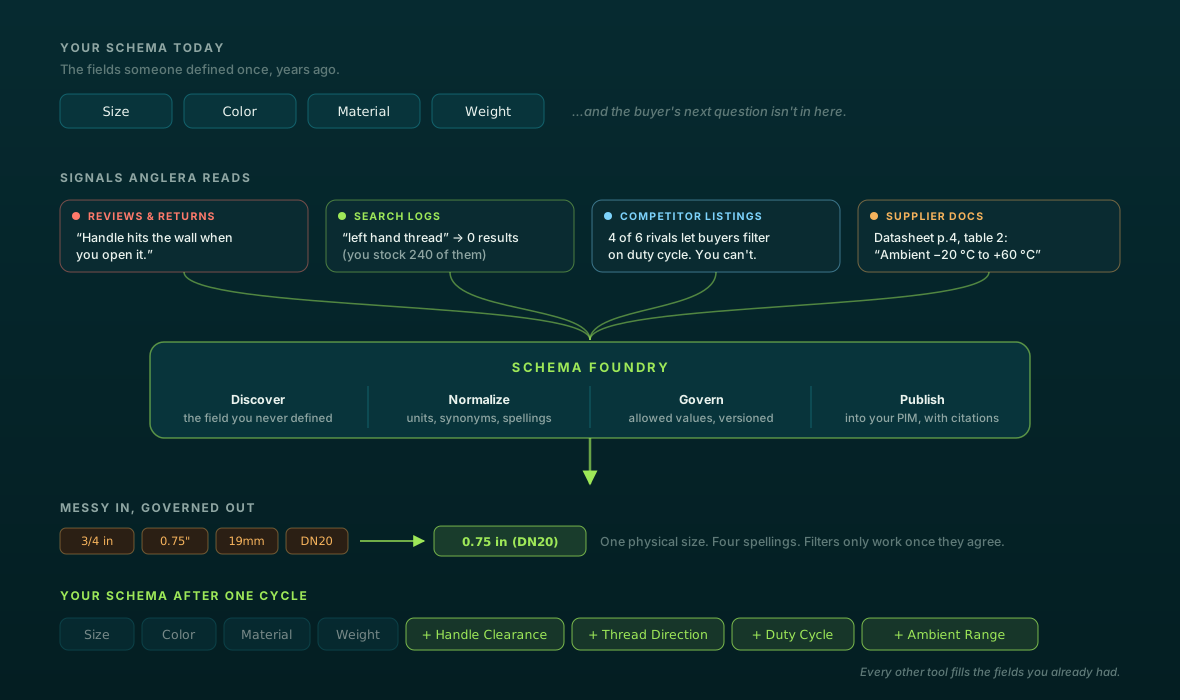
Filling the fields you defined has an invisible ceiling: a catalog can hit 100% complete and still miss the attribute that loses the sale, because completeness is measured against a schema someone drew years ago. Schema Foundry reads competitor listings, buyer searches, review complaints and your supplier docs, and proposes the fields you never defined — which is where QuikTek Info stops.

How Schema Foundry works
Schema Foundry: signals from reviews, search logs, competitor listings and supplier documents reveal attributes missing from your schema; the Foundry discovers, normalizes and governs them, so your schema ends the cycle with more fields than it started with.

What QuikTek Info does

QuikTek Info is an India-based offshore BPO founded in 2009 with 270+ data entry specialists who manually catalog, enrich, and optimize product data for eCommerce and B2B websites — including data entry, category taxonomy, SEO descriptions, image editing, and multi-channel feed management.

Pricing: Custom quote only; no published pricing tiers.

QuikTek Info website

When QuikTek Info is the right call

Teams who'd rather hand the work to people than run software, and need data entry, taxonomy mapping, SEO copy, and Photoshop retouching uploaded across channels by hand.

We'd rather tell you here than in month three of an implementation.

Capability verdicts reviewed against QuikTek Info's public documentation on July 14, 2026. Vendors ship quickly — if something here is out of date, tell us and we'll correct it.

See it on your own SKUs.

Bring one category and your supplier files. In 30 minutes you'll see it enriched — complete, structured, and consistent enough to launch on — plus the attributes your schema didn't have yet.

Book a demo