All comparisons
An alternative to ReFiBuyAI enrichment tools

Anglera vs ReFiBuy

The bottom line

Buy ReFiBuy if the goal is winning ChatGPT and Gemini product cards; buy Anglera if the goal is a catalog that is correct at the source. They overlap on enrichment but optimize toward different endpoints — many teams run both.

Both claim to enrich product data. This page is about where that claim stops.

The frame for this comparison

Product data is a practice, not a project.

ReFiBuy is built to make SKUs legible to AI shopping agents and to keep scoring them as models change; the question this page asks is a different one — what governs the values that get written, and who owns them when the next model reads the SKU differently.

01

Ground it

Mine every spec from every source.

Every value traced to a document you can open. The catalog is only as honest as what it was built from.

02

Align it

Aim the catalog at the buyer who actually buys.

Grounded data still loses if it answers questions nobody asked. Alignment is what turns specs into conversion.

03

Keep it alive

Product data is a practice, not a project.

Markets move, suppliers reissue, buyers change what they ask for. A catalog that is right in March is wrong by August unless something is watching.
Capability by capability

Where ReFiBuy stops.

Scored against public documentation. Grouped by the three acts — so you can see which ones ReFiBuy leaves on your desk.

01

Ground it

Mine every spec from every source.
Source mining
Where does it get specs from?
ReFiBuyLimited

Catalog feeds, site pages, reviews, Reddit; no supplier documents

AngleraYes

PDFs, spec tables, drawings, manuals, images, sites

Schema discovery
Does it find attributes that aren't in your schema yet?
ReFiBuyLimited

Generates attributes to meet engine specs, not new schema fields

AngleraYes

Proposes fields your schema never had

Governed vocabulary
Does it turn messy free-text into a governed pick list?
ReFiBuyLimited

Normalizes values at SKU level; no versioned pick lists documented

AngleraYes

Normalizes and governs allowed values, versioned

Taxonomy & classification
Can it classify every SKU into your hierarchy?
ReFiBuyLimited

Maps SKUs to AI engine product cards; hierarchy classification unclear

AngleraYes

Auto-classifies; channel and marketplace mapping

Citations & provenance
Can you see where any given value came from?
ReFiBuyYes

Each recommendation backed by citations and confidence scoring

AngleraYes

Every value cites its source doc and page

02

Align it

Aim the catalog at the buyer who actually buys.
Buyer personas
Is the content written for your buyer, or generically?
ReFiBuyLimited

Vertical and use-case context; no B2B versus B2C variants

AngleraYes

B2B specifier and B2C shopper enriched differently

Review, search & social signals
Does it learn what buyers ask from the live market?
ReFiBuyYes

Reviews, Reddit mentions, competitor standards feed the enrich loop

AngleraYes

Reviews, search, competitor rails, social — fed back

Copy & SEO
Does it write original, channel-ready copy?
ReFiBuyYes

Titles, descriptions, bullets, key features, and Q&A pairs

AngleraYes

Original copy per persona and channel

Product imagery
Can it produce usable images for SKUs that lack them?
ReFiBuyNo

No image generation found in public material

AngleraYes

Generates studio-grade imagery for photoless SKUs

03

Keep it alive

Product data is a practice, not a project.
Continuous re-enrichment
What happens when the market moves after go-live?
ReFiBuyYes

Closed-loop monitoring, recurring jobs, re-enriches as engines evolve

AngleraYes

Re-enriches on its own after go-live

Quality scoring
Does it score its own output and track catalog health?
ReFiBuyYes

Eligibility scorecard on four dimensions, tracked over time

AngleraYes

Scored against your standards; nothing publishes below bar

Write-back
Does enriched data land back in your system of record?
ReFiBuyYes

Syncs to PIM and ERP; named connectors still early access

AngleraYes

Writes back to PIM, ERP, warehouse, commerce

API, MCP & webhooks
Can your own tools and agents drive it headlessly?
ReFiBuyYes

REST API, webhooks, and MCP server; docs gated in early access

AngleraYes

API, webhooks, and MCP servers

Who does the work
Does it do the work, or help your team do it?
ReFiBuyLimited

Software with approval workflows; full-automation mode offered

AngleraYes

Anglera owns the work; review is a guardrail

KeyYesships itLimitedlimited or gatedYour teamyour team still does itNodoesn't do itAnglera differentiator
What “buyer signals” actually means

Six signals sitting in your market right now.

“Buyer signals” is the emptiest phrase in this category, so here is the literal thing. Each of these is an observation from a live market, the gap it exposes, and the field that gets created as a result.

Search signal·internal site search logs on the distributor storefront

"nema 4x enclosure 12x10x6 hinged" returns zero results, repeatedly, from buyers who then bounce — while the catalog carries dozens of enclosures that match

The environmental rating lives in description prose ("suitable for washdown and outdoor use"), so it is readable but not filterable and not answerable

Field createdenclosure_environmental_ratingNEMA 1 | NEMA 3R | NEMA 4 | NEMA 4X | NEMA 12 | NEMA 13 | IP54 | IP65 | IP66 | IP67
Review signal·one-star reviews on the retailer PDP for a marine hardware line

"Listing says stainless. It's 430 — the bracket pitted within one season 200 yards from the water. 316 or don't call it marine."

Material is modeled as one bucket, "stainless steel", so grade — the part that predicts corrosion behavior — never reaches the page or the agent answering "will this rust near salt water"

Field createdmaterial_alloy_gradeAISI 304 | AISI 304L | AISI 316 | AISI 316L | AISI 430 | 17-4 PH | Unspecified
Marketplace signal·the marketplace listing-quality report on an LED driver catalog

Several hundred drivers flagged for a missing required attribute; the dimming method is present, but only as a title suffix — "…-010V", "…TR", "…D2" — parsed off the SKU by whoever built the feed

Dimming protocol was never a field, so it is not validated, filtered, or asserted anywhere; each channel re-derives it from a naming convention that predates half the SKUs

Field createddimming_protocol0-10V | 1-10V | TRIAC (forward phase) | ELV (reverse phase) | DALI-2 | PWM | Non-dimmable
Why catalogs rot

A score measures how a SKU reads; the datasheet settles what it is

ReFiBuy scores every SKU on four stated dimensions — content quality, crawlability, semantic quality, contextual signals — then generates and enriches to close gaps, with an Enrichment Queue putting human review before publish. It is built to make a catalog legible to AI shopping agents. Anglera's argument is about what a legibility score measures by construction: all four dimensions are properties of the text. A clean title reads well whether the thread underneath is BSPT or NPT — only the datasheet settles that. Correctness moves at the speed a person reads a PDF. And where free text lands instead of a governed value, "black oxide", "blackened" and "BLK OX" arrive as three strings for one finish, and the filters return nothing. Anglera runs it the other way: fix the attribute and its value set, source every value to a document, then let anything downstream score it.

Messy in, governed out.

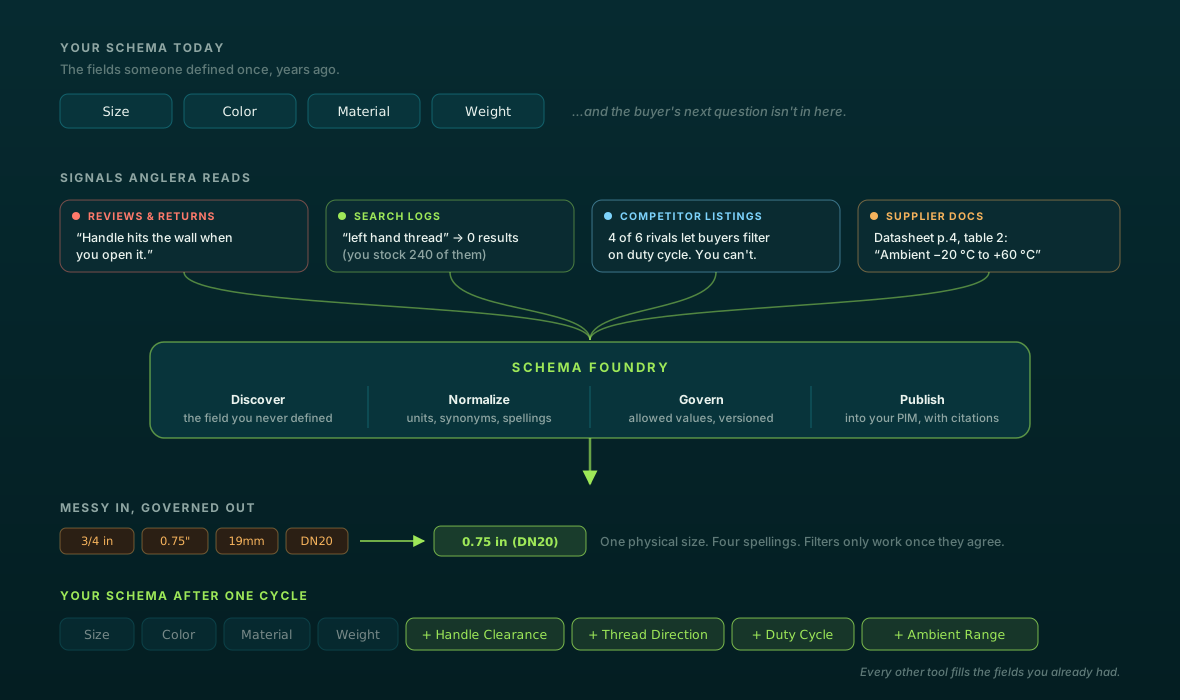
Values are normalized into a governed, versioned set of allowed values — so a filter works, and keeps working after the next import.

Nominal Size
3/4 in0.75"3/4"19mm3/4 inchDN20
0.75 in (DN20)

Six suppliers, six spellings, one physical size. Filters only work once they agree.

Finish
BlkblackBLACK MATTEMatte BlkRAL 9005
Black — Matte

Free text makes a colour filter useless. A governed value makes it a facet.

Material
SS316316 StainlessStainless Steel 316A4 Stainless
Stainless Steel — 316 / A4

Same alloy, four vocabularies, plus a trade name. Buyers search all of them.

And the part nobody else does

We don't just fill the template you handed us.

Filling the fields you defined has an invisible ceiling: a catalog can hit 100% complete and still miss the attribute that loses the sale, because completeness is measured against a schema someone drew years ago. Schema Foundry reads competitor listings, buyer searches, review complaints and your supplier docs, and proposes the fields you never defined — which is where ReFiBuy stops.

How Schema Foundry works
Schema Foundry: signals from reviews, search logs, competitor listings and supplier documents reveal attributes missing from your schema; the Foundry discovers, normalizes and governs them, so your schema ends the cycle with more fields than it started with.

What ReFiBuy does

ReFiBuy sells an "Agentic Commerce Optimization" platform built on a Commerce Intelligence Engine that runs a six-step loop: ingest, evaluate, enrich, distribute, sync, monitor. It scores every SKU across content quality, crawlability, semantic quality, and contextual signals, then generates titles, descriptions, bullets, and Q&A pairs so products are legible to AI shopping engines like ChatGPT, Perplexity, Gemini, and Claude. It distributes to OpenAI's Agentic Commerce Protocol and Google's UCP, and syncs enriched data back to systems like PIMs and ERPs. Founded 2025 by ChannelAdvisor's Scot Wingo; raised a $13.6M seed in May 2026.

Pricing: Not publicly disclosed — there is no pricing page and no listed tiers or dollar amounts. Their developer page states "SKU-based pricing you can forecast," and public material describes an annual subscription scoped by catalog size and monitored SKUs. Access currently runs through a design partner program and early access, with broader availability signaled for Q3 2026.

ReFiBuy website

When ReFiBuy is the right call

DTC and retail teams whose first priority is measurable visibility inside AI shopping engines, and who want SKU-level eligibility scoring against competitors on the offer card.

We'd rather tell you here than in month three of an implementation.

Capability verdicts reviewed against ReFiBuy's public documentation on July 14, 2026. Vendors ship quickly — if something here is out of date, tell us and we'll correct it.

See it on your own SKUs.

Bring one category and your supplier files. In 30 minutes you'll see it enriched — complete, structured, and consistent enough to launch on — plus the attributes your schema didn't have yet.

Book a demo