All comparisons
An alternative to Rely ServicesOffshore & BPO services

Anglera vs Rely Services

The bottom line

Buy Rely Services if you need people to key supplier data into your systems and want 40-60% off in-house labor cost. Buy Anglera if you need enrichment driven by buyer signals, cited to source, and re-run continuously without headcount.

Both claim to enrich product data. This page is about where that claim stops.

The frame for this comparison

Product data is a practice, not a project.

Rely Services is a BPO firm whose eCommerce data entry line takes source material a client already has — a manufacturer's website, a physical or digitized catalog, supplier spreadsheets — and keys the resulting records into Shopify, Amazon, Magento or eBay, with offshore delivery their page describes as "ready for you the next business day"; the question a catalog owner still has to answer is what governs the values between one batch and the next, when the manufacturer revises the datasheet and a supplier file spells the same value four ways.

01

Ground it

Mine every spec from every source.

Every value traced to a document you can open. The catalog is only as honest as what it was built from.

02

Align it

Aim the catalog at the buyer who actually buys.

Grounded data still loses if it answers questions nobody asked. Alignment is what turns specs into conversion.

03

Keep it alive

Product data is a practice, not a project.

Markets move, suppliers reissue, buyers change what they ask for. A catalog that is right in March is wrong by August unless something is watching.
Capability by capability

Where Rely Services stops.

Scored against public documentation. Grouped by the three acts — so you can see which ones Rely Services leaves on your desk.

01

Ground it

Mine every spec from every source.
Source mining
Where does it get specs from?
Rely ServicesYes

OCR and keying from PDFs, scanned catalogs, manufacturer sites

AngleraYes

PDFs, spec tables, drawings, manuals, images, sites

Schema discovery
Does it find attributes that aren't in your schema yet?
Rely ServicesNo

Works to client-supplied templates; no new attribute proposals

AngleraYes

Proposes fields your schema never had

Governed vocabulary
Does it turn messy free-text into a governed pick list?
Rely ServicesLimited

Analysts reformat to client standards; no versioned pick lists

AngleraYes

Normalizes and governs allowed values, versioned

Taxonomy & classification
Can it classify every SKU into your hierarchy?
Rely ServicesYes

Staff list SKUs into categories, subcategories, marketplace structures

AngleraYes

Auto-classifies; channel and marketplace mapping

Citations & provenance
Can you see where any given value came from?
Rely ServicesNo

No value-level citations; QC accuracy claims only

AngleraYes

Every value cites its source doc and page

02

Align it

Aim the catalog at the buyer who actually buys.
Buyer personas
Is the content written for your buyer, or generically?
Rely ServicesNo

No persona-tailored attribute or language variation described

AngleraYes

B2B specifier and B2C shopper enriched differently

Review, search & social signals
Does it learn what buyers ask from the live market?
Rely ServicesNo

No review, search, or competitor signal loop into enrichment

AngleraYes

Reviews, search, competitor rails, social — fed back

Copy & SEO
Does it write original, channel-ready copy?
Rely ServicesYes

In-house writing team drafts titles and descriptions

AngleraYes

Original copy per persona and channel

Product imagery
Can it produce usable images for SKUs that lack them?
Rely ServicesLimited

Image sourcing and editing; no generated product photography

AngleraYes

Generates studio-grade imagery for photoless SKUs

03

Keep it alive

Product data is a practice, not a project.
Continuous re-enrichment
What happens when the market moves after go-live?
Rely ServicesLimited

Retained team updates catalogs on client instruction, not autonomously

AngleraYes

Re-enriches on its own after go-live

Quality scoring
Does it score its own output and track catalog health?
Rely ServicesLimited

Internal QC accuracy rates; no catalog health tracking

AngleraYes

Scored against your standards; nothing publishes below bar

Write-back
Does enriched data land back in your system of record?
Rely ServicesYes

Staff key data directly into Amazon, Shopify, Magento

AngleraYes

Writes back to PIM, ERP, warehouse, commerce

API, MCP & webhooks
Can your own tools and agents drive it headlessly?
Rely ServicesNo

No public API, webhooks, or MCP server found

AngleraYes

API, webhooks, and MCP servers

Who does the work
Does it do the work, or help your team do it?
Rely ServicesYes

Their offshore staff perform the work end-to-end

AngleraYes

Anglera owns the work; review is a guardrail

KeyYesships itLimitedlimited or gatedYour teamyour team still does itNodoesn't do itAnglera differentiator
What “buyer signals” actually means

Six signals sitting in your market right now.

“Buyer signals” is the emptiest phrase in this category, so here is the literal thing. Each of these is an observation from a live market, the gap it exposes, and the field that gets created as a result.

Search signal·site-search log on the Shopify storefront

Shoppers type `nema 5-15p to c13 10ft` and `c14 right angle` into the search box and land on a 900-result power cord listing page they then abandon.

Cord SKUs carry length in the title, but the two connector ends only exist inside the description paragraph — so nothing can be filtered, faceted, or checked against the next batch.

Field createdplug_end_connector and device_end_connector — two separate fields, one per end of the cordIEC 60320 and NEMA designations only: C5, C7, C13, C14, C15, C19, C20, NEMA 1-15P, 5-15P, 5-15R, 5-20P, L6-30P
Review signal·customer questions on an Amazon laptop-backpack listing

Three questions ask whether a 15.6-inch Dell Precision in a rubber bumper case actually fits the sleeve marketed as "fits 17 inch laptop"; two three-star reviews say the sleeve is about 2 cm too shallow.

The listing states the screen size the bag is merchandised for, not the internal sleeve cavity — the number a buyer needs is nowhere in the record, so every re-key reproduces the same claim.

Field createdlaptop_sleeve_internal_dimensions_mm — height x width x depth, three valuesMillimetres, integers, measured cavity only; nominal screen-size strings such as "17 inch" are not valid entries in this field
Supplier signal·the quarterly price and product file from a coffee roaster

The same SKU line arrives as "Med-Dark" on the wholesale tab, "Medium/Dark" in the PDF sell sheet, "Full City+" on the bag artwork, and "Vienna" in the origin notes.

Whichever spelling the source document happened to use is what gets keyed, so roast becomes a free-text field that cannot be faceted and drifts every time the file is reissued.

Field createdroast_levelLight | Medium-Light | Medium | Medium-Dark | Dark | French, with a mapping table held in the schema: Cinnamon and City-minus to Light, City to Medium, Full City to Medium-Dark, Full City+ to Dark, Vienna to Dark, Italian to French
Why catalogs rot

What governs the next batch

Rely Services staffs the keying: source material in, listing fields out, offshore, with work their page describes as ready the next business day. That is a service you buy by the batch, and a batch inherits whatever vocabulary the source document happened to use. Anglera is not a PIM and does not replace one — it works alongside Akeneo, Salsify, or a Shopify metafield set — but the rule lives in the record rather than beside it: `roast_level` accepts six values plus a mapping table, and a cord carries two connector fields instead of one description paragraph. When the roaster reissues the price file in October and "Full City+" appears again, the mapping decides. The next batch inherits that decision instead of re-arguing it.

Messy in, governed out.

Values are normalized into a governed, versioned set of allowed values — so a filter works, and keeps working after the next import.

Nominal Size
3/4 in0.75"3/4"19mm3/4 inchDN20
0.75 in (DN20)

Six suppliers, six spellings, one physical size. Filters only work once they agree.

Finish
BlkblackBLACK MATTEMatte BlkRAL 9005
Black — Matte

Free text makes a colour filter useless. A governed value makes it a facet.

Material
SS316316 StainlessStainless Steel 316A4 Stainless
Stainless Steel — 316 / A4

Same alloy, four vocabularies, plus a trade name. Buyers search all of them.

And the part nobody else does

We don't just fill the template you handed us.

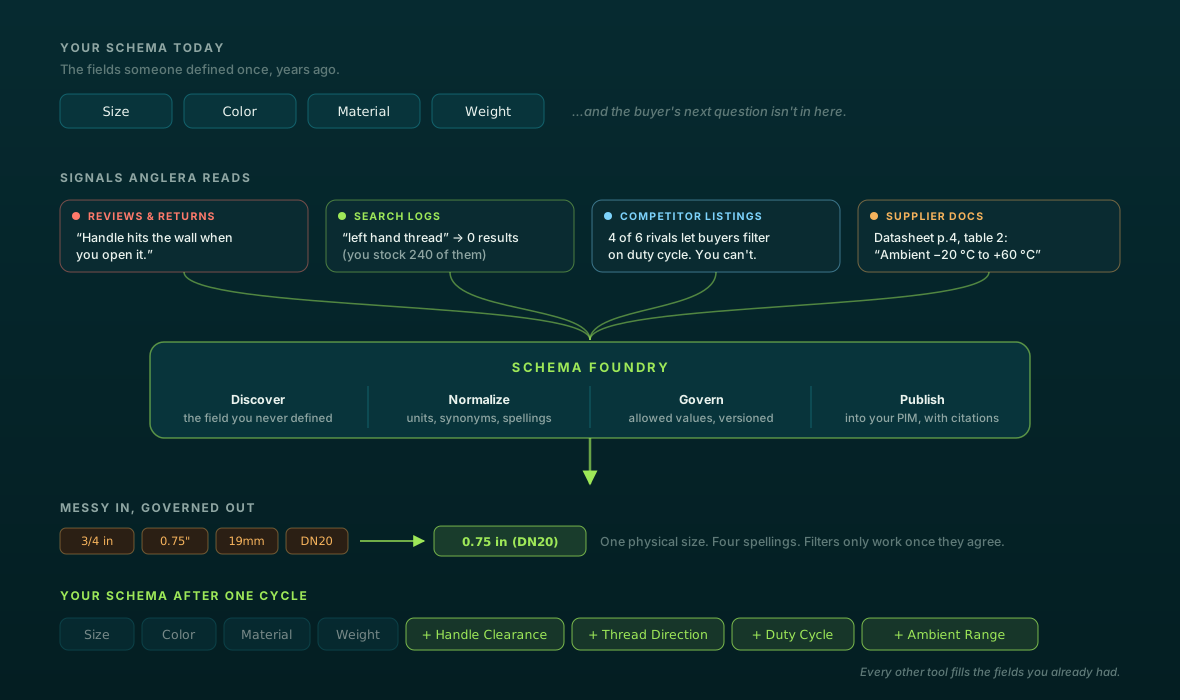
Filling the fields you defined has an invisible ceiling: a catalog can hit 100% complete and still miss the attribute that loses the sale, because completeness is measured against a schema someone drew years ago. Schema Foundry reads competitor listings, buyer searches, review complaints and your supplier docs, and proposes the fields you never defined — which is where Rely Services stops.

How Schema Foundry works
Schema Foundry: signals from reviews, search logs, competitor listings and supplier documents reveal attributes missing from your schema; the Foundry discovers, normalizes and governs them, so your schema ends the cycle with more fields than it started with.

What Rely Services does

Rely Services is a US-managed, India-delivered BPO firm founded in 1997 that provides manual data entry, catalog management, product data enrichment, and eCommerce content services for retailers and distributors. Human operators source, key, and format product attributes at scale, targeting 99.5% accuracy with promised cost savings of 40–60% versus in-house teams.

Pricing: Custom quote only; no public pricing. Markets 40–60% cost reduction versus in-house labor.

Rely Services website

When Rely Services is the right call

Teams with a defined attribute template and marketplace listings who want OCR, keying, taxonomy work, copywriting, and direct entry into Amazon, Shopify, or Magento handled by staff.

We'd rather tell you here than in month three of an implementation.

Capability verdicts reviewed against Rely Services's public documentation on July 14, 2026. Vendors ship quickly — if something here is out of date, tell us and we'll correct it.

See it on your own SKUs.

Bring one category and your supplier files. In 30 minutes you'll see it enriched — complete, structured, and consistent enough to launch on — plus the attributes your schema didn't have yet.

Book a demo