All comparisons
An alternative to StyliticsAI enrichment tools

Anglera vs Stylitics

The bottom line

Buy Stylitics if you're an apparel brand wanting outfitting, on-model imagery, and image-derived attributes as a managed service. Buy Anglera if enrichment must mine supplier documents, cite its sources, and improve your schema.

Both claim to enrich product data. This page is about where that claim stops.

The frame for this comparison

Product data is a practice, not a project.

With a styling engine already reading your feed, first-pass fill is the easy part — the hard part is the second pass, nine months on, when the assortment has turned over and the vocabulary has drifted since anyone last looked.

01

Ground it

Mine every spec from every source.

Every value traced to a document you can open. The catalog is only as honest as what it was built from.

02

Align it

Aim the catalog at the buyer who actually buys.

Grounded data still loses if it answers questions nobody asked. Alignment is what turns specs into conversion.

03

Keep it alive

Product data is a practice, not a project.

Markets move, suppliers reissue, buyers change what they ask for. A catalog that is right in March is wrong by August unless something is watching.
Capability by capability

Where Stylitics stops.

Scored against public documentation. Grouped by the three acts — so you can see which ones Stylitics leaves on your desk.

01

Ground it

Mine every spec from every source.
Source mining
Where does it get specs from?
StyliticsLimited

Computer vision on product images; no document mining found

AngleraYes

PDFs, spec tables, drawings, manuals, images, sites

Schema discovery
Does it find attributes that aren't in your schema yet?
StyliticsNo

Fills gaps against its own attribute library

AngleraYes

Proposes fields your schema never had

Governed vocabulary
Does it turn messy free-text into a governed pick list?
StyliticsLimited

Normalizes to proprietary taxonomy; no customer-governed pick lists

AngleraYes

Normalizes and governs allowed values, versioned

Taxonomy & classification
Can it classify every SKU into your hierarchy?
StyliticsYes

Taxonomy mapping against proprietary structure; marketplace-ready output

AngleraYes

Auto-classifies; channel and marketplace mapping

Citations & provenance
Can you see where any given value came from?
StyliticsNo

Hallucination detection and QA, but no value-level citations

AngleraYes

Every value cites its source doc and page

02

Align it

Aim the catalog at the buyer who actually buys.
Buyer personas
Is the content written for your buyer, or generically?
StyliticsLimited

Shopper personalization in outfitting; enrichment tuned to brand voice

AngleraYes

B2B specifier and B2C shopper enriched differently

Review, search & social signals
Does it learn what buyers ask from the live market?
StyliticsLimited

Trend and performance data informs content; no review or query mining

AngleraYes

Reviews, search, competitor rails, social — fed back

Copy & SEO
Does it write original, channel-ready copy?
StyliticsYes

Product descriptions and merchandising copy in brand voice

AngleraYes

Original copy per persona and channel

Product imagery
Can it produce usable images for SKUs that lack them?
StyliticsYes

Generates on-model shots, colorway swaps, background swaps

AngleraYes

Generates studio-grade imagery for photoless SKUs

03

Keep it alive

Product data is a practice, not a project.
Continuous re-enrichment
What happens when the market moves after go-live?
StyliticsLimited

800+ catalogs processed daily; re-enrichment triggers undocumented

AngleraYes

Re-enriches on its own after go-live

Quality scoring
Does it score its own output and track catalog health?
StyliticsLimited

Detects gaps internally; no public catalog health tracking

AngleraYes

Scored against your standards; nothing publishes below bar

Write-back
Does enriched data land back in your system of record?
StyliticsLimited

Delivers structured data to PIM, DAM, feeds; mechanics undocumented

AngleraYes

Writes back to PIM, ERP, warehouse, commerce

API, MCP & webhooks
Can your own tools and agents drive it headlessly?
StyliticsLimited

Widget and mobile SDKs, partner integrations; no MCP found

AngleraYes

API, webhooks, and MCP servers

Who does the work
Does it do the work, or help your team do it?
StyliticsYes

Managed service; their retail specialists refine outputs

AngleraYes

Anglera owns the work; review is a guardrail

KeyYesships itLimitedlimited or gatedYour teamyour team still does itNodoesn't do itAnglera differentiator
What “buyer signals” actually means

Six signals sitting in your market right now.

“Buyer signals” is the emptiest phrase in this category, so here is the literal thing. Each of these is an observation from a live market, the gap it exposes, and the field that gets created as a result.

Review signal·One- and two-star reviews on dining chair PDPs

"Chair is lovely but the arms top out around 26 inches and our table apron is 25 — they won't tuck under. Sent both back." Three more reviews on the same SKU say a version of this.

Arm height and under-arm clearance exist on the vendor's spec sheet and nowhere in the catalog, so no filter, no PDP line, and no styled room set can answer "will this slide under my table." Returns get coded *didn't fit* and the reason never travels back to the product record.

Field createdarm_height_in and clearance_under_arm_inInches to one decimal, measured floor-to-arm-top and floor-to-underside-of-arm on the assembled chair; NULL rather than 0 for armless SKUs, so "unknown" and "none" stay distinguishable.
Search signal·Onsite search logs, zero- and thin-result queries, jewelry

"nickel free" runs several hundred times a week and returns eleven items — the eleven that happen to have *nickel-free* typed into the description. "hypoallergenic" returns a different, barely overlapping handful. "surgical steel earrings" returns nothing.

Post material is prose, not a field. The buyer is asking a materials-safety question and the catalog can only answer it by string-matching copy, so the answer changes depending on which phrase the shopper happened to use — and every studded earring whose copywriter didn't think to mention it is invisible.

Field createdpost_material, with nickel_free derived from itpost_material: surgical stainless steel | titanium | niobium | 14k gold | 18k gold | sterling silver | gold-plated brass | gold-filled brass. nickel_free is computed from post_material and plating base, never hand-typed — otherwise it drifts into a marketing claim.
Marketplace signal·Google Merchant Center feed diagnostics, kids' footwear

A block of children's sneakers comes back flagged. The size column holds "32" and "13.5" side by side — EU child's and US child's — with no size_system set on either, so both get read against whatever scale the destination country defaults to.

The size run was built for a human reading a chart on the PDP, where the header says EU and the shopper supplies the context. The feed has no header. The scale has to be data on the variant, and once it isn't, the same ambiguity flows into every downstream surface that reads the feed.

Field createdsize_system on the variant, alongside size_valuesize_system: US | EU | UK | AU | JP | CN — exactly one per variant, no blanks and no "international". size_value keeps the printed value as-is; conversions get stored as separate mapped values, never written over the original.
Why catalogs rot

The question comes back nine months later

Stylitics is built to make a storefront merchandise itself — Shop the Look, Complete the Set, Shop the Room — and its own sequence is explicit: sync the client product feed, add enhanced attribution and metadata to ready products for styling, then generate the shoppable image. Its Catalog Enrichment product now sells that work on its own, including attribute completion for filtering and search, tuned to your taxonomy and delivered into your PIM. The vocabulary follows the origin — neckline shape, sleeve length, trouser type, closure type, silhouette — what you need to decide a mock neck pairs with a wide-leg trouser. Anglera's argument is about the second pass. Nine months on, the assortment has turned over twice, a vendor swapped a hook-and-eye closure for magnetic under the same style number, and *mock neck* is also living as *mockneck* and *funnel neck* because three merchandisers typed it. Fill rate looked finished. Nobody re-asked the question.

Messy in, governed out.

Values are normalized into a governed, versioned set of allowed values — so a filter works, and keeps working after the next import.

Nominal Size
3/4 in0.75"3/4"19mm3/4 inchDN20
0.75 in (DN20)

Six suppliers, six spellings, one physical size. Filters only work once they agree.

Finish
BlkblackBLACK MATTEMatte BlkRAL 9005
Black — Matte

Free text makes a colour filter useless. A governed value makes it a facet.

Material
SS316316 StainlessStainless Steel 316A4 Stainless
Stainless Steel — 316 / A4

Same alloy, four vocabularies, plus a trade name. Buyers search all of them.

And the part nobody else does

We don't just fill the template you handed us.

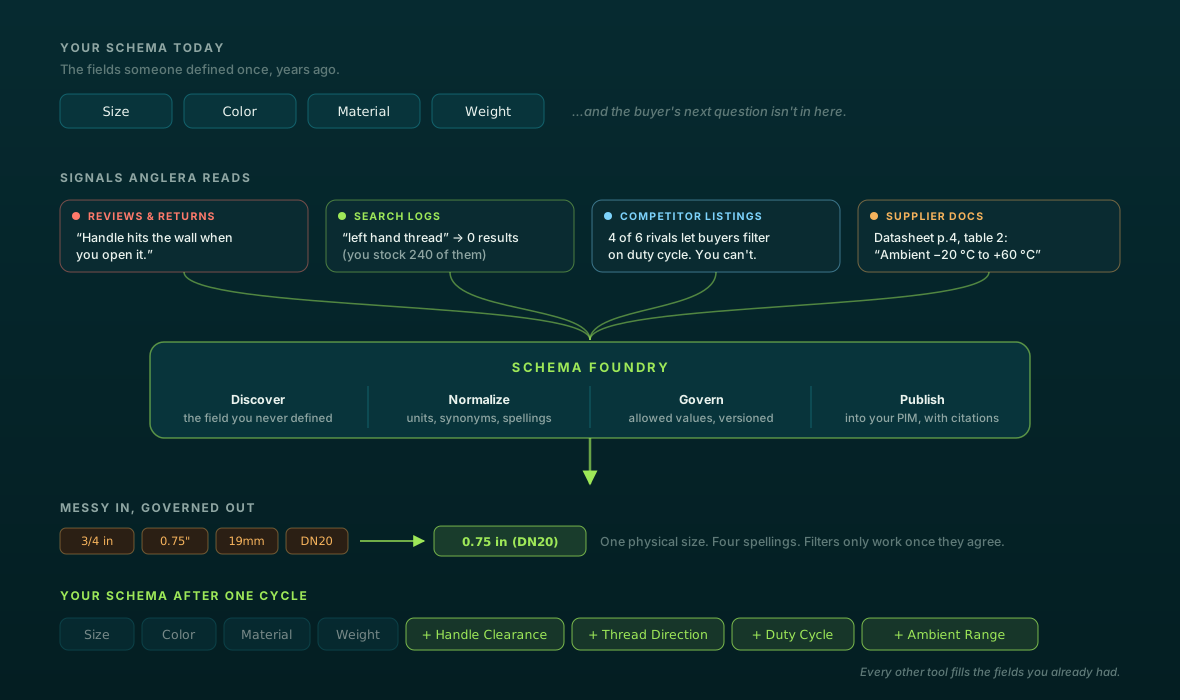
Filling the fields you defined has an invisible ceiling: a catalog can hit 100% complete and still miss the attribute that loses the sale, because completeness is measured against a schema someone drew years ago. Schema Foundry reads competitor listings, buyer searches, review complaints and your supplier docs, and proposes the fields you never defined — which is where Stylitics stops.

How Schema Foundry works
Schema Foundry: signals from reviews, search logs, competitor listings and supplier documents reveal attributes missing from your schema; the Foundry discovers, normalizes and governs them, so your schema ends the cycle with more fields than it started with.

What Stylitics does

Stylitics is a retail AI platform for apparel and fashion brands, best known for AI outfitting and bundling ("Shop the Look," "Complete the Look") that lifts AOV on PDPs. It also sells Catalog Enrichment, which runs proprietary computer vision over product imagery plus vendor metadata to fill missing attributes and generate descriptions, and AI Image Studio, which generates photoreal on-model shots and colorway swaps from flat-lay assets. Strata is its data infrastructure for classification and taxonomy mapping. It says it enriches 800+ catalogs daily, pairing multiple AI models with hallucination detection and human retail specialists.

Pricing: Undisclosed. No public list prices or tiers. Pricing is "customized to your catalog size, channels, and business goals" and usage-based: "Pricing scales with your catalog and activations." Quote-only via demo; G2 and Capterra list no pricing either. Timelines conflict — the homepage claims "45 days from contract to production," the pricing page says "most customers go live in under 2 weeks."

Stylitics website

When Stylitics is the right call

Fashion and apparel retailers who want outfitting, styling, and studio-grade on-model imagery alongside enrichment, and whose key attributes are genuinely visible in a product photo.

We'd rather tell you here than in month three of an implementation.

Capability verdicts reviewed against Stylitics's public documentation on July 14, 2026. Vendors ship quickly — if something here is out of date, tell us and we'll correct it.

See it on your own SKUs.

Bring one category and your supplier files. In 30 minutes you'll see it enriched — complete, structured, and consistent enough to launch on — plus the attributes your schema didn't have yet.

Book a demo