All comparisons
An alternative to TransForm SolutionsOffshore & BPO services

Anglera vs TransForm Solutions

The bottom line

Buy TransForm if you need people inside your systems doing catalog work you can't specify in advance; buy Anglera if you want that work to stop recurring — enrichment driven by buyer and market signals, cited and re-run automatically.

Both claim to enrich product data. This page is about where that claim stops.

The frame for this comparison

Product data is a practice, not a project.

Product data is a practice, not a project — and with a staffed offshore delivery model the work runs against a definition of what "done" means for each field, while the practice is everything that happens in the interval, when marketplaces, suppliers, and buyers quietly change the questions that definition was written to answer.

01

Ground it

Mine every spec from every source.

Every value traced to a document you can open. The catalog is only as honest as what it was built from.

02

Align it

Aim the catalog at the buyer who actually buys.

Grounded data still loses if it answers questions nobody asked. Alignment is what turns specs into conversion.

03

Keep it alive

Product data is a practice, not a project.

Markets move, suppliers reissue, buyers change what they ask for. A catalog that is right in March is wrong by August unless something is watching.
Capability by capability

Where TransForm Solutions stops.

Scored against public documentation. Grouped by the three acts — so you can see which ones TransForm Solutions leaves on your desk.

01

Ground it

Mine every spec from every source.
Source mining
Where does it get specs from?
TransForm SolutionsYes

Staff key specs from documents, images, video, websites

AngleraYes

PDFs, spec tables, drawings, manuals, images, sites

Schema discovery
Does it find attributes that aren't in your schema yet?
TransForm SolutionsNo

Fills client-defined fields; no new attribute proposals

AngleraYes

Proposes fields your schema never had

Governed vocabulary
Does it turn messy free-text into a governed pick list?
TransForm SolutionsLimited

Human cleansing and enrichment; no versioned governed value sets

AngleraYes

Normalizes and governs allowed values, versioned

Taxonomy & classification
Can it classify every SKU into your hierarchy?
TransForm SolutionsYes

Category mapping and marketplace listing performed by staff

AngleraYes

Auto-classifies; channel and marketplace mapping

Citations & provenance
Can you see where any given value came from?
TransForm SolutionsNo

No value-level source citations documented; ISO process controls only

AngleraYes

Every value cites its source doc and page

02

Align it

Aim the catalog at the buyer who actually buys.
Buyer personas
Is the content written for your buyer, or generically?
TransForm SolutionsNo

No persona-specific attribute or language variants documented

AngleraYes

B2B specifier and B2C shopper enriched differently

Review, search & social signals
Does it learn what buyers ask from the live market?
TransForm SolutionsLimited

Competitor and review monitoring sold as separate research deliverables

AngleraYes

Reviews, search, competitor rails, social — fed back

Copy & SEO
Does it write original, channel-ready copy?
TransForm SolutionsYes

Description writing and editing listed as core service

AngleraYes

Original copy per persona and channel

Product imagery
Can it produce usable images for SKUs that lack them?
TransForm SolutionsLimited

Background removal, retouching, cropping; no image generation

AngleraYes

Generates studio-grade imagery for photoless SKUs

03

Keep it alive

Product data is a practice, not a project.
Continuous re-enrichment
What happens when the market moves after go-live?
TransForm SolutionsLimited

Ongoing staffed upkeep; re-enrichment is human-scheduled, not autonomous

AngleraYes

Re-enriches on its own after go-live

Quality scoring
Does it score its own output and track catalog health?
TransForm SolutionsLimited

Cites 99.5% QA accuracy; no catalog health dashboard

AngleraYes

Scored against your standards; nothing publishes below bar

Write-back
Does enriched data land back in your system of record?
TransForm SolutionsYes

Teams work directly inside client commerce and order systems

AngleraYes

Writes back to PIM, ERP, warehouse, commerce

API, MCP & webhooks
Can your own tools and agents drive it headlessly?
TransForm SolutionsNo

Services firm; no public API, webhooks, or MCP

AngleraYes

API, webhooks, and MCP servers

Who does the work
Does it do the work, or help your team do it?
TransForm SolutionsYes

Their dedicated offshore staff do the work, not software

AngleraYes

Anglera owns the work; review is a guardrail

KeyYesships itLimitedlimited or gatedYour teamyour team still does itNodoesn't do itAnglera differentiator
What “buyer signals” actually means

Six signals sitting in your market right now.

“Buyer signals” is the emptiest phrase in this category, so here is the literal thing. Each of these is an observation from a live market, the gap it exposes, and the field that gets created as a result.

Supplier signal·Manufacturer spec sheet, revision B, emailed to purchasing

The reissued LM-80 data for a 150W LED high bay reads "L80 at 60,000 h, 25 °C ambient." The listing still says "50,000 hour lifespan," which is what the previous revision implied. Both numbers are defensible. Only one is current.

Lifespan is carried as a marketing sentence rather than a rated measurement with a maintenance threshold and a test ambient. When the supplier revises, nothing in the catalog knows anything changed.

Field createdlumen_maintenance_rating — threshold plus rated hours plus test ambient, sourced to the spec revision it came fromL70 | L80 | L90, paired with rated_hours (integer) and test_ambient (25 °C | 55 °C | 85 °C)
Marketplace signal·Category attribute report in the marketplace seller dashboard

Nitrile exam gloves flag for a missing "thickness at fingertip (mil)." The catalog carries one thickness — 4 mil — copied off the box, which is the palm figure. Fingertip runs thicker, cuff thinner.

One number is doing the work of three measurement points. The listing passes the format check and still answers the buyer's actual question wrong.

Field createdglove_thickness_mil, recorded separately at fingertip, palm, and cuffmeasurement_point: fingertip | palm | cuff; value in mil to one decimal
Review signal·Product reviews, read alongside the return reason codes on the same SKU

Reviews on a 60-inch stainless steel kitchen prep table keep landing on one sentence: "shipped knocked down in two cartons, legs bolt on, went through a 30-inch doorway." The return reasons are that sentence inverted — "wouldn't fit through the door."

The page publishes assembled dimensions. The purchase decision is being made on carton count and whether the thing goes through the door in pieces.

Field createdassembly_format, with carton_count and per-carton shipping dimensionsfully_assembled | legs_attach_by_hand | bolt_together_knock_down | modular_sections
Why catalogs rot

The spec is a snapshot. The catalog isn't.

TRANSFORM's catalog line is built around the recurring motion — "the constant additions, updations and deletions in your product catalogs," plus "routine hygiene checks of the product catalog, along with cleanup and maintenance" — delivered by dedicated teams working inside the platform you already run (WooCommerce, Magento, Shopify, BigCommerce). Their own catalog case study describes AI handling initial product data structuring and marketplace attribute mapping while trained personnel verify critical information fields. Verification presumes a definition of critical: which fields, which formats, which judgment calls. Catalogs rot against that definition. A marketplace adds a required attribute in March. A supplier reissues a spec sheet with a different lumen maintenance rating. Buyers start filtering on a field nobody defined. None of it arrives as a ticket. It arrives as slow divergence between work executed faithfully and the questions the catalog is now being asked. The rot is the time between noticing and re-running.

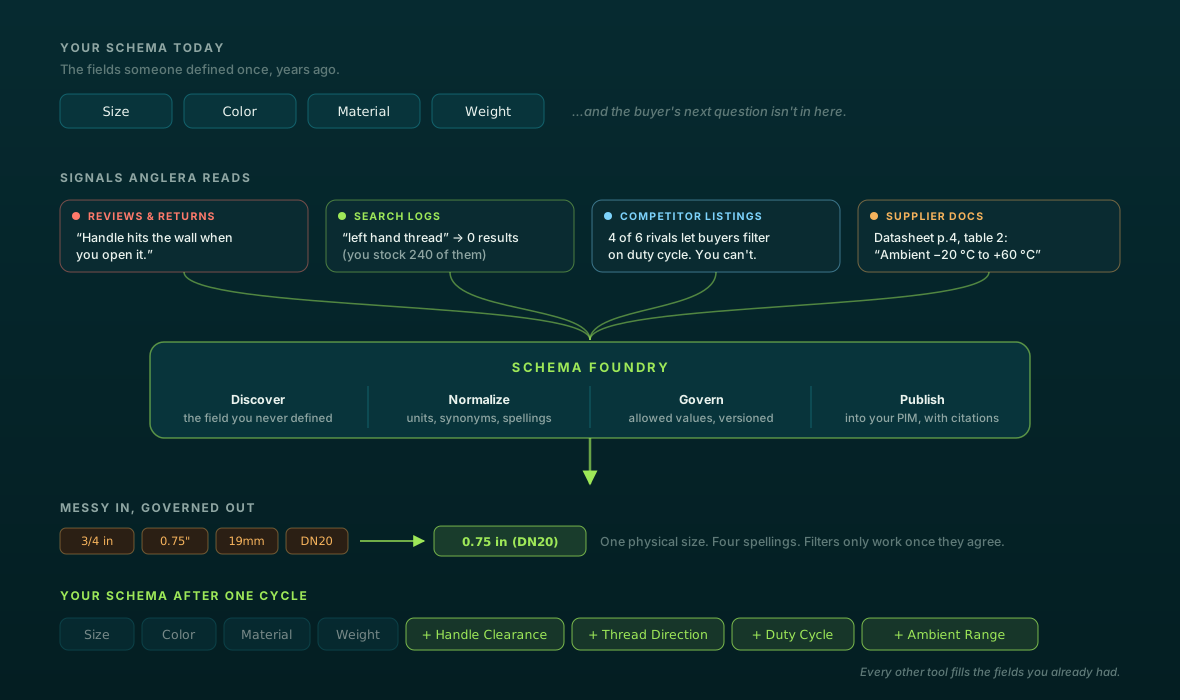
Messy in, governed out.

Values are normalized into a governed, versioned set of allowed values — so a filter works, and keeps working after the next import.

Nominal Size
3/4 in0.75"3/4"19mm3/4 inchDN20
0.75 in (DN20)

Six suppliers, six spellings, one physical size. Filters only work once they agree.

Finish
BlkblackBLACK MATTEMatte BlkRAL 9005
Black — Matte

Free text makes a colour filter useless. A governed value makes it a facet.

Material
SS316316 StainlessStainless Steel 316A4 Stainless
Stainless Steel — 316 / A4

Same alloy, four vocabularies, plus a trade name. Buyers search all of them.

And the part nobody else does

We don't just fill the template you handed us.

Filling the fields you defined has an invisible ceiling: a catalog can hit 100% complete and still miss the attribute that loses the sale, because completeness is measured against a schema someone drew years ago. Schema Foundry reads competitor listings, buyer searches, review complaints and your supplier docs, and proposes the fields you never defined — which is where TransForm Solutions stops.

How Schema Foundry works
Schema Foundry: signals from reviews, search logs, competitor listings and supplier documents reveal attributes missing from your schema; the Foundry discovers, normalizes and governs them, so your schema ends the cycle with more fields than it started with.

What TransForm Solutions does

TRANSFORM Solutions is an India-based BPO and business process outsourcing firm with 20+ years in operation, providing manual product data entry, eCommerce catalog management, data annotation, and back-office data processing services to global clients ranging from SMBs to Fortune 500 companies.

TransForm Solutions website

When TransForm Solutions is the right call

Teams with messy, judgment-heavy catalog work and no appetite to define it — TransForm's staff extract specs, map categories, write descriptions, and work directly in your commerce systems.

We'd rather tell you here than in month three of an implementation.

Capability verdicts reviewed against TransForm Solutions's public documentation on July 14, 2026. Vendors ship quickly — if something here is out of date, tell us and we'll correct it.

See it on your own SKUs.

Bring one category and your supplier files. In 30 minutes you'll see it enriched — complete, structured, and consistent enough to launch on — plus the attributes your schema didn't have yet.

Book a demo