All comparisons
An alternative to TrustanaPIM platforms

Anglera vs Trustana

The bottom line

Buy Trustana if you want their repository to become your source of truth. Buy Anglera if you already run Akeneo, Salsify, or inRiver and want enrichment written back into it — live in about 30 days.

Both claim to enrich product data. This page is about where that claim stops.

The frame for this comparison

Product data is a practice, not a project.

Trustana and Anglera both work next to the system of record — Unify ingests from ERPs, PIMs, supplier feeds, PDFs and images, and Trustana's documented enrichment runs include re-enrichment controls like overwriting previously AI-filled values, re-enriching on category change, and removing attributes that no longer apply — so the comparison isn't whether a catalogue ever gets re-touched, it's what triggers the next pass: an operator bulk-selecting products in the grid, or a standing read of demand-side signals that re-opens the schema before anyone thinks to look.

01

Ground it

Mine every spec from every source.

Every value traced to a document you can open. The catalog is only as honest as what it was built from.

02

Align it

Aim the catalog at the buyer who actually buys.

Grounded data still loses if it answers questions nobody asked. Alignment is what turns specs into conversion.

03

Keep it alive

Product data is a practice, not a project.

Markets move, suppliers reissue, buyers change what they ask for. A catalog that is right in March is wrong by August unless something is watching.
Capability by capability

Where Trustana stops.

Scored against public documentation. Grouped by the three acts — so you can see which ones Trustana leaves on your desk.

01

Ground it

Mine every spec from every source.
Source mining
Where does it get specs from?
TrustanaYes

PDF catalogs, spec sheets, manuals, images, supplier sites

AngleraYes

PDFs, spec tables, drawings, manuals, images, sites

Schema discovery
Does it find attributes that aren't in your schema yet?
TrustanaNo

Fills defined and library attributes; proposes no new fields

AngleraYes

Proposes fields your schema never had

Governed vocabulary
Does it turn messy free-text into a governed pick list?
TrustanaLimited

Standardizes naming, formats, value rules; versioning unclear

AngleraYes

Normalizes and governs allowed values, versioned

Taxonomy & classification
Can it classify every SKU into your hierarchy?
TrustanaYes

100+ category taxonomies, category trees, channel export templates

AngleraYes

Auto-classifies; channel and marketplace mapping

Citations & provenance
Can you see where any given value came from?
TrustanaYes

Explainability layers show source type and source file/link

AngleraYes

Every value cites its source doc and page

02

Align it

Aim the catalog at the buyer who actually buys.
Buyer personas
Is the content written for your buyer, or generically?
TrustanaNo

Channel and tone rules; no persona-specific enrichment

AngleraYes

B2B specifier and B2C shopper enriched differently

Review, search & social signals
Does it learn what buyers ask from the live market?
TrustanaLimited

Conversion and feed signals loop back; no review/search mining

AngleraYes

Reviews, search, competitor rails, social — fed back

Copy & SEO
Does it write original, channel-ready copy?
TrustanaYes

Titles, descriptions, SEO metadata, FAQs, pros/cons

AngleraYes

Original copy per persona and channel

Product imagery
Can it produce usable images for SKUs that lack them?
TrustanaYes

Generates gap-fill visuals; background removal, upscaling, resizing

AngleraYes

Generates studio-grade imagery for photoless SKUs

03

Keep it alive

Product data is a practice, not a project.
Continuous re-enrichment
What happens when the market moves after go-live?
TrustanaYour team

User-triggered enrichment runs with approval and rejection gates

AngleraYes

Re-enriches on its own after go-live

Quality scoring
Does it score its own output and track catalog health?
TrustanaYes

Channel readiness scores, missing fields, fill-rate tracking

AngleraYes

Scored against your standards; nothing publishes below bar

Write-back
Does enriched data land back in your system of record?
TrustanaYes

API export and syndication to commerce platforms, internal systems

AngleraYes

Writes back to PIM, ERP, warehouse, commerce

API, MCP & webhooks
Can your own tools and agents drive it headlessly?
TrustanaYes

Public API and webhooks documented; no MCP server found

AngleraYes

API, webhooks, and MCP servers

Who does the work
Does it do the work, or help your team do it?
TrustanaYour team

Software; customer team reviews and approves enriched data

AngleraYes

Anglera owns the work; review is a guardrail

KeyYesships itLimitedlimited or gatedYour teamyour team still does itNodoesn't do itAnglera differentiator
What “buyer signals” actually means

Six signals sitting in your market right now.

“Buyer signals” is the emptiest phrase in this category, so here is the literal thing. Each of these is an observation from a live market, the gap it exposes, and the field that gets created as a result.

Review signal·Product reviews on the retailer's own PDP

"Bought this 1/2" impact wrench for the 5.0Ah pack I already own. Wouldn't seat — turns out mine's the older slim-post 20V, not the newer one. Sending it back."

Battery platform lives in the marketing copy ("part of the 20V family") but isn't a field, so two mechanically incompatible packs share a voltage and read as interchangeable. The returns get coded as defective rather than wrong fit.

Field createdbattery_platform — single-select, required on every cordless tool and bare-tool SKUGoverned platform names taken from the manufacturer's own naming, one value per mechanical interface, never merged on voltage alone. Bare-tool SKUs additionally carry compatible_pack_series[].
Search signal·Internal site search logs on an electrical distributor's catalogue

"din rail 35mm", "din mount contactor", "ts35 power supply", "can this go on a rail" — a steady weekly stream of sessions, most ending on the category page with no product click

Mounting method exists only inside the datasheet PDF and occasionally in the description. Buyers are filtering on a panel-build constraint the faceted nav can't answer, so they leave and buy from whoever exposes it.

Field createdmounting_method — multi-select, since a unit can be both rail- and panel-mountable — plus rail_standard where applicableDIN rail (TS35 / 35mm) | DIN rail (TS15 / G32) | Panel / surface mount | Flush / cut-out mount | 19" rack | Free-standing. "Snap-on", "top-hat" and "symmetric rail" all normalise to TS35.
Marketplace signal·Feed processing report from a grocery marketplace's nightly validation

"Offers suppressed: allergen_information required. Ingredient string contains advisory text ('may contain traces of peanut') — advisory statements are not accepted in this field."

The supplier PDF states two different things — what's in the recipe, and what the production line risks — and both were read into one free-text ingredients blob. The field shows populated and green while the offers sit dark.

Field createdallergen_contains[] and allergen_advisory[] — two separate governed multi-selects, read from the label panel rather than the ingredient stringThe 14 regulated allergen groups as a closed value set: cereals containing gluten, crustaceans, eggs, fish, peanuts, soybeans, milk, nuts, celery, mustard, sesame, sulphur dioxide/sulphites, lupin, molluscs. "Soya" / "soy" / "soja" → Soybeans. Advisory phrasing ("may contain", "produced on a line that also handles") maps to allergen_advisory only, never to allergen_contains.
Why catalogs rot

The rot next to a PIM isn't bad data — it's data that was right once

Working alongside a PIM, catalogues rarely rot by breaking. They rot by aging. A supplier reissues a spec sheet and the rated input moves from 45W to 60W. A channel adds a required recycled-content field. Merchandising re-maps 3,000 SKUs from *Cables* to *Charging Accessories*, and a third of the attributes that were relevant no longer are. The PIM faithfully stores the old value with its old timestamp and its old provenance. Nothing errors. The listing just quietly stops matching what's in the box. Meanwhile the demand side keeps moving — search queries, return comments, feed validation rules — and none of it reaches the schema unless someone is reading it. A completion pass is accurate the day it lands and decays from there. The job is standing, not scheduled.

Messy in, governed out.

Values are normalized into a governed, versioned set of allowed values — so a filter works, and keeps working after the next import.

Nominal Size
3/4 in0.75"3/4"19mm3/4 inchDN20
0.75 in (DN20)

Six suppliers, six spellings, one physical size. Filters only work once they agree.

Finish
BlkblackBLACK MATTEMatte BlkRAL 9005
Black — Matte

Free text makes a colour filter useless. A governed value makes it a facet.

Material
SS316316 StainlessStainless Steel 316A4 Stainless
Stainless Steel — 316 / A4

Same alloy, four vocabularies, plus a trade name. Buyers search all of them.

And the part nobody else does

We don't just fill the template you handed us.

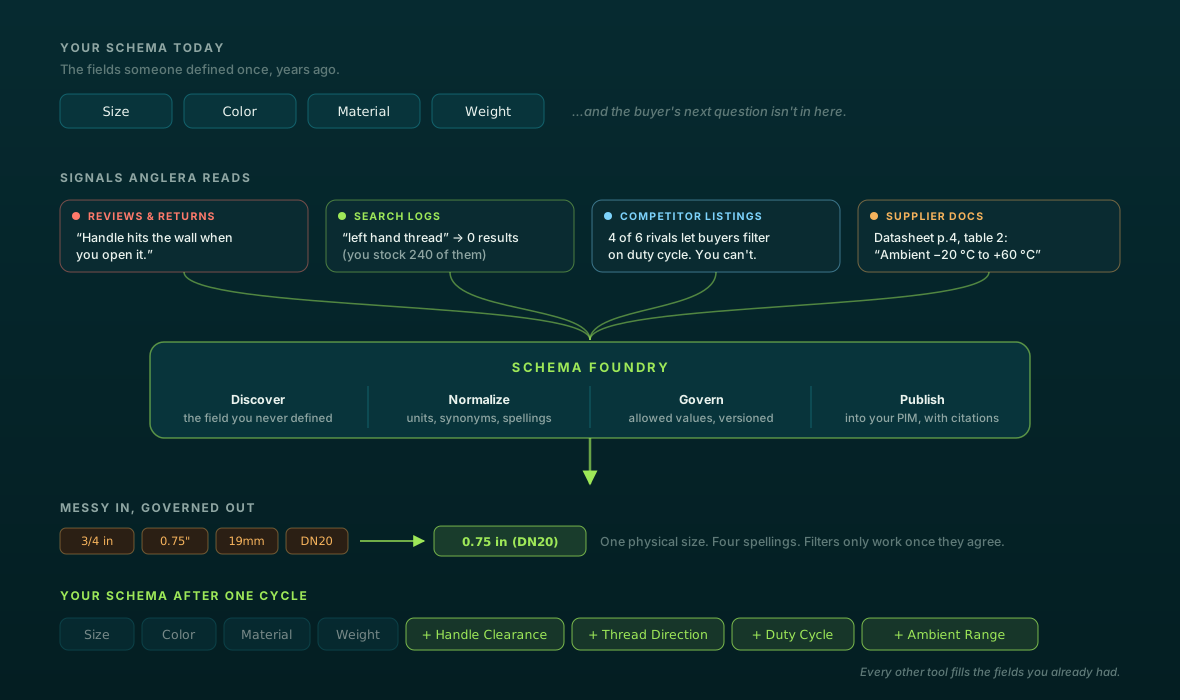
Filling the fields you defined has an invisible ceiling: a catalog can hit 100% complete and still miss the attribute that loses the sale, because completeness is measured against a schema someone drew years ago. Schema Foundry reads competitor listings, buyer searches, review complaints and your supplier docs, and proposes the fields you never defined — which is where Trustana stops.

How Schema Foundry works
Schema Foundry: signals from reviews, search logs, competitor listings and supplier documents reveal attributes missing from your schema; the Foundry discovers, normalizes and governs them, so your schema ends the cycle with more fields than it started with.

What Trustana does

Trustana is a Singapore-based, Temasek-seeded AI-native product data platform, founded in 2020, that automates product data operations from onboarding through enrichment to syndication. Its three modules, Unify, Enrich, and Activate, consolidate data from ERPs, PIMs, supplier feeds, PDFs, and images into a single source of truth, fill gaps with AI-generated attributes, specs, copy, and images, then publish to ecommerce channels via an open API. It targets mid-market and enterprise retailers, marketplaces, and distributors across categories like grocery, consumer electronics, hardware, industrials, and automotive parts.

Trustana website

When Trustana is the right call

Retailers and marketplaces consolidating ERP, PIM, and supplier feeds into one new repository, who want onboarding, enrichment, and channel syndication from a single AI-native vendor.

We'd rather tell you here than in month three of an implementation.

Capability verdicts reviewed against Trustana's public documentation on July 14, 2026. Vendors ship quickly — if something here is out of date, tell us and we'll correct it.

See it on your own SKUs.

Bring one category and your supplier files. In 30 minutes you'll see it enriched — complete, structured, and consistent enough to launch on — plus the attributes your schema didn't have yet.

Book a demo