All comparisons
An alternative to VelouAI enrichment tools

Anglera vs Velou

The bottom line

Buy Velou if your catalog is fashion or lifestyle and the missing data is visible in your own photos and copy — its vertical model is genuinely good there. Choose Anglera when specs live in supplier documents and values need citations.

Both claim to enrich product data. This page is about where that claim stops.

The frame for this comparison

Product data is a practice, not a project.

A first pass is the easy part: this comparison is about day 31 — when a supplier swaps a fabric, a shopper asks for a number no photograph contains, and someone has to decide whether last quarter's generated value is still true.

01

Ground it

Mine every spec from every source.

Every value traced to a document you can open. The catalog is only as honest as what it was built from.

02

Align it

Aim the catalog at the buyer who actually buys.

Grounded data still loses if it answers questions nobody asked. Alignment is what turns specs into conversion.

03

Keep it alive

Product data is a practice, not a project.

Markets move, suppliers reissue, buyers change what they ask for. A catalog that is right in March is wrong by August unless something is watching.
Capability by capability

Where Velou stops.

Scored against public documentation. Grouped by the three acts — so you can see which ones Velou leaves on your desk.

01

Ground it

Mine every spec from every source.
Source mining
Where does it get specs from?
VelouLimited

Reads product images and existing text; no document mining found

AngleraYes

PDFs, spec tables, drawings, manuals, images, sites

Schema discovery
Does it find attributes that aren't in your schema yet?
VelouLimited

Vertical model adds new metafields; not derived from market signals

AngleraYes

Proposes fields your schema never had

Governed vocabulary
Does it turn messy free-text into a governed pick list?
VelouLimited

Generates standardized tags; no versioned governed pick lists documented

AngleraYes

Normalizes and governs allowed values, versioned

Taxonomy & classification
Can it classify every SKU into your hierarchy?
VelouLimited

Variant clustering and product graph; channel category mapping undocumented

AngleraYes

Auto-classifies; channel and marketplace mapping

Citations & provenance
Can you see where any given value came from?
VelouNo

No value-level citation or lineage in docs or UI

AngleraYes

Every value cites its source doc and page

02

Align it

Aim the catalog at the buyer who actually buys.
Buyer personas
Is the content written for your buyer, or generically?
VelouNo

Vertical-tuned for retail; no B2B/B2C persona variants found

AngleraYes

B2B specifier and B2C shopper enriched differently

Review, search & social signals
Does it learn what buyers ask from the live market?
VelouLimited

Tracking API captures searches and clicks; enrichment loopback undocumented

AngleraYes

Reviews, search, competitor rails, social — fed back

Copy & SEO
Does it write original, channel-ready copy?
VelouYes

SEO descriptions, FAQs, alt text, fit and styling notes

AngleraYes

Original copy per persona and channel

Product imagery
Can it produce usable images for SKUs that lack them?
VelouNo

Analyzes product images; no image generation or editing

AngleraYes

Generates studio-grade imagery for photoless SKUs

03

Keep it alive

Product data is a practice, not a project.
Continuous re-enrichment
What happens when the market moves after go-live?
VelouLimited

Claims self-optimizing catalogs; Commerce-1 re-runs are operator-triggered

AngleraYes

Re-enriches on its own after go-live

Quality scoring
Does it score its own output and track catalog health?
VelouYes

AI Readiness Audit scores catalog against agent requirements

AngleraYes

Scored against your standards; nothing publishes below bar

Write-back
Does enriched data land back in your system of record?
VelouYes

Writes Shopify metafields directly; pushes to channels and feeds

AngleraYes

Writes back to PIM, ERP, warehouse, commerce

API, MCP & webhooks
Can your own tools and agents drive it headlessly?
VelouLimited

REST indexing and search APIs plus webhooks; no MCP server found

AngleraYes

API, webhooks, and MCP servers

Who does the work
Does it do the work, or help your team do it?
VelouYour team

Software; team reviews drafts and publishes to storefront

AngleraYes

Anglera owns the work; review is a guardrail

KeyYesships itLimitedlimited or gatedYour teamyour team still does itNodoesn't do itAnglera differentiator
What “buyer signals” actually means

Six signals sitting in your market right now.

“Buyer signals” is the emptiest phrase in this category, so here is the literal thing. Each of these is an observation from a live market, the gap it exposes, and the field that gets created as a result.

Review signal·reviews and return comments on your own product pages

Four reviews on one counter stool, same complaint: "ordered a pair, the seat sits 26 in off the floor and our island overhang is 25 in — knees don't fit." The listing says "counter height" and the hero shot is styled against a table.

"Counter height" is a class you can infer from a photo. The number that decides the purchase — seat height, and the clearance it leaves under an overhang — lives in the supplier's dimension sheet, not in the image or the copy. Until the number is a field, the class is a guess wearing a label.

Field createdseat_height_in — numeric, sourced from the supplier dimension sheet; height_class derived from it, never the other way roundDining (17–19 in) | Counter (24–27 in) | Bar (29–32 in) | Extra-tall (33–36 in) | Adjustable
Search signal·on-site search logs, specifically the zero-result and refine-then-abandon queries

Recurring queries with nothing behind them: "gold filled not plated", "nickel free hoops", "14k solid". The listings they should have matched say "gold-tone finish" and "18k gold look".

Composition is being described in the copy rather than governed as a field, so solid karat, gold-filled, vermeil and plated brass all collapse into the same marketing adjective — and nickel content, which is the reason a repeat buyer is searching at all, is never stated anywhere in the record.

Field createdmetal_composition (enum) plus nickel_content_declared (enum, taken from the supplier's material declaration, not inferred)metal_composition: Solid 10k | Solid 14k | Solid 18k | Gold-filled (1/20 14k) | Vermeil (925 sterling base, ≥2.5 µm gold) | Gold-plated (brass base) | Gold-tone (base metal unspecified). nickel_content_declared: Declared nickel-free | Contains nickel | Not declared
Supplier signal·the tech pack PDF attached to the purchase order, read next to the live product page

The outdoor cushion tech pack reads: "Face: 100% solution-dyed acrylic. Lightfastness 1,500 hrs (AATCC 16.3). Water repellency: 80 spray rating (AATCC 22)." The live page says "fade-resistant, water-repellent fabric."

The adjectives can be written from the description; the numbers cannot. They exist only in a PDF nobody parsed — and they are what answers the Phoenix-patio question, survives a warranty dispute, and lets a shopper choose between two cushions that both say "fade-resistant."

Field createdlightfastness_hours (integer) with test_method recorded beside it, plus face_fiber_content (enum) — extracted from the tech pack, with the source page kept as provenanceface_fiber_content: Solution-dyed acrylic | Solution-dyed olefin | Piece-dyed polyester | Cotton canvas | Unspecified. test_method: AATCC 16.3 | AATCC 16.1 | ISO 105-B02 | Not stated
Why catalogs rot

What rots after the first pass

Enrichment models read what's in front of them. Velou's stated method is to analyze raw text and imagery to generate missing attributes and tags (velou.com) — a real answer to a thin catalog, and a first pass is where the work starts, not where it ends. A supplier swaps the fabric on a colorway and the description never changes, so whatever was inferred from that description stays unchanged with it. A merchant hand-corrects a seat height; something has to remember that decision, or the next pass relitigates it. Six months in, if nobody can say which values came from a spec sheet and which were generated, nobody publishes a filter on them. Velou's blog draws the line itself: "waterproof" and "water penetration resistance: class 2 (EN 343:2019)" are not the same claim. Completeness is a rate you hold, not a number you hit.

Messy in, governed out.

Values are normalized into a governed, versioned set of allowed values — so a filter works, and keeps working after the next import.

Nominal Size
3/4 in0.75"3/4"19mm3/4 inchDN20
0.75 in (DN20)

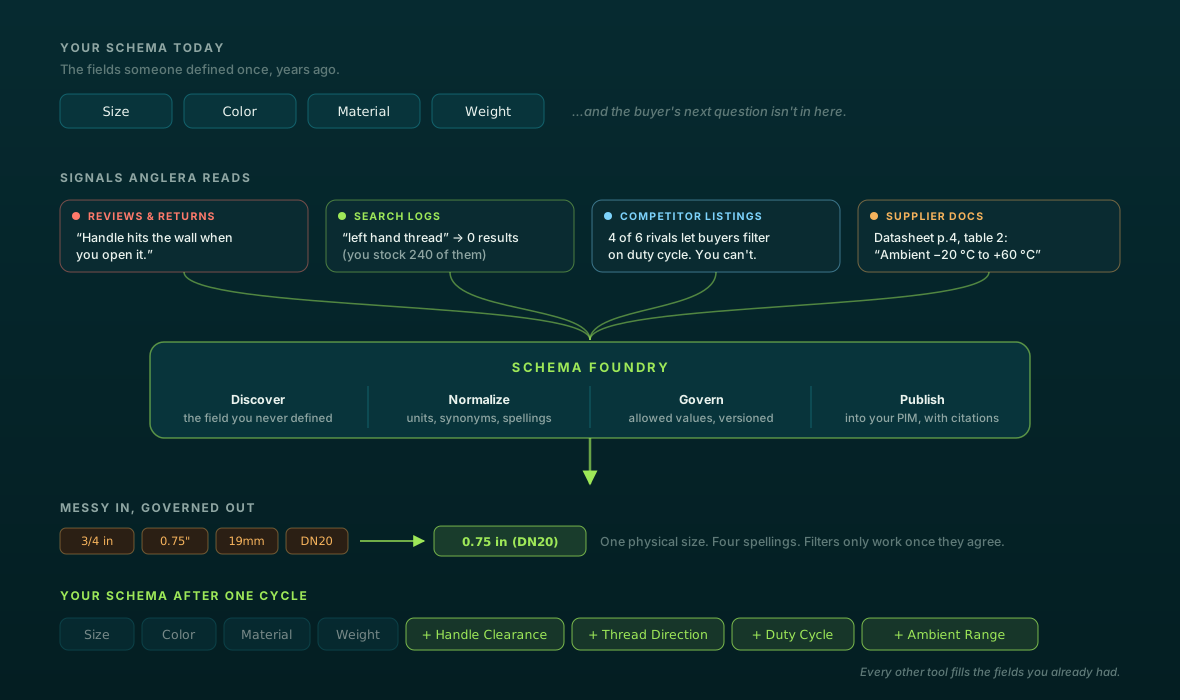
Six suppliers, six spellings, one physical size. Filters only work once they agree.

Finish
BlkblackBLACK MATTEMatte BlkRAL 9005
Black — Matte

Free text makes a colour filter useless. A governed value makes it a facet.

Material
SS316316 StainlessStainless Steel 316A4 Stainless
Stainless Steel — 316 / A4

Same alloy, four vocabularies, plus a trade name. Buyers search all of them.

And the part nobody else does

We don't just fill the template you handed us.

Filling the fields you defined has an invisible ceiling: a catalog can hit 100% complete and still miss the attribute that loses the sale, because completeness is measured against a schema someone drew years ago. Schema Foundry reads competitor listings, buyer searches, review complaints and your supplier docs, and proposes the fields you never defined — which is where Velou stops.

How Schema Foundry works
Schema Foundry: signals from reviews, search logs, competitor listings and supplier documents reveal attributes missing from your schema; the Foundry discovers, normalizes and governs them, so your schema ends the cycle with more fields than it started with.

What Velou does

Velou is a New York-based product data enrichment platform, founded in 2018, built around Commerce-1 — a retail-specific model it says was trained on 4 trillion tokens of retail text and imagery and refined with reinforcement learning from merchandisers. It reads existing product descriptions and product images to generate structured attributes, standardized tags, variant clusters, SEO copy, alt text, and FAQs, then writes them back into the customer's platform (Shopify metafields, feeds, channels). It also ships search and discovery APIs — search, suggestions, similarity, and Complete the Look — reflecting its origins as an AI site-search and catalog copilot product.

Pricing: Partially public. The Shopify app lists a free trial (10 products), Essentials at $99/month (500 products, 75K monthly visitors), and Growth at $250/month (3,000 products, 250K monthly visitors) — scaling on both SKU count and traffic. Beyond those tiers nothing is published: enterprise and non-Shopify deployments are quote-only via demo request, with no rate card or implementation fees disclosed.

Velou website

When Velou is the right call

Shopify fashion, jewelry, and home brands wanting fast, accurate attribute and metafield fill from existing photos and descriptions — plus site search, similarity, and Complete the Look in one vendor.

We'd rather tell you here than in month three of an implementation.

Capability verdicts reviewed against Velou's public documentation on July 14, 2026. Vendors ship quickly — if something here is out of date, tell us and we'll correct it.

See it on your own SKUs.

Bring one category and your supplier files. In 30 minutes you'll see it enriched — complete, structured, and consistent enough to launch on — plus the attributes your schema didn't have yet.

Book a demo