All comparisons
Works with VizitAI enrichment tools

Anglera + Vizit

The bottom line

Buy Vizit if you need to know which product image converts and why — it measures imagery but never makes any, so pair it with something that generates the assets and fills the attributes it doesn't touch.

Vizit and Anglera solve different halves of the problem — this page is about the seam between them.

The frame for this comparison

Product data is a practice, not a project.

Vizit's axis is the picture — proprietary content scores that predict how a brand's images and video will perform with a given audience, down to rearranging which shot leads the carousel; the practice question sits one layer down, in the attribute record under that image, and it comes back every week the pack changes, the retailer adds a required field, or a shopper needs a spec that only a field can carry.

01

Ground it

Mine every spec from every source.

Every value traced to a document you can open. The catalog is only as honest as what it was built from.

02

Align it

Aim the catalog at the buyer who actually buys.

Grounded data still loses if it answers questions nobody asked. Alignment is what turns specs into conversion.

03

Keep it alive

Product data is a practice, not a project.

Markets move, suppliers reissue, buyers change what they ask for. A catalog that is right in March is wrong by August unless something is watching.
Capability by capability

Where Vizit stops.

Scored against public documentation. Grouped by the three acts — so you can see which ones Vizit leaves on your desk.

01

Ground it

Mine every spec from every source.
Source mining
Where does it get specs from?
VizitNo

Reads images for visual cues, not spec documents

AngleraYes

PDFs, spec tables, drawings, manuals, images, sites

Schema discovery
Does it find attributes that aren't in your schema yet?
VizitNo

Scores existing imagery; proposes no new attributes

AngleraYes

Proposes fields your schema never had

Governed vocabulary
Does it turn messy free-text into a governed pick list?
VizitNo

Visual analytics only; no attribute value normalization

AngleraYes

Normalizes and governs allowed values, versioned

Taxonomy & classification
Can it classify every SKU into your hierarchy?
VizitNo

Category benchmarks for scoring; no SKU classification

AngleraYes

Auto-classifies; channel and marketplace mapping

Citations & provenance
Can you see where any given value came from?
VizitLimited

Explains score drivers via visual cues; no value citations

AngleraYes

Every value cites its source doc and page

02

Align it

Aim the catalog at the buyer who actually buys.
Buyer personas
Is the content written for your buyer, or generically?
VizitLimited

Audience Lens scores same image per consumer segment

AngleraYes

B2B specifier and B2C shopper enriched differently

Review, search & social signals
Does it learn what buyers ask from the live market?
VizitYes

Behavioral image data and competitor benchmarks feed recommendations

AngleraYes

Reviews, search, competitor rails, social — fed back

Copy & SEO
Does it write original, channel-ready copy?
VizitNo

Imagery only; no titles, descriptions, or bullets

AngleraYes

Original copy per persona and channel

Product imagery
Can it produce usable images for SKUs that lack them?
VizitNo

Scores and reorders existing images; generates none

AngleraYes

Generates studio-grade imagery for photoless SKUs

03

Keep it alive

Product data is a practice, not a project.
Continuous re-enrichment
What happens when the market moves after go-live?
VizitYes

Always-on monitoring; automated monthly benchmark updates

AngleraYes

Re-enriches on its own after go-live

Quality scoring
Does it score its own output and track catalog health?
VizitYes

Vizit Score is the core product; tracks over time

AngleraYes

Scored against your standards; nothing publishes below bar

Write-back
Does enriched data land back in your system of record?
VizitLimited

Salsify app reorders PDP carousel; no attribute writeback

AngleraYes

Writes back to PIM, ERP, warehouse, commerce

API, MCP & webhooks
Can your own tools and agents drive it headlessly?
VizitLimited

Salsify app integration; no public API docs found

AngleraYes

API, webhooks, and MCP servers

Who does the work
Does it do the work, or help your team do it?
VizitYour team

Software recommends; brand's team creates the content

AngleraYes

Anglera owns the work; review is a guardrail

KeyYesships itLimitedlimited or gatedYour teamyour team still does itNodoesn't do itAnglera differentiator
What “buyer signals” actually means

Six signals sitting in your market right now.

“Buyer signals” is the emptiest phrase in this category, so here is the literal thing. Each of these is an observation from a live market, the gap it exposes, and the field that gets created as a result.

Review signal·Marketplace reviews on a 12-cup drip coffee maker

"The carafe looks identical to the old model in every photo. Mine is glass, not thermal, and the coffee is cold in forty minutes. Nowhere on the page does it say which one you're getting."

Carafe type is visible in the imagery but is not a field, so it can't be filtered, compared, or syndicated — and two variants photograph the same.

Field createdcarafe_typeGlass / Thermal (vacuum-insulated stainless) / Ceramic
Marketplace signal·Grocery item-setup rejection report from a retailer feed

Item bounces with "Net Content and Net Content UOM required." The front of the pack reads 12 FL OZ; the record carries Size: 12 and a free-text pack description.

The measure exists on the label and in the photo, but the record has a number with no unit — the retailer needs the value and the UOM as separate governed fields.

Field creatednet_content_uomGS1 UOM codes: fl oz / mL / L / oz / lb / g / kg / ct
Search signal·Internal site search logs on a skincare category

"fragrance free moisturizer" is a top-20 query and returns 40 results. The claim appears on the tube in the hero image, and in copy as "unscented," "no added fragrance," and "fragrance-free" across three brands in the same category.

A purchase-deciding claim is carried by artwork and by prose in three spellings, so the facet can't be built and the query returns the whole category.

Field createdfragrance_statusFragrance-free / Unscented (masking fragrance present) / Lightly fragranced / Fragranced
Why catalogs rot

Vizit ranks the image; the record under it is separate work

Vizit grades pictures: content scores predict how images and video will perform for an audience, Audience Lens explains which visual elements are doing the work, and its Conversion Optimizer app in the Salsify PXM App Center can rearrange the visual content in a product carousel. That output is about the image. The attribute record beneath it is a different artifact, moving on its own clock. Pack art gets refreshed to 14 ct while the record still says 12. A claim lives only in the picture — fragrance-free printed on the tube, a UL mark on the base of the lamp — until someone writes it into a field, where it can be filtered, syndicated, and read by a model. Retailers gate item setup on attribute completeness, and the fields they add each quarter arrive with no image attached. Vizit ranks the photo. Keeping the record true to it is weekly work in a governed vocabulary.

Messy in, governed out.

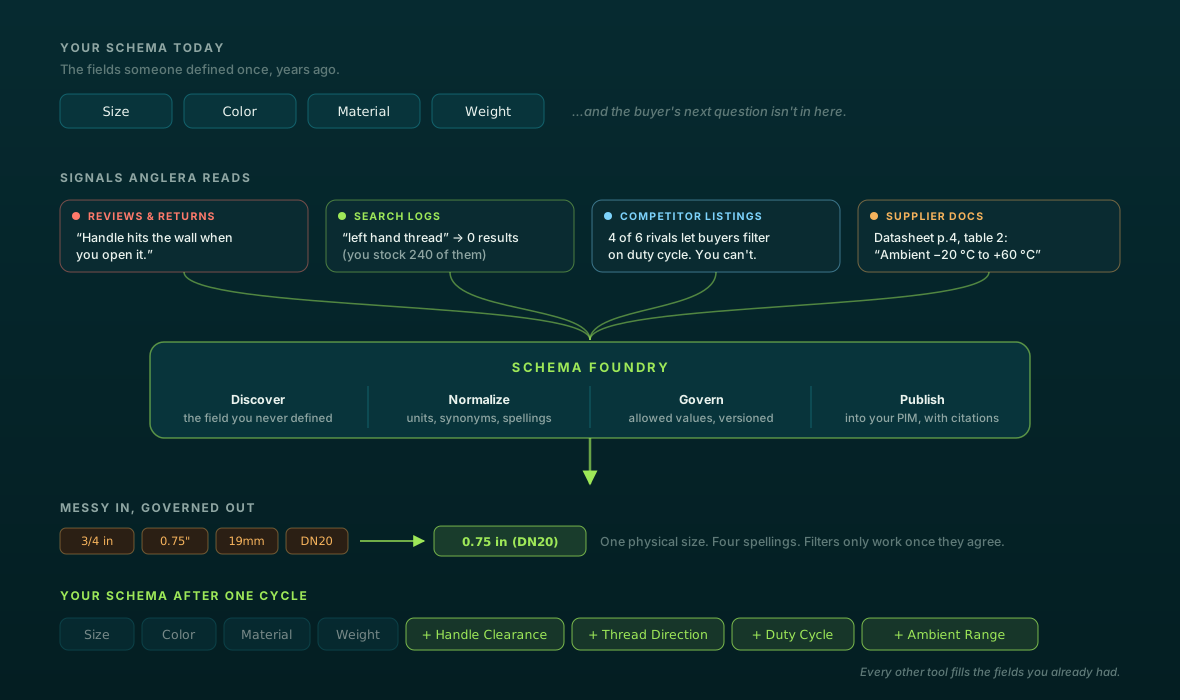
Values are normalized into a governed, versioned set of allowed values — so a filter works, and keeps working after the next import.

Nominal Size
3/4 in0.75"3/4"19mm3/4 inchDN20
0.75 in (DN20)

Six suppliers, six spellings, one physical size. Filters only work once they agree.

Finish
BlkblackBLACK MATTEMatte BlkRAL 9005
Black — Matte

Free text makes a colour filter useless. A governed value makes it a facet.

Material
SS316316 StainlessStainless Steel 316A4 Stainless
Stainless Steel — 316 / A4

Same alloy, four vocabularies, plus a trade name. Buyers search all of them.

And the part nobody else does

We don't just fill the template you handed us.

Filling the fields you defined has an invisible ceiling: a catalog can hit 100% complete and still miss the attribute that loses the sale, because completeness is measured against a schema someone drew years ago. Schema Foundry reads competitor listings, buyer searches, review complaints and your supplier docs, and proposes the fields you never defined — which is where Vizit stops.

How Schema Foundry works
Schema Foundry: signals from reviews, search logs, competitor listings and supplier documents reveal attributes missing from your schema; the Foundry discovers, normalizes and governs them, so your schema ends the cycle with more fields than it started with.

What Vizit does

Vizit is a Boston-based visual AI platform that predicts how product imagery will perform in ecommerce. Its patented models scan a stated 15,000+ visual cues per image and apply "Audience Lens" scoring — trained on online behavioral data rather than surveys — to predict how a given consumer demographic responds. Products include Vizit Score, PDP Visual Grader, always-on Content Effectiveness Monitoring, and a Conversion Optimizer app for Salsify that automatically reorders PDP carousel imagery. Publicly named customers include L'Oréal, Mars, Kimberly-Clark and Ghirardelli; it raised a $25M Series B led by Industry Ventures in October 2024.

Pricing: Not publicly disclosed. Vizit publishes no pricing page or tiers; all paths route to a demo request. The only public signal is a G2 reviewer noting that cost made it hard to justify as a global rollout across multiple markets, which points to enterprise contracts scaled by market or catalog scope. Treat any figure as unverified until quoted.

Vizit website

When Vizit is the right call

CPG and brand teams with a full creative pipeline already producing imagery, who need audience-specific evidence on which asset converts and how to order the PDP carousel.

We'd rather tell you here than in month three of an implementation.

Capability verdicts reviewed against Vizit's public documentation on July 14, 2026. Vendors ship quickly — if something here is out of date, tell us and we'll correct it.

See it on your own SKUs.

Bring one category and your supplier files. In 30 minutes you'll see it enriched — complete, structured, and consistent enough to launch on — plus the attributes your schema didn't have yet.

Book a demo