An alternative to Vserve Ebusiness SolutionsOffshore & BPO services
Anglera vs Vserve Ebusiness Solutions
The bottom line
Buy Vserve if you need people to do catalog work you can't systematize — 3D renders, marketplace-specific mapping, one-off cleanups. Buy Anglera if the enrichment never stops and you'd rather not pay hourly for it forever.
Both claim to enrich product data. This page is about where that claim stops.
The frame for this comparison
Product data is a practice, not a project.
Vserve is built to get source documents into fields correctly — trained people, an assigned program manager, KPIs, billed hourly — so the comparison worth having isn't about the keying, it's about what happens to a SKU once the document it was checked against has been superseded.
01
Ground it
Mine every spec from every source.
Every value traced to a document you can open. The catalog is only as honest as what it was built from.
02
Align it
Aim the catalog at the buyer who actually buys.
Grounded data still loses if it answers questions nobody asked. Alignment is what turns specs into conversion.
03
Keep it alive
Product data is a practice, not a project.
Markets move, suppliers reissue, buyers change what they ask for. A catalog that is right in March is wrong by August unless something is watching.
Capability by capability
Where Vserve Ebusiness Solutions stops.
Scored against public documentation. Grouped by the three acts — so you can see which ones Vserve Ebusiness Solutions leaves on your desk.
Does it find attributes that aren't in your schema yet?
Vserve Ebusiness SolutionsNo
Maps to existing schema; no new attribute discovery
AngleraYes
Proposes fields your schema never had
Governed vocabulary
Does it turn messy free-text into a governed pick list?
Vserve Ebusiness SolutionsLimited
Manual normalization and dedup; no versioned pick lists
AngleraYes
Normalizes and governs allowed values, versioned
Taxonomy & classification
Can it classify every SKU into your hierarchy?
Vserve Ebusiness SolutionsYes
Categorization plus marketplace-specific mapping, done by staff
AngleraYes
Auto-classifies; channel and marketplace mapping
Citations & provenance
Can you see where any given value came from?
Vserve Ebusiness SolutionsNo
Double-entry check against source; no value-level citations
AngleraYes
Every value cites its source doc and page
02
Align it
Aim the catalog at the buyer who actually buys.
CapabilityVserve Ebusiness SolutionsAnglera
Buyer personas
Is the content written for your buyer, or generically?
Vserve Ebusiness SolutionsNo
No persona-tailored enrichment; marketplace formatting only
AngleraYes
B2B specifier and B2C shopper enriched differently
Review, search & social signals
Does it learn what buyers ask from the live market?
Vserve Ebusiness SolutionsLimited
Separate SEO team does keyword, competitor research
AngleraYes
Reviews, search, competitor rails, social — fed back
Copy & SEO
Does it write original, channel-ready copy?
Vserve Ebusiness SolutionsYes
SEO-optimized titles and descriptions written by staff
AngleraYes
Original copy per persona and channel
Product imagery
Can it produce usable images for SKUs that lack them?
Vserve Ebusiness SolutionsYes
CGI and 3D product rendering studio; also editing
AngleraYes
Generates studio-grade imagery for photoless SKUs
03
Keep it alive
Product data is a practice, not a project.
CapabilityVserve Ebusiness SolutionsAnglera
Continuous re-enrichment
What happens when the market moves after go-live?
Vserve Ebusiness SolutionsLimited
Retained teams handle updates; not autonomous re-enrichment
AngleraYes
Re-enriches on its own after go-live
Quality scoring
Does it score its own output and track catalog health?
Vserve Ebusiness SolutionsLimited
Free one-time catalog audit against GS1 standards
AngleraYes
Scored against your standards; nothing publishes below bar
Write-back
Does enriched data land back in your system of record?
Vserve Ebusiness SolutionsYes
Staff enter data directly into client PIM, marketplaces
AngleraYes
Writes back to PIM, ERP, warehouse, commerce
API, MCP & webhooks
Can your own tools and agents drive it headlessly?
Vserve Ebusiness SolutionsNo
No public API, webhooks, or MCP found
AngleraYes
API, webhooks, and MCP servers
Who does the work
Does it do the work, or help your team do it?
Vserve Ebusiness SolutionsYes
Their offshore staff do the work; people, not software
AngleraYes
Anglera owns the work; review is a guardrail
KeyYesships itLimitedlimited or gatedYour teamyour team still does itNodoesn't do itAnglera differentiator
What “buyer signals” actually means
Six signals sitting in your market right now.
“Buyer signals” is the emptiest phrase in this category, so here is the literal thing. Each of these is an observation from a live market, the gap it exposes, and the field that gets created as a result.
Review signal·Q&A and review threads on the product page and the marketplace listing
On a 12-port docking station: "Listing says USB-C charging. It puts out 65W. My workstation laptop wants 100W and drops to trickle charge as soon as the dock is loaded."
"USB-C charging" arrives as a bullet, not a field. Power delivery wattage is per-port and it decides fitment, but it sits in prose — no facet reads it, no comparison table shows it, and the bullet is perfectly accurate against the spec sheet while the field it should populate does not exist.
Field createdusb_c_power_delivery_watts (per downstream port)Integer watts from the USB-PD ladder — 15, 27, 30, 45, 60, 65, 90, 100, 140 — with "Data only" as an explicit value for non-charging ports rather than a blank.
Search signal·Internal site search logs, including the zero-result report
The lighting category shows repeat queries for "0-10v dimmable high bay", "1-10v led high bay 5000k" and "dali high bay", all returning near-nothing — while the fixtures are in stock and their drivers are named on the datasheets.
Dimming protocol reached the catalog as a phrase in the description ("dimmable driver included"), so the facet doesn't exist. A specifier who knows the protocol reads the empty result as "they don't carry it" and leaves.
Field createddimming_protocol0-10V | 1-10V | TRIAC (forward phase) | ELV (reverse phase) | DALI-2 | DMX512 | PWM | Non-dimmable — 0-10V and 1-10V held distinct, never merged into "low voltage dimming".
Marketplace signal·Walmart and eBay listing quality / item specifics reports
A block of automotive halogen bulbs is flagged incomplete: Bulb Base Type empty. The base code is in every title — "H11 55W Low Beam, 2-Pack" — and printed on the box, but not in the field the vehicle fitment filter reads.
Title text is not an attribute. The SKUs are live and technically accurate, and they are still invisible to every shopper who filters by vehicle instead of typing. The failure shows up as absence, not as an error anyone could catch by checking the entry against a source document.
Field createdbulb_base_typeClosed list of ANSI/ECE base codes: H1, H3, H4, H7, H8, H9, H11, H11B, H13, 9004, 9005, 9006, 9007, D1S, D2S, D2R, D3S, D4S — H11B kept separate from H11, since the connector differs.
Why catalogs rot
What the second pair of eyes is checking against
Vserve describes its quality mechanism directly: "dual-layer human validation checks, where one expert enters the data and another verifies it against the source document." That is built to answer one question well — does the field match the document.
Two others sit outside that check. The source moves: a supplier reissues a datasheet with a revised IP rating, a marketplace makes an item spec required, and a SKU that matched its document in March no longer matches in July. Nothing was mis-typed. The source is also silent: when a spec sheet never states duty cycle, a check against that sheet confirms an empty field. It was never wrong. It was never proposed.
Vserve names a "Hybrid Human + Technology Model" alongside the human layer. Anglera works the interval: watch for drift, propose the missing field, fill it, keep it filled.
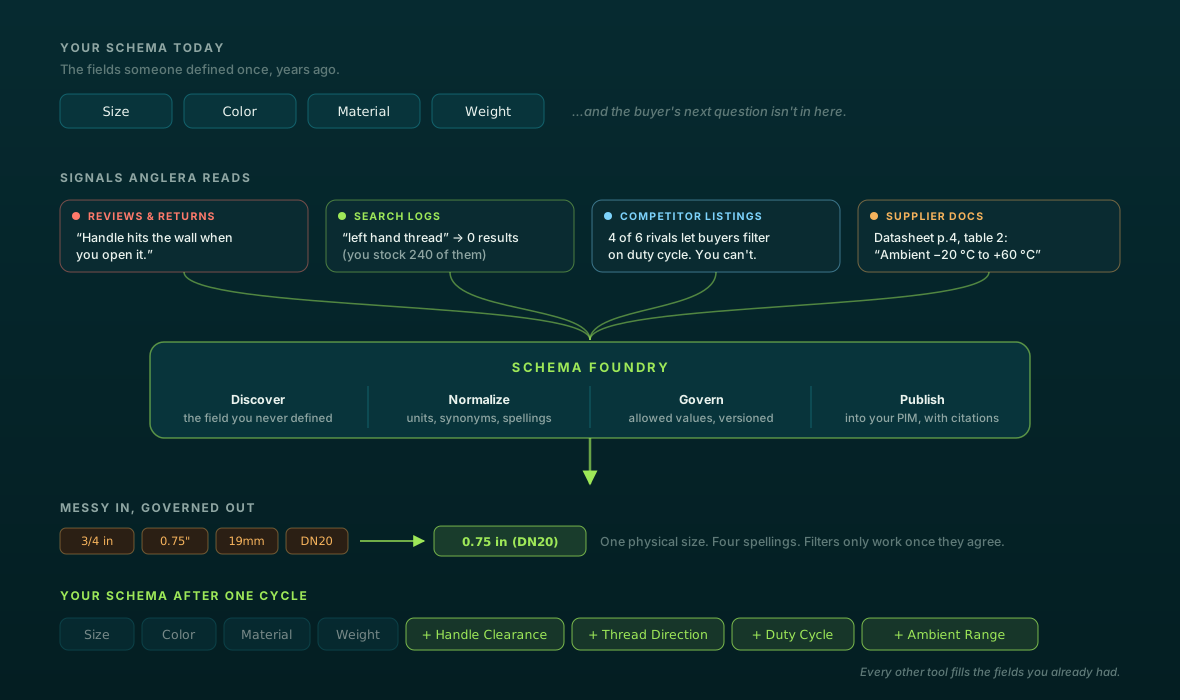
Messy in, governed out.
Values are normalized into a governed, versioned set of allowed values — so a filter works, and keeps working after the next import.
Nominal Size
3/4 in0.75"3/4"19mm3/4 inchDN20
0.75 in (DN20)
Six suppliers, six spellings, one physical size. Filters only work once they agree.
Finish
BlkblackBLACK MATTEMatte BlkRAL 9005
Black — Matte
Free text makes a colour filter useless. A governed value makes it a facet.
Material
SS316316 StainlessStainless Steel 316A4 Stainless
Stainless Steel — 316 / A4
Same alloy, four vocabularies, plus a trade name. Buyers search all of them.
And the part nobody else does
We don't just fill the template you handed us.
Filling the fields you defined has an invisible ceiling: a catalog can hit 100% complete and still miss the attribute that loses the sale, because completeness is measured against a schema someone drew years ago. Schema Foundry reads competitor listings, buyer searches, review complaints and your supplier docs, and proposes the fields you never defined — which is where Vserve Ebusiness Solutions stops.
Vserve Ebusiness Solutions is an India-based offshore BPO that manually enriches product catalogs, manages data entry, cleans and standardizes SKUs, and handles ecommerce catalog processing for B2B and B2C clients. They have 15+ years of experience and charge $6–$20/hour for human-labor-driven catalog work.
Pricing: $6–$20/hour (hourly offshore labor model; no public per-SKU or SaaS pricing)
Teams needing human hands on messy, judgment-heavy catalog work: print catalogs and scans, CGI/3D product rendering, marketplace-by-marketplace mapping, or a one-time GS1 audit.
We'd rather tell you here than in month three of an implementation.
Capability verdicts reviewed against Vserve Ebusiness Solutions's public documentation on July 14, 2026. Vendors ship quickly — if something here is out of date, tell us and we'll correct it.
See it on your own SKUs.
Bring one category and your supplier files. In 30 minutes you'll see it enriched — complete, structured, and consistent enough to launch on — plus the attributes your schema didn't have yet.