Contentserv vs Plytix: Which PIM Fits Your Business?
Contentserv and Plytix are both all-in-one product content platforms — PIM, DAM, and syndication under one roof — but they are aimed at very different buyers. Contentserv (now branded Centric PXM) is an enterprise-grade PXM suite built for fashion, lifestyle, luxury, and consumer goods companies that need governed, multi-locale product experiences at scale, with digital shelf analytics included. Plytix is purpose-built for small and mid-sized businesses: unlimited users, a freemium entry point, and built-in AI that generates and translates product descriptions without a dedicated copywriting team.
These two platforms rarely compete head-to-head in a single RFP. When they do, the question is almost always about organizational scale: are you a growing SMB that needs to get running in weeks on a manageable budget, or an enterprise that needs the governance, rich media depth, and analytics horsepower to manage a complex multi-channel catalog across multiple markets? The answer shapes almost every dimension of the comparison below.
Neither platform, however, solves the same upstream problem. Both Contentserv and Plytix assume you arrive with reasonably complete product data and a team ready to author or approve content. In practice, SKUs come from suppliers as raw specs, thin descriptions, and copy written for the factory floor. Whichever platform you choose, the incoming data still needs work before it is genuinely buyer-ready.
| Contentserv | Plytix | Anglera | |
|---|---|---|---|
| Target market | Enterprise and upper mid-market — fashion, lifestyle, luxury, and consumer goods companies that need governed, multi-channel product experiences at scale with dedicated IT and data teams | Small and mid-sized businesses — ecommerce brands, DTC sellers, and growing retailers that need a practical all-in-one tool without enterprise contract overhead or long onboarding | Works alongside either platform — ~30-day implementation that layers enrichment on top of whichever PIM the team already runs, regardless of company size |
| Pricing & entry cost | Subscription-based across Starter, Professional, and Enterprise tiers; pricing is not publicly disclosed and requires a direct quote; costs scale with modules selected, user count, and data volume | Freemium tier available; paid plans start around $733/month on catalog-size-based tiers; add-ons for AI credits and extra distribution channels; unlimited users on all paid plans | Priced per SKU enriched — layers onto the existing PIM investment without replacing it; no per-user pricing |
| Suite scope | PIM + DAM + syndication + digital shelf analytics in a unified PXM suite; built to eliminate siloed tools across the entire product content lifecycle for enterprise teams | PIM + DAM + AI content generation + channel feed syndication in a single tool; designed so SMB teams can build product content once and publish it across ecommerce channels and marketplaces | Not a suite — a focused enrichment engine that reads from and writes back to either PIM; works alongside existing DAM and syndication capabilities without replacing them |
| AI & content generation | AI capabilities exist within the broader PXM suite; dedicated AI description generation is not a primary differentiator in current Contentserv positioning — the focus is governance and experience management at scale | Built-in AI for generating and translating product descriptions is a core pitch; AI credit add-ons available; designed for SMB teams without dedicated copywriters who need a faster path from data to channel-ready content | Enriches against buyer signals — how real customers search, filter, and compare — rather than reformatting existing copy; results are written back to the PIM record automatically without manual review loops |
| Digital shelf analytics | Included as part of the PXM suite; provides visibility into how product content performs across channels — a meaningful differentiator for enterprise teams managing large, multi-channel catalogs with retailer scorecards | Not highlighted as a core feature; Plytix centers on content creation and distribution, not post-publication shelf analytics; SMB buyers typically monitor performance through channel platforms directly | Scores every SKU against buyer signals before content goes out — upstream signal intelligence that strengthens whatever analytics the PIM already surfaces downstream |
| User seats | Per-user pricing is standard for enterprise platforms; seat costs accumulate at scale and are part of the quote conversation | Unlimited users on all paid plans — a deliberate SMB differentiator that removes per-seat friction for growing teams and agencies managing client catalogs | No per-user model; operates as a backend enrichment service connected to the PIM via API — seat count is irrelevant |
| Implementation complexity | Enterprise-grade deployment; timelines reflect the scope of configuring PIM, DAM, syndication, and analytics together; suited to organizations with dedicated IT, data governance, and change management resources | Cloud-based with faster onboarding by design; SMB teams can get started without a long consulting engagement; lower initial configuration burden than a full enterprise PXM rollout | ~30 days from kickoff to enriched SKUs written back to the PIM, regardless of which platform is in place; no platform migration required |
How to choose between Contentserv and Plytix
Choose Contentserv if you are an enterprise or upper mid-market company in fashion, lifestyle, luxury, or consumer goods — and your core challenge is governing rich, localized product content across dozens of channels and markets. Contentserv's strength is the full PXM suite: a single system of record that handles PIM, DAM, syndication, and digital shelf analytics together, so large catalog teams are not stitching together separate tools. If you need retailer scorecards, multi-locale publishing, and the audit trail that enterprise compliance requires, Contentserv is built for that complexity.
Choose Plytix if you are a small or mid-sized business that needs to centralize product data, generate content, and push it to ecommerce channels without a multi-month implementation or an enterprise contract. The unlimited-user model is a real advantage for growing teams and agencies. The built-in AI for generating and translating descriptions reduces the time your team spends writing copy. If your primary goal is getting clean, consistent product content published across marketplaces and ecommerce channels on a reasonable budget and timeline, Plytix is designed for exactly that.
A few signals that sharpen the decision:
- If you manage tens of thousands of SKUs across multiple markets with strict governance requirements, Contentserv's enterprise architecture is the right foundation.
- If you have a team under 50 people, a catalog of modest to mid-range size, and you want to be live in weeks rather than months, Plytix's simplicity and pricing are hard to argue with.
- If digital shelf analytics — tracking content performance across retailer pages — is a primary KPI, Contentserv includes it natively; Plytix does not.
- If budget transparency matters early, Plytix is the only one of the two with a public starting price.
Whichever you pick, the data still has to get done
Both Contentserv and Plytix assume your product data is already in reasonable shape. Contentserv's governance workflows and Plytix's AI generation tools both operate on the content your team brings in or authors inside the platform. Neither automatically gathers what is missing from the supplier record, resolves conflicts across data sources, or calibrates every attribute and description against how your actual buyers search and decide.
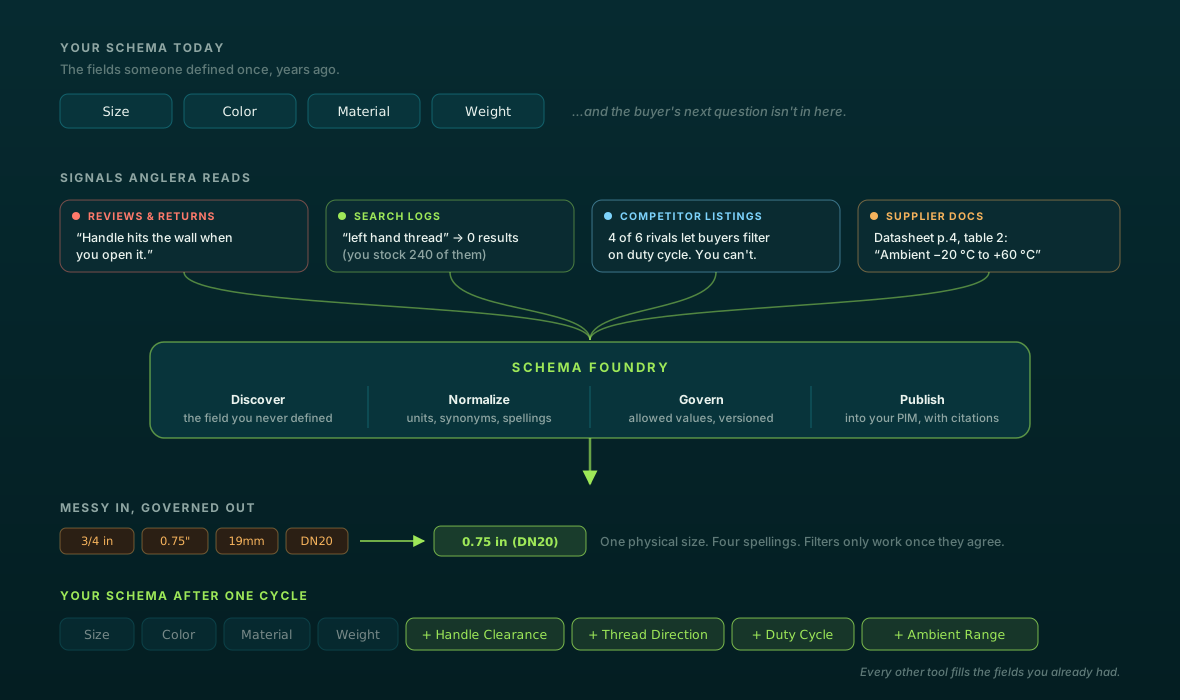
That is the gap Anglera fills. Anglera connects to your Contentserv or Plytix instance via API, pulls your existing SKUs, and enriches every attribute and description against buyer signals — the search terms, filters, and comparison patterns real customers use. The improved content writes back to the same PIM record your team already works in. Your system of record stays intact. The content Contentserv then governs and distributes — or that Plytix publishes to your channels — is buyer-ready from the start, not just well-organized.
Implementation is approximately 30 days with no platform migration required. Anglera is not a PIM and not a syndication platform. It is the enrichment layer that does the work both platforms assume has already happened.
Frequently asked questions
Do Contentserv and Plytix actually compete with each other?
Rarely in a direct evaluation. Contentserv targets enterprise and upper mid-market companies in fashion, lifestyle, and consumer goods that need a full PXM suite — PIM, DAM, syndication, and digital shelf analytics — with the governance and implementation depth that entails. Plytix targets small and mid-sized businesses that need a practical, affordable, fast-to-launch all-in-one tool. A company that belongs in one category will almost never seriously evaluate the other. When they do appear in the same shortlist, it usually signals the buyer is on the boundary between SMB and mid-market and is weighing complexity against cost.
Is Plytix capable enough for a company that is scaling past SMB?
Plytix is designed for SMBs, and its architecture reflects that. Unlimited users and a low entry price are genuine advantages, but companies scaling into enterprise territory often hit limits around data model complexity, governance workflows, localization depth, and the absence of built-in digital shelf analytics. If those requirements are on the near-term roadmap, evaluating an enterprise-grade platform like Contentserv earlier — before a costly migration — is worth considering.
Does Contentserv include AI content generation like Plytix does?
Contentserv includes AI capabilities within its PXM suite, but dedicated AI description generation is not a primary differentiator in its current positioning. The focus is enterprise-scale governance, rich media management, and multi-channel distribution. Plytix treats built-in AI for generating and translating product descriptions as a core product feature — it is explicitly aimed at SMB teams that do not have dedicated copywriting resources.
How does Anglera work with Contentserv or Plytix?
Anglera connects to either platform via API, reads your existing SKUs and attribute data, runs enrichment against buyer signals — how your customers actually search, filter, and compare products — and writes the improved content back to the same PIM record. No migration is required. Your team continues working in Contentserv or Plytix as usual; the underlying product data simply gets better. Implementation takes approximately 30 days.
What does Anglera do that Plytix's built-in AI does not?
Plytix's built-in AI generates and translates product descriptions from the data already in your PIM — it accelerates content authoring. Anglera works from the outside in: it identifies what buyer signals your SKUs are missing, gathers and resolves data across sources, and rewrites attributes and descriptions to match how real buyers search and decide — not just how your supplier described the product. The distinction is between generating content faster and generating content that is calibrated to actual purchase behavior.