EnterWorks vs inriver: Which Enterprise PIM Fits Your Catalog?
EnterWorks and inriver are both enterprise PIMs — they both centralize product data, govern it through workflows, and push it to downstream channels. That overlap makes the comparison feel muddy from the outside. But the architectural choices, the buyer profiles they serve best, and the capabilities they bundle differ enough that picking the wrong one creates real pain.\n\nEnterWorks (now Precisely EnterWorks) is a 20-year-old PIM/MDM/DAM data hub with deep roots in B2B distribution. Its EnterWorks Enable platform is built around governed, relationship-heavy catalog management — role-based workflows, complex product hierarchies, business rules, and tight ERP integration. Customers like Orgill, US Foods, and Johnstone Supply reflect that DNA: high SKU counts, complex attribute models, and operational workflows where governance and auditability matter as much as content quality. Since its acquisition by Precisely in 2021, it sits alongside Precisely's broader data integrity and MDM portfolio, which can be an advantage if your organization already runs Precisely tools.\n\ninriver entered the market as a modern SaaS PIM and has steadily expanded into what it calls a full product content lifecycle platform: PIM plus built-in syndication plus digital shelf analytics in a single composable subscription. That bundling appeals to brands and manufacturers who want fewer vendors and a tighter loop between authoring content and measuring how it performs on digital shelves. Its 1,600+ global brand customer base skews toward omnichannel manufacturers and retailers rather than traditional wholesale distributors.\n\nBoth platforms share a critical gap: neither enriches your product data. EnterWorks governs whatever your team has put in. inriver's AI features generate and suggest content from existing attributes, but they do not research missing data from external sources or score completeness against how buyers actually search and filter. Whichever platform you choose, incomplete supplier data arrives incomplete — and stays that way until someone fills the gaps.
| EnterWorks | inriver | Anglera | |
|---|---|---|---|
| Platform type and architecture | Enterprise PIM/MDM/DAM data hub — historically on-premises or hosted, now also cloud-deployed as part of Precisely. Strong MDM layer alongside PIM gives it master data governance depth beyond catalog management alone. | Pure SaaS PIM built on a composable architecture with Core, Professional, and Enterprise tiers. Cloud-native from the start; no on-prem option. API-first design makes it extensible but the platform itself is the subscription. | Cloud-based enrichment layer that connects to either architecture. Reads from and writes back to your PIM — whether EnterWorks or inriver — without requiring a deployment change or a parallel system. |
| B2B distribution and manufacturing fit | Built for complex B2B catalogs: wholesale distributors, industrial manufacturers, and retailers managing deep product hierarchies, multi-tiered pricing relationships, and operational governance across large teams. Orgill, US Foods, and Johnstone Supply are reference customers. | Strong fit for omnichannel manufacturers and brands managing multi-locale content, variant complexity, and digital distribution. B2B manufacturer use cases are supported but the platform's momentum is more brand and retail-channel oriented than pure B2B distribution. | Purpose-built for B2B distributors and manufacturers whose product data arrives incomplete from suppliers. Works alongside whichever PIM governs the catalog. |
| Syndication and channel reach | Integrates with third-party syndication platforms and e-commerce connectors via APIs; does not include built-in syndication as a core feature. Channel distribution typically requires a separate integration layer. | Bundles built-in syndication as part of the platform — a meaningful differentiator versus standalone PIMs. Digital channels, retailer portals, and marketplace integrations are managed within inriver rather than through a separate syndication tool. | Channel-agnostic. Anglera enriches data before it reaches the syndication layer — so what flows through EnterWorks integrations or inriver's built-in syndication is already complete and attributed. |
| Digital shelf analytics | No native digital shelf analytics capability. Performance measurement of live product listings requires integration with third-party tools. | Includes digital shelf analytics to monitor how content performs on live channels post-publication — visibility into search ranking, content score, and channel-specific gaps without leaving the platform. | Scores every SKU for buyer-signal readiness before content goes live, so gaps are identified and fixed proactively rather than discovered after poor shelf performance. Complements inriver's reactive analytics. |
| Data governance and workflow | Role-based workflows, business rules engine, complex product relationships, and MDM-level governance. Built for organizations where multi-team catalog governance — with auditability and rules enforcement — is a hard requirement. | Configurable approval workflows, completeness rules, and data model governance within a modern SaaS interface. Strong but lighter-weight than full MDM; suited to teams that need governance without a dedicated MDM platform. | Enriches product data upstream of governance workflows. Records enter the approval queue already filled and scored rather than half-empty — reducing the manual effort that governance processes are designed to catch. |
| AI and enrichment capability | Traditional PIM with no native AI enrichment. Completeness rules flag gaps; filling them requires your team, agencies, or external data work. | AI-assisted content generation produces titles, descriptions, and bullet points based on existing attributes and channel templates. Useful for copy variation at scale; does not research missing attributes from external sources. | Buyer-signal intelligence: researches missing attributes from supplier sites and external sources, normalizes values, scores each SKU against how buyers search and decide, and writes enriched records back to the PIM automatically. |
| Pricing and implementation | Custom enterprise licensing; reported base around $150,000 with cost scaling by users and implementation complexity. No free tier. Implementation timelines are long and typically require specialized consulting resources. | Subscription SaaS across Core, Professional, and Enterprise tiers; no public pricing — requires a sales conversation. SaaS delivery generally compresses implementation compared to on-prem enterprise deployments, but enterprise configurations still take months. | Per-SKU enrichment pricing with approximately 30-day implementation. Connects to your existing PIM without replacing it — no rip-and-replace, no parallel system to maintain, no six-figure platform investment. |
How to choose between EnterWorks and inriver
Choose EnterWorks if your organization is a large B2B distributor, wholesale operation, or manufacturer that needs MDM-level data governance alongside PIM — not just catalog management but master data integrity across enterprise systems. EnterWorks earns its place when your product data governance spans multiple ERPs, complex trading relationships, or regulatory and operational auditability requirements that a lighter SaaS PIM would not satisfy. It is also the natural choice if your organization already runs Precisely's broader data integrity or analytics portfolio and wants to keep master data in a unified Precisely environment. Be prepared for the investment: enterprise licensing, a long implementation, and the consulting resources that typically accompany both.\n\nChoose inriver if you are a manufacturer, brand, or omnichannel retailer who wants PIM, syndication, and digital shelf analytics from a single SaaS subscription rather than three separate vendor relationships. inriver's composable architecture and built-in channel distribution make it efficient for teams managing complex omnichannel content — multiple locales, rich media, variant hierarchies — who want to shorten the loop between authoring content and measuring how it performs on digital shelves. Its SaaS delivery also reduces the IT overhead that comes with on-premises or heavily customized enterprise deployments.\n\nThe edge cases: If your catalog is heavily B2B distribution with complex ERP dependencies and you already have a syndication layer that works, EnterWorks' governance depth may be worth the cost. If you are starting a greenfield PIM project and want modern SaaS with fewer integration dependencies, inriver's bundled capabilities are worth serious evaluation. If you already run EnterWorks and are evaluating inriver, the most honest question is whether inriver's syndication and digital shelf analytics capabilities justify the migration cost — for many organizations with stable governance workflows, the answer is no.
Whichever you pick, the data still has to get done
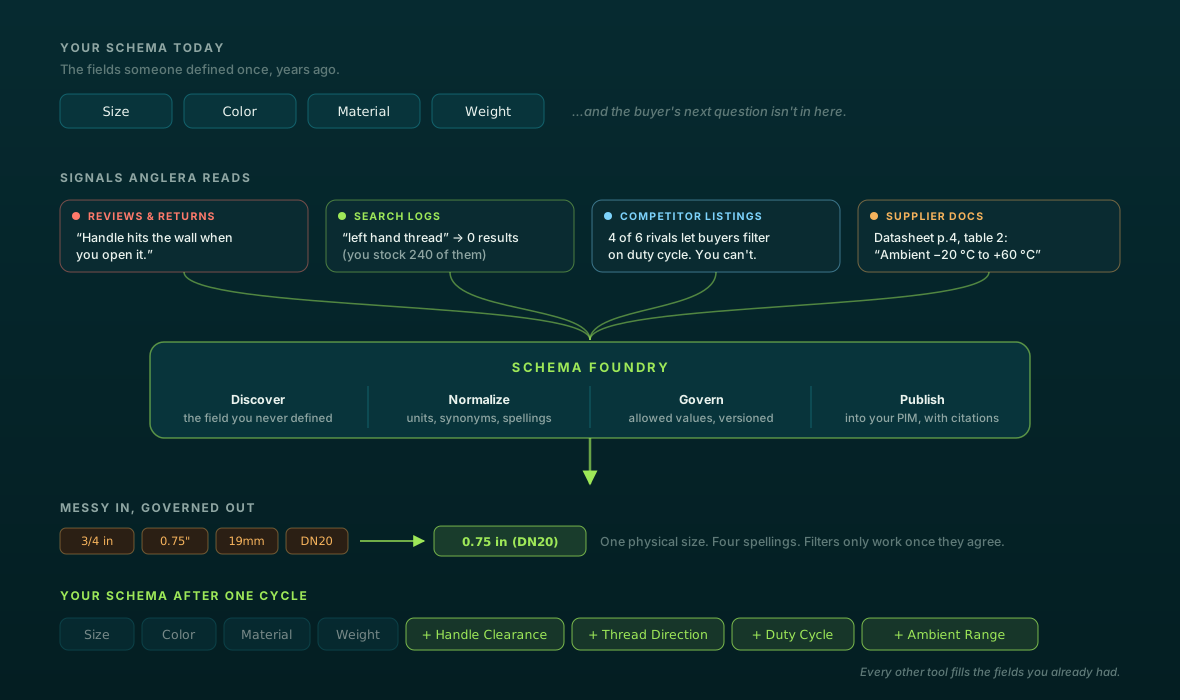
Both EnterWorks and inriver are systems of record. They govern, version, and distribute the product data your team puts into them. What neither one does is fill the gaps in that data.\n\nEnterWorks' governance engine — its business rules, completeness flags, and role-based workflows — catches missing required fields. But catching a gap is not the same as closing it. The closing still happens manually: someone on your catalog team, an agency, or an offshore data operator researches the spec, types the value, and submits for approval. At catalog scale, across thousands of SKUs updated by dozens of suppliers, that process is where the hours go.\n\ninriver's AI features move the needle further. AI-assisted content generation can produce title variants and description drafts from what is already in the PIM. But it generates from existing attributes — it does not go out and research what is missing. If a supplier's feed arrives without load ratings, chemical compatibility data, or package dimensions, inriver's AI has nothing to work from. The record stays incomplete until someone adds the missing source data.\n\nAnglera operates upstream of both platforms. It reads your existing catalog — from EnterWorks, inriver, or whatever system of record you run — identifies which attributes are missing, thin, or inconsistent, and researches and fills them using buyer-signal intelligence: how your buyers actually search, filter, and compare before purchasing. Enriched, scored records are written back to your PIM. By the time a record enters EnterWorks' governance workflow or inriver's syndication layer, it is already complete.\n\nThe workflow is additive. You keep whichever PIM you have chosen. Anglera connects in approximately 30 days and begins enriching in bulk, then keeps pace as your supplier catalog grows and changes. The governance, syndication, and analytics capabilities of your chosen platform operate on data that is already ready — rather than spending cycles flagging and chasing the gaps that incomplete supplier feeds always leave behind.
Frequently asked questions
EnterWorks and inriver are both PIMs — what is the real difference?
The meaningful differences are in architecture and bundled capabilities. EnterWorks is a traditional enterprise PIM/MDM/DAM hub with deep governance roots and on-prem or hosted deployment options — it suits organizations that need MDM-level master data control alongside catalog management, particularly in B2B distribution and wholesale. inriver is a modern SaaS PIM that bundles built-in syndication and digital shelf analytics into a subscription platform — it suits manufacturers and brands who want fewer vendor relationships and a tighter content-to-shelf feedback loop. Both do core PIM well; the decision usually turns on whether you need MDM depth or built-in syndication and analytics.
Does inriver's AI enrichment remove the need for a separate enrichment tool?
Not at catalog scale or for data with significant supplier gaps. inriver's AI features generate content variations — titles, descriptions, bullet points — from attributes already in the PIM. They do not research missing attributes from external sources, supplier sites, or manufacturer data sheets. If your supplier feeds arrive with thin specs, missing dimensions, or absent technical attributes, inriver's AI has nothing to generate from, and those gaps remain until someone fills them manually. A dedicated enrichment layer that researches and fills missing data from external sources addresses a different problem than AI-assisted copy generation.
Is EnterWorks still actively developed, or is it a sunset product under Precisely?
EnterWorks is part of Precisely's active product portfolio. Precisely acquired it through Winshuttle in 2021 and continues to sell and maintain it alongside its broader data integrity and MDM offerings. It is not publicly positioned as a sunset product. That said, buyers evaluating EnterWorks should ask Precisely directly about the product roadmap and investment priorities, as large acquisitions can shift how aggressively a platform evolves relative to Precisely's other data management tools.
My supplier data arrives with missing specs. Which PIM handles that better?
Neither, in practice. EnterWorks will flag missing required attributes in governance workflows but will not research or fill them. inriver will surface completeness gaps through scoring but its AI generation requires existing attribute values to work from. Both platforms assume reasonably complete supplier data as input — the gap between what suppliers send and what buyers need to make a purchase decision is the operational problem that a dedicated enrichment layer is built to solve, sitting upstream of whichever PIM you run.
If we already run EnterWorks, is it worth switching to inriver for the built-in syndication?
Only if syndication management is a significant operational burden in your current stack and you lack a working integration layer that handles it today. If your EnterWorks deployment is stable, your governance workflows are embedded, and your existing syndication integrations are functioning, the migration cost — in time, data modeling effort, and organizational disruption — typically outweighs the convenience of bundled syndication. The more compelling trigger for switching is if you are also seeking digital shelf analytics and a SaaS-native architecture, not syndication alone.