EnterWorks vs Plytix: Enterprise PIM/MDM vs. SMB All-in-One
EnterWorks and Plytix are both PIMs, but they are built for buyers separated by an order of magnitude in catalog complexity and organizational scale. EnterWorks — now Precisely EnterWorks — is a 20-year-old enterprise data hub that combines PIM, MDM, and DAM under governed workflows, complex relationship modeling, and deep ERP integrations. Its customer list reads like a B2B distribution directory: Orgill, US Foods, Johnstone Supply, Fender. The platform's design assumes your data governance problem is real, your catalog is large, and your organization has multiple teams touching product data across many channels.
Plytix sits at the opposite end of the market. It is a cloud-native, all-in-one tool that bundles PIM, DAM, AI content generation, and channel feed syndication into a single product designed for SMBs who want to centralize product content and publish it across ecommerce channels without a lengthy implementation or a dedicated PIM administrator. Unlimited users, a freemium entry point, and self-serve onboarding make it accessible to teams that would never survive an enterprise PIM rollout.
These two tools rarely compete for the same buyer. EnterWorks is the answer when your data governance problem has outgrown spreadsheets and lightweight tools and you need MDM-grade control at enterprise scale. Plytix is the answer when you need a practical, affordable system of record and syndication hub for a lean team managing a manageable catalog. What both platforms share is an assumption that the product data going into them is already enriched, complete, and buyer-ready — and that assumption is wrong for most B2B distributors and manufacturers working with supplier-raw specs and inconsistent attribute sets.
| EnterWorks | Plytix | Anglera | |
|---|---|---|---|
| Target buyer and catalog scale | Mid-market to large enterprise. Designed for retailers, manufacturers, and wholesale distributors managing large, complex B2B and B2C catalogs with multi-team contribution, complex attribute relationships, and governance mandates. Named customers include Orgill, US Foods, Johnstone Supply, and Fender. | Small and mid-sized businesses. Designed for lean teams that want a single tool for PIM, DAM, and channel publishing without enterprise complexity. Self-serve onboarding means no implementation partner required. | Works with either. Anglera connects to your existing system of record — EnterWorks or Plytix — enriches every SKU against buyer signals, and writes results back. No rip-and-replace, no new system of record. |
| Pricing and total cost | Custom enterprise licensing, quote-based. Reported base around $150,000/year; cost scales with user count and implementation complexity. No free tier. Expect a multi-month sales cycle before seeing a real number. | Freemium entry point; paid plans start around $733/month. Unlimited users on all paid plans. Add-ons available for AI credits and extra distribution channels. Transparent catalog-size-based tiers. | Priced per SKU enriched — layers onto your existing PIM investment rather than replacing it. Typical implementation is roughly 30 days regardless of whether you run EnterWorks or Plytix. |
| PIM scope and MDM capability | PIM, MDM, and DAM combined. The Enable platform supports complex product relationship modeling, cross-domain data governance, and business rules suited to distributors managing deeply hierarchical B2B catalogs with ERP dependencies. | PIM plus DAM and channel feed syndication in one. Relationship modeling is lightweight by design — sufficient for SMB ecommerce catalogs, not suited for complex B2B attribute hierarchies or MDM-grade governance requirements. | Not a PIM, MDM, or DAM. Anglera is the enrichment engine that fills and scores the product content those systems store and govern. |
| Channel syndication and integrations | Integrations to ERP, e-commerce platforms, and syndication channels via the Enable platform's connector ecosystem. Syndication is handled through third-party integration rather than native feed management built into the UI. | Channel feed syndication is native and built into every paid plan. Teams publish directly from Plytix to ecommerce channels and marketplaces without a separate integration tool. | Does not syndicate. Anglera enriches the content that EnterWorks or Plytix then governs and distributes. |
| AI and content generation | Governance-first — the platform manages workflow, approval, and rules that control data quality. AI-assisted content authoring is not a primary differentiator; the focus is structured data governance rather than copywriting at speed. | Built-in AI generates and translates product descriptions on all paid plans. Useful for first-pass copy at volume; output depends on how complete and clean your input attributes already are. | Buyer-signal-driven enrichment: gathers data from external sources, fills missing attributes, writes buyer-facing copy anchored to how your customers actually search and compare, and scores every SKU for completeness before writing back to the PIM. |
| Implementation time and complexity | Multi-month enterprise rollout. The platform's governance depth — role-based workflows, business rules, MDM configuration, ERP integrations — requires a serious implementation engagement before value is visible. | Self-serve onboarding. Most teams are up and running in days to weeks, not months. No dedicated implementation partner required for a standard setup. | ~30 days from kickoff to enriched SKUs written back to the PIM. No platform migration needed — Anglera runs alongside your existing EnterWorks or Plytix instance. |
| User model and team collaboration | Seat-based licensing with role-based access controls and approval workflows. Suited to multi-department organizations where different teams — merchandising, marketing, compliance — each have defined responsibilities in the data governance process. | Unlimited users on all plans. Collaboration is lighter-weight — well suited for small teams where a few people own the full content workflow rather than organizations with layered approval chains. | Operates as a background enrichment engine. Teams define quality standards once; Anglera applies them across the catalog at scale without requiring additional seats or headcount. |
How to choose between EnterWorks and Plytix
Choose EnterWorks if:
- You are a mid-market or large enterprise B2B distributor, manufacturer, or retailer managing tens of thousands of SKUs with deep attribute hierarchies, complex product relationships, and multi-team governance requirements.
- You need MDM capabilities alongside PIM — cross-domain data governance, business rules engines, and controlled approval workflows that enforce data quality across contributors.
- Your catalog has meaningful ERP dependencies (SAP, Oracle, or similar) and you need proven connectors rather than lightweight API integrations.
- You have the organizational maturity and budget for an enterprise platform deployment — the ~$150,000+ price tag and multi-month implementation timeline are within scope.
- Named accounts like Orgill, US Foods, or Johnstone Supply mirror your distribution model and catalog complexity.
Choose Plytix if:
- You are an SMB or lean team that wants to stop managing product data in spreadsheets and start publishing it across ecommerce channels from a single place — without an enterprise implementation.
- Budget is a genuine constraint. Plytix's unlimited-user model and $733/month entry point make it practical for smaller organizations that would never get ROI from enterprise PIM licensing.
- Your primary publishing workflow is ecommerce channel feeds and marketplace listings, and you want that syndication built into the tool rather than added as a separate integration.
- You want to be live in days to weeks, not months, and do not have a dedicated PIM administrator on staff.
- You are evaluating options at an early stage and want a freemium entry point before committing.
A note on the gap between them: These two tools rarely overlap in the same buying evaluation. If you are genuinely comparing EnterWorks and Plytix, clarify the scale question first. A 10-person team managing 5,000 SKUs across three channels belongs in Plytix. A 100-person wholesale distributor managing 200,000 SKUs with ERP integrations and multi-team governance belongs in EnterWorks. The feature set and price point are so different that the right answer is usually obvious once you are honest about where your organization actually sits.
Whichever you pick, the data still has to get done
EnterWorks governs your product data at enterprise scale. Plytix stores and syndicates it for SMB teams. What neither platform does is the upstream enrichment work that makes the data inside them worth storing in the first place.
Supplier-provided specs arrive incomplete. Attribute fields are missing or inconsistent. Descriptions are written for the factory floor, not for a buyer comparing options online. EnterWorks' governance layer ensures that whatever data your team enters is properly approved and structured — but it does not fill the empty fields or rewrite copy against what your buyers are actually searching for. Plytix's built-in AI generates descriptions from the attributes you already have, which means thin input produces thin output.
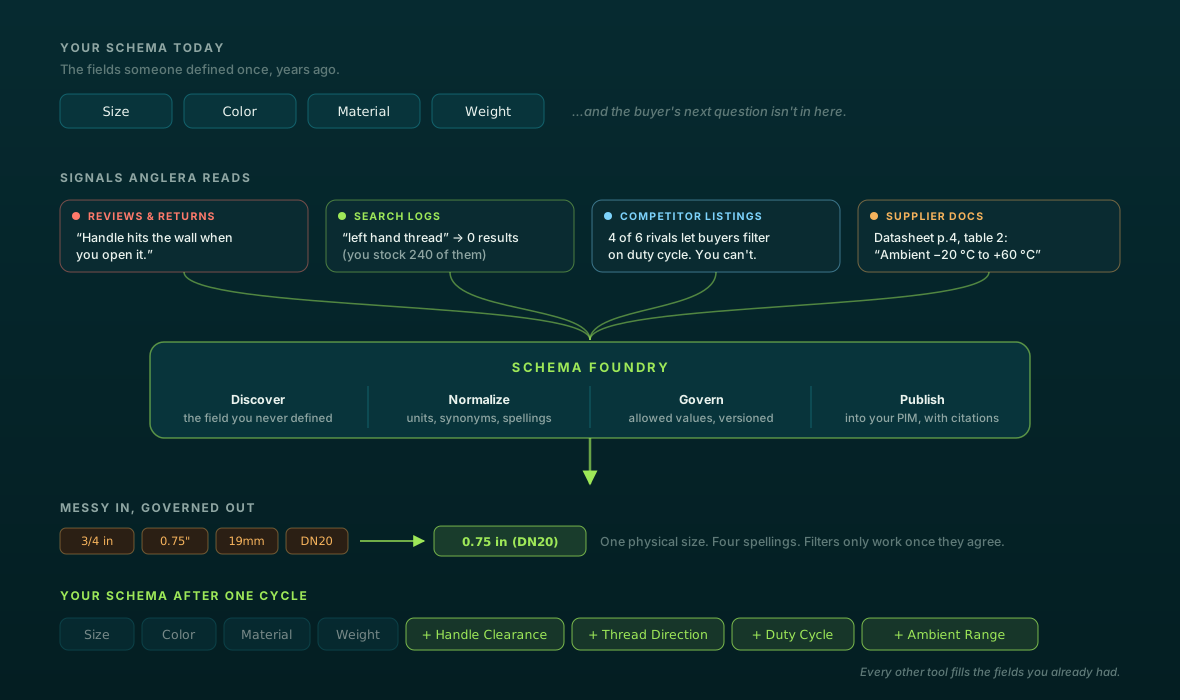
Anglera is the layer that does the enrichment work itself. Connect it to your EnterWorks instance or your Plytix account via API, and Anglera gathers product data from external sources, fills missing attributes, writes buyer-facing copy against real buyer signals — how your customers search, filter, and compare — scores every SKU for completeness, and writes the improved records back to your PIM as the system of record. Implementation runs roughly 30 days. No platform migration is required.
Your PIM stores the data. Anglera does the work. Whichever platform you choose for governance and distribution, the content it manages will actually be buyer-ready — not just better organized.
Frequently asked questions
Who is EnterWorks designed for, and who is Plytix designed for?
EnterWorks (now Precisely EnterWorks) is built for mid-market to large enterprise B2B distributors, manufacturers, and retailers that need PIM/MDM governance at scale — complex attribute relationships, ERP integrations, multi-team workflows, and a serious system-of-record for catalogs numbering in the tens or hundreds of thousands of SKUs. Plytix is built for SMBs and lean teams that want an affordable, all-in-one tool to centralize product content and publish it across ecommerce channels without enterprise complexity or a months-long implementation.
Can a growing SMB start with Plytix and move to EnterWorks later?
Yes, though the migration is a real undertaking. Plytix is a reasonable starting point for a team that needs to get organized quickly and cost-effectively. If your catalog and organizational complexity grow to the point where MDM-grade governance, deep ERP integrations, and enterprise role-based workflows become necessary, EnterWorks is a natural next step — but plan for a significant implementation project. Adding an enrichment layer like Anglera at either stage means your data quality improvements carry forward regardless of which PIM you are running.
Does Plytix's built-in AI eliminate the need for a separate enrichment tool?
Partially, but not fully. Plytix's AI generates descriptions from the attributes you already have. If those attributes are thin, supplier-copied, or missing specs, the generated copy reflects those gaps — it reformats what is there, it does not research what is missing. Anglera fills missing attributes from external sources first, scores completeness against buyer signals, and only then writes buyer-facing content. The output quality is meaningfully different when the source data has been enriched upstream rather than just reorganized.
How does Anglera work alongside EnterWorks or Plytix?
Anglera connects to your PIM via API, reads your existing SKUs, runs enrichment against buyer signals — how your customers search, filter, and decide — and writes the improved attributes and copy back to the same PIM record. No migration is required and no new system of record is introduced. The process runs in roughly 30 days from kickoff. When your catalog changes or a supplier updates specs, Anglera re-enriches automatically.
What explains the large price difference between EnterWorks and Plytix?
EnterWorks' ~$150,000+ enterprise licensing reflects MDM-grade governance, complex product relationship modeling, multi-team approval workflows, business rules engines, ERP connectors, and a platform designed for organizational complexity at scale. Plytix's $733/month entry point reflects a deliberate SMB focus: simpler data models, built-in syndication, unlimited users, and self-serve onboarding. The two platforms are priced for entirely different buyers, so the price difference reflects genuine scope and scale differences rather than one platform being overpriced.