inriver vs Unilog CX1 / CIMM2: PIM Comparison for B2B Distributors and Manufacturers
inriver and Unilog CX1 are both marketed to B2B manufacturers and distributors, but they solve different problems. inriver is a purpose-built PIM that manages the complete product content lifecycle and distributes content outward to many channels. Unilog CX1 is an all-in-one B2B commerce suite — storefront, PIM, CMS, and ERP integration — that also sells a managed library of pre-enriched distributor content. Comparing them head-to-head only makes sense once you know which problem you are actually trying to solve.
If you need a world-class PIM to sit at the center of a composable commerce stack, you are shopping for inriver. If you are a mid-market distributor who wants a single vendor to handle your website, your catalog, and your ERP connection, you are shopping for Unilog. The two platforms overlap at the PIM layer but diverge sharply everywhere else.
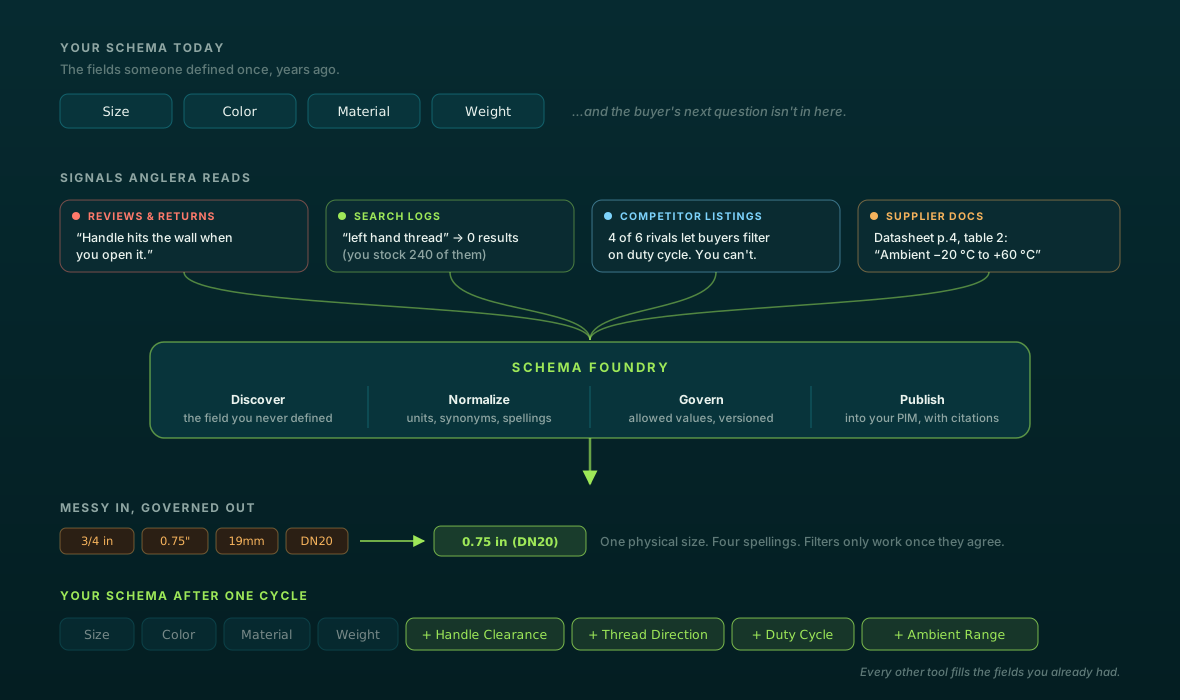
What neither platform does on its own is automatically gather, clean, and enrich your product attributes from raw sources — manufacturer sites, vendor PDFs, internal spec sheets — and score them against real buyer signals before writing the results back to your system of record. That is the gap Anglera fills, regardless of which platform you choose.
| inriver | Unilog CX1 / CIMM2 | Anglera | |
|---|---|---|---|
| Platform scope | PIM-only (plus built-in syndication and digital shelf analytics). inriver is a specialized platform; you supply the storefront, DAM, and ERP separately. | All-in-one: eCommerce storefront, PIM, CMS/site builder, site search, and ERP integration (CX1 Connect) in a single suite. One vendor for the full stack. | Not a platform — a focused enrichment service. Connects to your PIM or Unilog data layer, enriches content, and writes results back. No storefront, no syndication engine. |
| Ideal buyer | Mid-to-large brands, manufacturers, and omnichannel retailers with complex product hierarchies, many distribution channels, and a need to monitor digital shelf performance across retail partners. | Mid-market B2B distributors, manufacturers, and wholesalers — especially in electrical, HVAC, plumbing, and industrial distribution — who want an affordable, purpose-built eCommerce suite without assembling best-of-breed tools. | Any distributor, manufacturer, or retailer whose product data contains gaps, inconsistent attributes, or content that does not match what buyers actually search for — regardless of PIM or commerce platform. |
| PIM depth and data modeling | Deep: relationship modeling across variants, channels, and locales; supplier onboarding workflows; governance and approval chains; built for catalogs with complex attribute structures and multilingual needs. | Solid for standard distribution catalogs — attribute management, taxonomy, and category hierarchy — but less flexible for highly complex product relationships or large-scale multilingual deployments. | Not a PIM and does not replace one. Works within the attribute model the PIM already defines: fills empty fields, normalizes inconsistent values, and adds net-new attributes extracted from source content. |
| Product content library and managed enrichment | No proprietary content library. Enrichment depends on what suppliers submit or what you build through integrations with third-party content providers. The platform governs and distributes; it does not generate content. | A core differentiator: a managed library of 10M+ vendor SKUs from approximately 2,000 manufacturers, plus subscription-based enrichment, taxonomy, gap-fill, and normalization services. Strong coverage in trades verticals; weaker on proprietary or long-tail SKUs. | Crawls manufacturer sites, distributor feeds, vendor PDFs, and open sources to extract and structure attributes for any SKU — including proprietary items and long-tail catalog inventory that pre-built libraries do not cover. Complements Unilog's library where coverage ends; fills the gap inriver does not address at all. |
| Syndication and channel distribution | Built-in syndication to retailers, marketplaces, and channel partners, with digital shelf analytics to track live content quality and completeness at retail. A meaningful advantage for brands distributing through many retail touchpoints. | Focused on the distributor's own eCommerce storefront rather than multi-retailer syndication. Channel reach is the distributor's site, not an outbound content distribution network. | Enriches content before it reaches any channel, improving quality scores and search relevance wherever the data lands — whether that is a retailer portal, a marketplace, or the distributor's own Unilog storefront. |
| ERP and tech-stack integration | API-first and composable. Pre-built connectors and REST APIs for major ERPs, DAMs, and commerce platforms. Designed to plug into a modern best-of-breed stack rather than replace it. | Deep ERP integration is a primary selling point. CX1 Connect is built for the ERPs common in distribution — Epicor, SAP, Eclipse, and similar — making the platform especially practical for distributors whose operations run on those systems. | Integrates with the PIM or Unilog data layer via API. No direct ERP dependency; enrichment results flow through whatever system already owns the product record. |
| Pricing and time to value | Custom enterprise pricing across Core, Professional, and Enterprise tiers. Scoped by users, modules, and data volume. Multi-month implementation is typical for full deployments. | Quote-based; third-party sources cite entry pricing in the low hundreds per month, but real deployments scale with catalog size, content subscriptions, and managed services. Multi-month implementation with setup, data migration, and ERP configuration. | Subscription priced on catalog volume; approximately 30-day onboarding. Does not require replacing or re-implementing either platform — runs alongside the existing stack. |
How to choose between inriver and Unilog CX1 / CIMM2
Choose inriver if your organization is a brand, manufacturer, or retailer that distributes product content to multiple retail partners or marketplaces, needs governance workflows for supplier-submitted content, and wants digital shelf analytics to measure how that content performs after it leaves your PIM. inriver is the stronger choice when your problem is managing complexity across many channels, locales, and downstream partners — and when you have (or plan to build) a separate commerce platform and ERP integration layer alongside it. It fits larger organizations with dedicated PIM teams and the IT resources to maintain a composable stack.
Choose Unilog CX1 if you are a mid-market B2B distributor or manufacturer looking for one vendor to handle your eCommerce storefront, your catalog, your site search, and your ERP connection — particularly if you operate in electrical, HVAC, plumbing, or industrial distribution. Unilog's pre-built content library and managed enrichment services mean you can launch eCommerce without sourcing all your product data from scratch, and the platform is purpose-built for the operational patterns common in those verticals. It is the more practical choice if you want to avoid assembling a multi-vendor tech stack and if your catalog overlaps heavily with the manufacturer SKUs Unilog already covers.
The clearest disqualifier for each: if you need a distributor-facing storefront and ERP integration out of the box, inriver does not provide them. If you need multi-retailer syndication or digital shelf analytics, Unilog does not provide them either.
Whichever you pick, the data still has to get done
Whichever platform you choose, one problem remains: the product attributes that flow into your PIM or Unilog catalog are rarely complete, consistent, or aligned to what buyers actually search for. inriver governs and distributes the content you give it — it does not generate or clean that content. Unilog's managed library covers known manufacturer SKUs well, but it does not reach your proprietary items, your long-tail inventory, or the attributes that differentiate your catalog from a competitor running the same platform.
Anglera closes that gap in approximately 30 days. It reads your existing catalog — whether stored in inriver, in Unilog's PIM, or in an ERP export — crawls manufacturer sites, vendor PDFs, and distributor feeds, extracts and normalizes structured attributes, scores every SKU against real buyer signals, and writes the enriched data back to your system of record. The result is that the content flowing through inriver's syndication engine or appearing on your Unilog storefront is already done: filled, normalized, and optimized before a channel or a customer ever sees it.
Anglera does not replace either platform. It does the enrichment work both platforms assume has already happened.
Frequently asked questions
Can inriver and Unilog CX1 replace each other?
Not practically. inriver is a PIM that assumes you already have a storefront and ERP integration — it does not provide them. Unilog CX1 bundles a storefront, PIM, CMS, and ERP connector into a single suite but does not offer multi-retailer syndication or digital shelf analytics. They serve overlapping but distinct buyer profiles, and a distributor choosing between them is really choosing between a specialized best-of-breed PIM and a purpose-built all-in-one commerce platform.
Does Unilog CX1 have a standalone PIM option, or do you have to take the full platform?
Unilog sells CX1 as an integrated suite; the PIM is embedded in the broader platform rather than sold as a standalone module. Buyers who want only a PIM without the storefront and ERP layers are generally better served by a dedicated PIM vendor like inriver. Unilog's value proposition depends on adopting most of the stack.
Does inriver include any product content, or just the platform?
inriver is platform-only — it provides the data model, governance workflows, and syndication engine, but it does not supply a library of manufacturer content. You bring your own data, either sourced from suppliers through inriver's onboarding tools or ingested from third-party content providers. This is a meaningful distinction from Unilog, which sells managed content subscriptions alongside the software.
How does Anglera work alongside inriver or Unilog without disrupting the existing setup?
Anglera connects to your PIM or Unilog data layer via API, reads your current catalog, identifies gaps and inconsistencies, and enriches attributes by crawling authoritative sources. Enriched data is written back to the same system of record — your inriver PIM or your Unilog catalog — so existing workflows, governance rules, and channel connections are not disrupted. Implementation typically takes about 30 days and does not require a platform migration.
Which platform is better for electrical and HVAC distributors specifically?
Unilog CX1 has a meaningful head start in electrical, HVAC, plumbing, and industrial distribution. More than 50 AD member companies run on the platform, and Unilog's content library has strong manufacturer SKU coverage in those verticals. For a mid-market distributor in those industries launching eCommerce for the first time, Unilog's combination of industry-specific content, ERP integration with common distribution ERPs, and an included storefront reduces the implementation scope considerably compared to assembling a stack around inriver.