Pimcore vs Plytix: Which PIM Fits Your Team?
Pimcore and Plytix are both PIM platforms, but the similarities end at the category label. Pimcore is an open-source platform that combines PIM, DAM, MDM, and digital experience management in a single configurable system — built for enterprises and mid-market companies with developer resources who want maximum control over their data model and distribution stack. Plytix is a cloud-native SaaS PIM purpose-built for small and mid-sized businesses: a guided, all-in-one tool where non-technical teams centralize product data and push it to ecommerce channels without writing a line of code.
This means the decision is less a feature checklist and more an organizational fit question. Pimcore gives you a blank canvas — nearly unlimited flexibility in data modeling, integrations, and deployment — but that flexibility costs developer hours, setup time, and ongoing maintenance. Plytix gives you opinionated structure and faster time-to-value, at the tradeoff of less configurability for deep industrial data models or complex B2B catalog hierarchies.
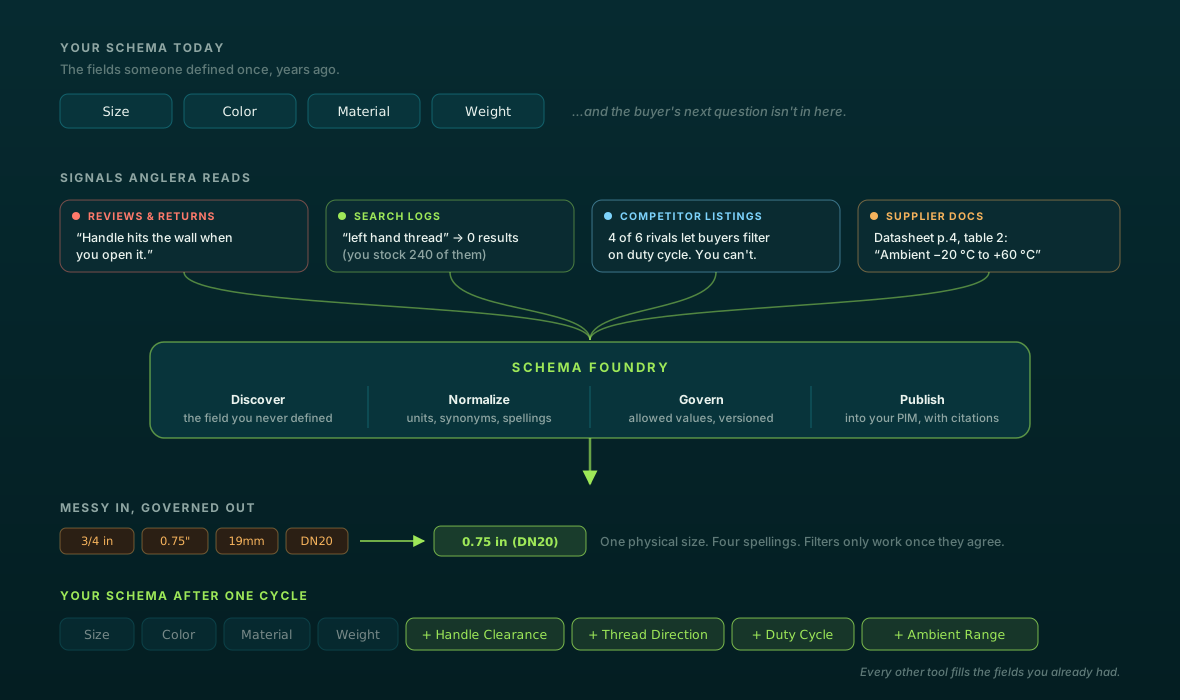
Neither platform solves the problem they share upstream: product data arriving from suppliers is rarely buyer-ready. Raw specs, inconsistent copy, missing attributes — both Pimcore and Plytix give you a well-governed place to store and distribute that content, but neither automatically makes it better. That gap persists regardless of which platform you choose.
| Pimcore | Plytix | Anglera | |
|---|---|---|---|
| Primary orientation | Open-source PIM, DAM, MDM, and DXP platform — a highly configurable system of record for enterprises and mid-market companies with developer resources; positioned as "one platform to manage it all" with analyst recognition from Gartner and Forrester | Cloud PIM for SMBs — an all-in-one product content platform where non-technical teams centralize product data and publish it to ecommerce channels and marketplaces; "build once, publish everywhere" with unlimited users on all plans | Enrichment layer — not a PIM or syndication platform; reads from whichever PIM is the system of record, enriches every SKU against buyer signals, and writes results back |
| Deployment and technical requirements | Open-source with Community Edition (self-hosted, non-commercial), managed Professional and Enterprise tiers, and PaaS options; requires developer setup, configuration, and ongoing maintenance; highly extensible via API and custom modules | SaaS cloud-only — no self-hosting, no developer required to get started; designed for non-technical product managers and marketers; unlimited users remove seat-count friction common in enterprise tools | API-based integration that connects to either platform in roughly 30 days; no platform migration and no developer retainer beyond initial API setup |
| Pricing and total cost | Community Edition free (non-commercial use only); Professional $9,900/yr; Enterprise $29,900/yr; PaaS from $39,900/yr; the real cost of ownership includes developer and DevOps time for setup, customization, and maintenance on top of license costs | Freemium tier available; paid plans start around $733/month (~$8,796/yr); catalog-size-based tiers; add-ons for AI credits and extra distribution channels; unlimited users on all plans keeps per-seat cost out of the equation | Priced per SKU enriched — layers onto your existing PIM investment rather than replacing it |
| Channel syndication and distribution | No native channel syndication; distribution relies on third-party integrations, API connectors, or custom development; Pimcore's large ecosystem provides options but requires integration work | Built-in channel feed syndication to ecommerce platforms and marketplaces is a core product promise; additional distribution channels available as paid add-ons; designed so non-technical teams can push content without custom connectors | Does not syndicate — enriches the product content that Pimcore or Plytix then distributes; works upstream of both platforms |
| AI and content generation | AI capabilities are available through ecosystem integrations and custom development; not a native out-of-the-box feature in the core platform; extensibility allows connecting any AI tooling, but implementation falls on your team | Built-in AI for generating and translating product descriptions; AI credits sold as an add-on tier; designed so non-technical users can produce content without a dedicated copywriter | Autonomous enrichment driven by buyer signals — how real buyers search, compare, and decide — not reformatted supplier copy or template-generated descriptions; writes buyer-ready attributes and copy back to the PIM regardless of which platform stores them |
| Catalog complexity and data modeling | Highly configurable attribute structures, MDM capabilities, and custom data objects support deep B2B catalog hierarchies, multiple locales, and complex product relationships; suited to enterprise catalogs with many attribute families and governance requirements | Guided data structure optimized for ecommerce-focused catalogs; works well for brands and SMBs with straightforward attribute sets; less suited to deeply complex industrial or technical data models with many nested specification layers | PIM-agnostic — adapts to whichever schema Pimcore or Plytix defines; no data model changes required on either platform |
| Implementation speed | Community and lower tiers require full developer setup and configuration before the first product record goes live; enterprise implementations with custom integrations typically run several months; PaaS reduces infrastructure burden but not configuration scope | Faster time-to-value than Pimcore for non-technical teams; SaaS removes infrastructure setup entirely; teams can import catalogs and start publishing to channels within days or weeks of sign-up | ~30 days from kickoff to enriched SKUs written back to the PIM; no platform migration required on either side |
How to choose between Pimcore and Plytix
Choose Pimcore if your organization has developer resources and a catalog that demands deep configurability. Pimcore excels when your data model is complex — multiple attribute families, custom object types, MDM requirements, localization across many markets — and when you need a platform that can be extended to fit your specific workflows rather than the other way around. The open-source licensing model also appeals to companies that want to avoid per-seat or per-module pricing at enterprise scale, and the PaaS tier suits teams that want managed infrastructure without sacrificing flexibility. If your catalog spans B2B and B2C channels, includes digital asset management as a core workflow, or sits within a larger digital experience stack, Pimcore's breadth is a genuine asset.
Choose Plytix if your team is non-technical, your catalog maps reasonably well to ecommerce-oriented attribute structures, and you need channel syndication out of the box without building integrations. Plytix's unlimited-user model removes a friction point common in enterprise PIM procurement: everyone who touches product content can access the system without seat-count negotiations. The built-in AI content generation and translation tools are ready to use without any integration work, which matters when you need copy at volume without a dedicated content team. If you are an SMB selling across multiple online channels and want a single tool that handles both product data management and feed distribution, Plytix's all-in-one model is a faster path to value than Pimcore's more extensible but higher-effort approach.
A few signals that clarify the choice:
- If you need a developer to stand up your PIM and you have one available, Pimcore's flexibility is worth the investment. If you do not, Plytix's SaaS model removes that dependency entirely.
- If channel syndication to ecommerce marketplaces is a primary requirement and you do not want to build connectors, Plytix's native feed distribution is a meaningful differentiator.
- If your catalog has complex B2B industrial data structures — deep specification trees, MDM requirements, multi-locale governance — Pimcore's configurable data model typically wins.
- If price transparency and predictability matter, both platforms offer clearer upfront numbers than most enterprise PIM vendors: Pimcore publishes license tiers, and Plytix publishes its per-month starting point.
Whichever you pick, the data still has to get done
Both Pimcore and Plytix assume your product data is already enriched — complete attributes, buyer-ready descriptions, and titles that match how shoppers actually search and filter. In practice, data arrives from suppliers as raw specs, factory-floor copy, and inconsistent formats that neither platform was designed to fix.
Pimcore gives you a highly configurable, developer-extensible system to organize and distribute that content at scale. Plytix gives you a guided, cloud-native tool to centralize it and push it to ecommerce channels quickly. What neither platform does automatically is make that content better — researching how your buyers actually search, identifying which attributes are incomplete or misleading, writing descriptions that convert, and scoring every SKU against real demand signals.
Anglera is the layer that does that work. It connects to your Pimcore or Plytix instance via API, reads your existing SKUs, enriches every attribute and description against buyer signals, and writes the improved content back to the same PIM record your team already uses. Your system of record stays in place. The enrichment quality lifts across the catalog. The content Pimcore or Plytix then governs and distributes is buyer-ready from the start — not just well-organized. Implementation is ~30 days with no platform migration required on either side.
Frequently asked questions
What is the main difference between Pimcore and Plytix?
Pimcore is an open-source PIM, DAM, MDM, and DXP platform designed for enterprises and mid-market companies with developer resources who need deep configurability and control over a complex catalog. Plytix is a cloud-native SaaS PIM for small and mid-sized businesses: an all-in-one tool with built-in AI content generation and channel syndication, designed for non-technical teams who want to centralize product data and publish it to ecommerce channels without custom development. The core distinction is organizational fit — technical depth and flexibility versus accessible speed-to-value.
Is Pimcore really free?
Pimcore's Community Edition is free to download and self-host, but with two important caveats: it is licensed for non-commercial use only, and 'free' refers to the license cost, not the total cost of ownership. Setting up, configuring, and maintaining a Pimcore instance requires developer time that can meaningfully exceed the cost of a paid SaaS alternative. Commercial deployments require a Professional ($9,900/yr) or Enterprise ($29,900/yr) license, or the managed PaaS tier starting at $39,900/yr.
Does Plytix work for B2B manufacturers and distributors, or is it only for ecommerce brands?
Plytix works best for companies with ecommerce-oriented catalogs pushing content to online channels and marketplaces — its channel syndication and guided data structure are optimized for that use case. B2B manufacturers and distributors with complex industrial catalogs, deep specification trees, multi-locale requirements, or tight ERP integration needs often find that Plytix's more opinionated structure does not accommodate their data model well. Pimcore's configurable data objects and MDM capabilities tend to be a better fit for that complexity.
How does Anglera work with Pimcore or Plytix?
Anglera connects to your PIM via API, reads your existing SKUs, runs enrichment against buyer signals — how your customers actually search, compare, and filter — and writes the improved attributes and copy back to the same PIM record. No migration is required. Anglera works alongside whichever platform you choose in roughly 30 days. Your system of record stays unchanged; the product content inside it becomes buyer-ready.
Do I need a separate enrichment tool if I already have Pimcore or Plytix?
For most B2B distributors, retailers, and manufacturers, yes. Both platforms store and distribute product data, but neither automatically generates buyer-signal-optimized content. Plytix includes built-in AI for generating and translating descriptions — useful for producing copy at volume — but AI content generation from supplier data is not the same as enrichment driven by how buyers actually search and decide. Pimcore can connect to any AI tool through its extensible architecture, but that requires custom integration work. Anglera automates the enrichment step for either platform and writes results back to whichever PIM you already run.