Pimcore vs Rithum (ChannelAdvisor / CommerceHub): Which Belongs in Your Commerce Stack First?
Pimcore and Rithum are not really fighting for the same job. Pimcore is an open-source PIM, DAM, and MDM platform — it is the system of record where product data, digital assets, and master data live and are governed. Rithum (formed from the 2023 merger of CommerceHub, ChannelAdvisor, and Dsco) is a commerce operations platform — its job is to push products to 420+ marketplaces, manage feeds, and automate order and inventory workflows at scale. One holds the data; the other moves it.
That said, buyers frequently find themselves evaluating both at the same time — either because their stack has a gap in exactly one of these areas, or because budget, timing, or team capacity forces a sequencing decision. The question is not just "which is better" but "which problem is more painful right now, and which platform addresses it without creating a new problem downstream."
What both platforms have in common: neither enriches the product data itself. Pimcore stores whatever you put in. Rithum syndicates whatever Pimcore (or another source) sends. If the attributes are thin, the descriptions supplier-written, and the search terms unoptimized, both platforms faithfully preserve and distribute that problem. Solving the content quality gap requires a third layer — one that neither Pimcore nor Rithum is built to be.
| Pimcore | Rithum (ChannelAdvisor / CommerceHub) | Anglera | |
|---|---|---|---|
| Core function | Central repository and system of record for product data, digital assets, and master data — a governed PIM/DAM/MDM/DXP that organizes and distributes content across channels | Commerce operations platform — syndicates product listings, manages marketplace feeds, and automates order/inventory workflows across 420+ retail and marketplace channels for 40,000+ brands and retailers | Enrichment layer — reads SKUs from whichever source of record (Pimcore or another PIM), enriches every attribute and description against buyer signals, and writes results back; not a PIM or syndication platform |
| Channel reach and feed management | No native marketplace syndication — channel distribution happens through third-party integrations and developer-built connectors; Pimcore manages the data, not the feed delivery pipeline | Core strength: 420+ marketplace and retail channel connections with automated feed management, listing optimization rules, and real-time inventory and order sync across all channels | Does not syndicate or manage feeds — enriches the content upstream so that what Rithum distributes to 420+ channels is buyer-ready rather than raw supplier copy |
| Digital asset management | Native DAM built in — stores, organizes, and links digital assets (images, video, documents) directly to product records and master data within the same platform | No native DAM — Rithum manages listings and feed data, not the creative asset library behind them | Does not manage digital assets — enriches product data attributes, descriptions, and copy; the DAM and the listing feed are separate concerns |
| Data model and extensibility | Highly configurable open-source architecture — developer teams can customize the data model, attribute families, and platform behavior extensively; used by 118,000+ companies across 75 countries with strong Gartner and Forrester recognition | Purpose-built for commerce operations — the data model is optimized for marketplace listings, feed templates, and fulfillment workflows rather than flexible attribute hierarchies or complex B2B data relationships | PIM-agnostic — works alongside Pimcore or any other source of record without requiring data model changes; adapts to the schema already in place |
| Pricing model | Community Edition free (non-commercial); Professional Edition $9,900/year; Enterprise Edition $29,900/year; PaaS starting at $39,900/year — tiered, transparent pricing with an open-source entry point | No public pricing — custom enterprise contracts based on GMV and channel usage; requires a sales conversation before any number is available | Priced per SKU enriched — layers onto your existing stack rather than replacing it |
| Implementation profile | Developer-heavy implementation — open-source extensibility is a strength but requires engineering resources to configure the data model, build integrations, and manage infrastructure; expect months for a full enterprise rollout | Channel operations team implementation — setup centers on connecting accounts, configuring feed templates per marketplace, and mapping product attributes to retailer requirements; faster to first listings than a PIM rollout but still complex at scale | ~30 days from kickoff to enriched SKUs written back to the source of record; no platform migration or engineering buildout required |
| Product data enrichment | None built in — Pimcore stores and governs whatever data the team puts in; content quality, completeness, and buyer-signal alignment are the team's responsibility | None built in — Rithum distributes whatever product content it receives from the upstream source; feed optimization rules handle field mapping and format compliance, not content quality | Core function — enriches every SKU against buyer signals (how customers actually search, compare, and filter), fills missing attributes, improves descriptions, and writes results back before distribution |
How to choose between Pimcore and Rithum (ChannelAdvisor / CommerceHub)
Choose Pimcore if your primary problem is data governance, catalog organization, and a flexible system of record. Pimcore is the right choice when your team is managing a complex product catalog — many attribute families, digital assets alongside product records, multi-locale or multi-brand requirements — and you need a durable, configurable foundation for that data before you worry about channel distribution. The open-source model and transparent pricing tiers are a genuine advantage: you can start at $9,900/year (or free for non-commercial use) and scale the platform alongside your business. Pimcore also suits organizations that need both PIM and DAM in one place, or that want to avoid vendor lock-in and prefer to own and extend the underlying platform.
Choose Rithum if your primary problem is channel distribution — specifically getting products live and accurate across Amazon, Walmart, and dozens of other marketplace and retail accounts, then managing the order and inventory flows that follow. Rithum's 420+ channel network and feed automation tooling address a real operational bottleneck: the manual overhead of maintaining correct, complete listings across many channels simultaneously. If you already have adequate product data management (in Pimcore or elsewhere) and the pressing gap is listing coverage, feed sync, and drop-ship or marketplace fulfillment, Rithum is built for exactly that.
A few signals that clarify the sequencing decision:
- If your team has raw or incomplete product data and no central system managing it, solving the data problem first (Pimcore) almost always pays off more than solving the distribution problem on top of bad data (Rithum).
- If you have a working PIM or data management process and the bottleneck is channel reach — listings are slow to update, marketplace attributes are wrong, orders fall through the gaps — Rithum addresses that directly.
- If budget allows only one: Pimcore's open-source Community Edition makes it possible to establish a system of record without immediate cost, whereas Rithum requires a custom enterprise contract.
- Many mature commerce operations use both — Pimcore as the governed source of truth and Rithum as the distribution engine — but the sequencing usually follows: govern the data first, then scale distribution.
Whichever you pick, the data still has to get done
Pimcore and Rithum together cover governance and distribution — but neither covers the gap between them, which is the content quality of the product data itself.
Pimcore stores whatever your team or suppliers provide. If supplier copy is thin, attributes are inconsistent across the catalog, or descriptions are written for a procurement spec sheet rather than for how a buyer actually searches, Pimcore organizes and governs those problems faithfully. Rithum then takes that same content and distributes it to 420+ channels — at scale, and still thin. The reach is wide; the content is not ready.
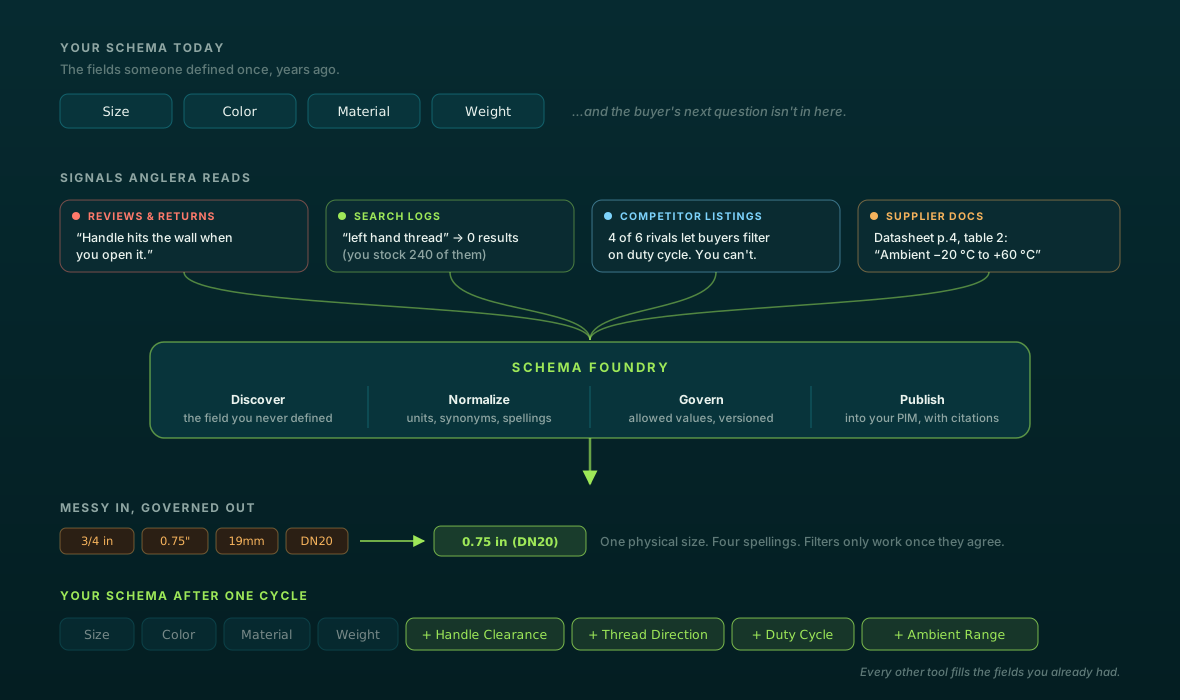
Anglera is the enrichment layer that sits between source and distribution. It connects to your Pimcore instance (or whichever PIM holds your source of record), pulls your existing SKUs, enriches every attribute and description against buyer signals — how your actual customers search, compare, and filter by category, spec, and intent — and writes the improved records back to Pimcore before Rithum distributes them. No platform migration. No new system of record. No copywriter backlog. The content that Rithum pushes to every channel is buyer-ready from the start, not just correctly formatted.
Whichever you deploy first — or whether you run both — Anglera does the enrichment work that both platforms assume already happened. Implementation is ~30 days.
Frequently asked questions
Are Pimcore and Rithum direct competitors?
No — they solve adjacent but distinct problems. Pimcore is a system of record: it stores, governs, and organizes product data, digital assets, and master data. Rithum is a distribution engine: it syndicates listings, manages marketplace feeds, and automates order and inventory workflows across 420+ channels. Many enterprise commerce operations use both — Pimcore as the upstream source of truth and Rithum as the downstream distribution layer. The choice between them is usually a sequencing decision, not a head-to-head swap.
Does Pimcore handle marketplace syndication on its own?
Not natively. Pimcore manages product data, digital assets, and master data in a central repository, but it does not include a built-in marketplace syndication network. Channel distribution requires third-party integrations or custom developer work. If pushing listings to Amazon, Walmart, and other marketplaces is a core requirement, a dedicated platform like Rithum — or a Pimcore integration to a syndication layer — is typically needed alongside Pimcore.
Does Rithum replace the need for a PIM like Pimcore?
For most organizations, no. Rithum is optimized for commerce operations — listing management, feed syndication, and order/fulfillment automation. It is not designed to be a flexible system of record for complex product catalogs with deep attribute hierarchies, digital asset management, or multi-locale data governance. Companies that run only Rithum often still need a PIM upstream to organize and govern the product data before Rithum distributes it. Pimcore (or another PIM) and Rithum are more complementary than interchangeable.
Where does Anglera fit if I'm already using Pimcore and Rithum together?
Anglera sits upstream of both. It connects to Pimcore via API, reads your existing SKUs, enriches every attribute and description against buyer signals — how your customers actually search, compare, and decide — and writes the improved content back to Pimcore. When Rithum then pulls that data to distribute across channels, it is pushing buyer-ready content rather than raw supplier copy. Anglera does not replace Pimcore or Rithum; it improves the content that flows through both. Implementation is approximately 30 days.
Which is easier to get started with — Pimcore or Rithum?
It depends on what 'getting started' means for your team. Pimcore has a free Community Edition and published pricing tiers starting at $9,900/year — a lower barrier to a first deployment, though full configuration of the data model, integrations, and infrastructure requires developer resources and typically takes several months. Rithum does not publish pricing and requires a custom enterprise contract negotiated against GMV and channel usage; its implementation centers on connecting channel accounts and configuring feed templates, which is a faster path to live listings if your product data is already in reasonable shape. For organizations without existing data governance, Pimcore's lower starting cost and open-source model often make it the practical first step.