Pimcore vs Unilog CX1 / CIMM2: A Practical Comparison for B2B Buyers
Pimcore and Unilog CX1 (formerly CIMM2) are both used by B2B companies to manage product data, but they solve different problems. Pimcore is a flexible, open-source foundation for storing and organizing product data, digital assets, and master data — used across industries by over 118,000 companies. Unilog CX1 is a purpose-built B2B commerce suite aimed at mid-market distributors, bundling a storefront, a built-in PIM, a content library, and ERP integration into a single subscription so distributors can get online without assembling a best-of-breed stack.
A buyer choosing between them is really making an architectural decision: do you want a developer-extensible data platform you build on top of, or an all-in-one commerce suite calibrated to distribution workflows? The answer depends on your vertical, your internal technical capacity, and whether you need a storefront or already have one.
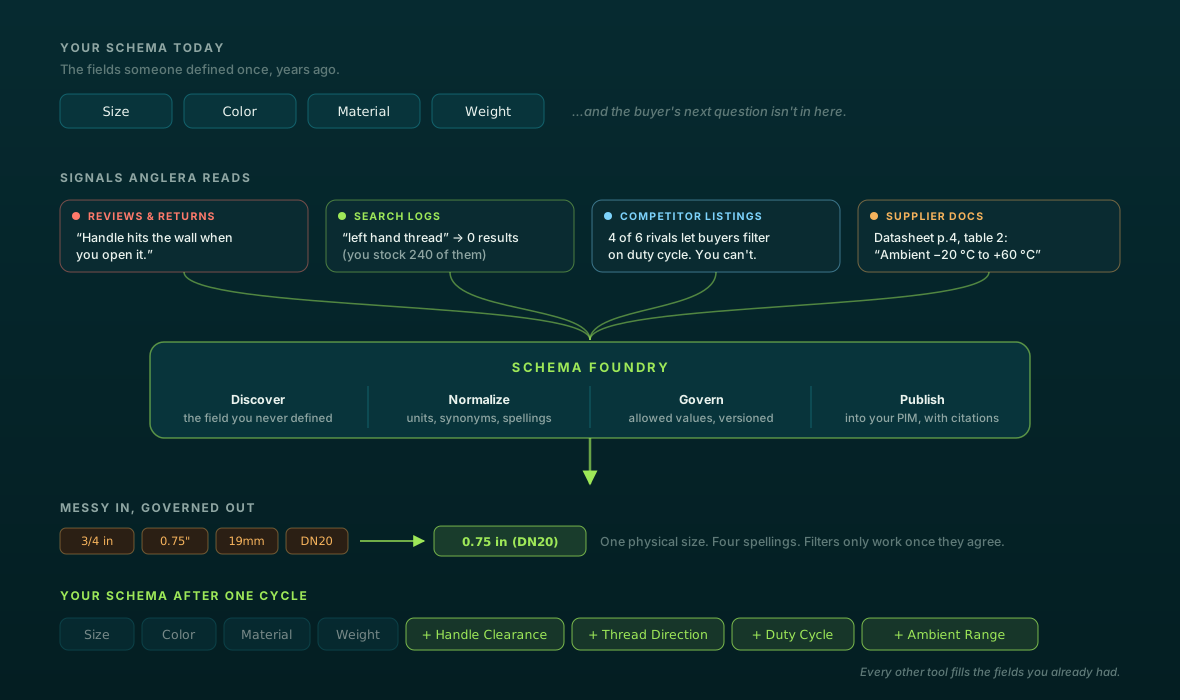
What neither platform solves on its own is the continuous work of enriching product data against buyer signals — filling attribute gaps, normalizing supplier feeds, scoring completeness, and keeping data current as catalogs change. That work has to happen somewhere, and it is the gap Anglera fills regardless of which platform sits underneath.
| Pimcore | Unilog CX1 / CIMM2 | Anglera | |
|---|---|---|---|
| Core function | Open-source PIM, DAM, MDM, and DXP in one codebase. Manages where product data and digital assets live — not how they get enriched or scored. | All-in-one B2B commerce suite: storefront, built-in PIM, CMS, site search, and ERP integration bundled together. Also runs a managed content library of 10M+ SKUs from ~2,000 manufacturers. | Sits on top of either platform as the enrichment engine — pulling raw data from the PIM, enriching and scoring it against buyer signals, and writing results back to the source of truth. |
| Target buyer | Enterprise and upper mid-market companies across industries that need a flexible, developer-extensible data platform and have the internal technical resources or SI budget to build on it. | Mid-market B2B distributors — especially in electrical, industrial, plumbing, and HVAC — that want turnkey eCommerce without assembling or maintaining a best-of-breed stack. | Any B2B company with incomplete, inconsistent, or unscored product data sitting in a PIM, regardless of which PIM or commerce platform they use. |
| Product enrichment | No enrichment engine built in. Data quality depends entirely on what your team imports and maintains. Pimcore stores what you give it. | Managed content subscriptions and enrichment services backed by the 10M+ SKU library. Coverage is strong within supported verticals and manufacturer networks; gaps remain for proprietary or private-label SKUs. | Continuously enriches every SKU against live buyer signals — attributes, descriptions, categorization, completeness scoring — and writes the result back to the PIM. Works across any catalog, not just covered manufacturer networks. |
| eCommerce storefront | DXP capabilities exist, but a production B2B storefront requires substantial custom development. Pimcore is not a commerce platform out of the box. | Includes a full B2B storefront with faceted search, punch-out, customer-specific pricing hooks, and ERP sync. Commerce is the core product. | Not a storefront. Enriches the product data that powers whichever storefront you use — Unilog's, a separate commerce platform, or a custom build. |
| Deployment and ownership | Open-source (self-hosted) or cloud PaaS. You control the infrastructure and own the customization burden. Significant developer resources required to stand up and maintain. | Multi-tenant SaaS hosted by Unilog. Less DIY flexibility, but also less internal infrastructure overhead. Configuration rather than custom development. | SaaS with a ~30-day implementation. Connects to whichever system stores your product data; no infrastructure to manage. |
| Pricing structure | Community Edition free (non-commercial); Professional $9,900/year; Enterprise $29,900/year; PaaS from $39,900/year. Infrastructure, developer time, and SI partner fees add significantly to total cost. | Quote-based SaaS — platform subscription plus optional content subscriptions and managed enrichment services. Third-party estimates cite entry pricing in the low hundreds per month, but real deployments are scoped by catalog size and modules. | Separate subscription priced by catalog size and enrichment volume. Complements rather than replaces your PIM spend. |
| Implementation timeline | Flexible but labor-intensive. Community edition users build from scratch; Professional and Enterprise deployments typically run months and often require SI partners. | Multi-month implementation managed by Unilog's services team. Less DIY than Pimcore but still a structured project — not a self-serve launch. | ~30 days from connecting the data source to first enriched SKUs written back to your PIM, independent of the underlying platform's implementation timeline. |
How to choose between Pimcore and Unilog CX1 / CIMM2
Choose Pimcore if you need a flexible, extensible data platform that can grow to cover MDM, DAM, and digital experience management across multiple brands or channels — and you have the technical resources or SI budget to build and maintain it. Pimcore is a strong fit for companies that want to own their infrastructure, are not tied to a single vertical, and plan to integrate a separate commerce layer (or already have one). Its open-source model is genuinely valuable if you have developers who can use it; it is a liability if you do not.
Choose Unilog CX1 if you are a mid-market distributor in electrical, industrial, plumbing, or HVAC who wants to launch B2B eCommerce without assembling a best-of-breed stack. The bundled storefront, content library, and ERP integration reduce the number of vendors you have to manage and give you a faster path to a live site than building on Pimcore would. If you are already an AD member or operate in one of Unilog's core verticals, the content subscription can meaningfully accelerate your catalog coverage — but only for SKUs within their manufacturer network.
The decision is not really between them if your primary need is pure PIM flexibility with no immediate commerce requirement (lean Pimcore) versus a turnkey distribution commerce platform (lean Unilog). Where buyers genuinely struggle is if they want Unilog's ease of deployment but have significant proprietary or private-label catalog that falls outside Unilog's content library — in that case, neither platform fully solves the enrichment problem on its own.
Whichever you pick, the data still has to get done
Pimcore and Unilog CX1 both assume your product data is already in good shape — complete, attributed, and scored against what buyers actually search for. In practice, it rarely is.
Pimcore stores whatever you put into it. If your supplier feeds are sparse, your attribute coverage is inconsistent, or your descriptions are written for procurement rather than discovery, that is what Pimcore holds and distributes. No enrichment happens inside the platform.
Unilog's content subscriptions cover the ~2,000 manufacturers in their network well. But your proprietary SKUs, private-label items, recently onboarded suppliers, and anything outside that library land in the same state as they would in any other PIM: unenriched and unscored.
Anglera operates as the enrichment layer between your raw catalog and your PIM — whichever PIM that is. It connects to Pimcore's repository or to the PIM inside CX1, enriches and scores every SKU against live buyer signals (attributes, completeness, descriptions, categorization), and writes the results back to the source of truth in about 30 days. The platform underneath does not change; the data quality that comes out of it does.
Whichever tool you choose today, the enrichment work still has to happen. Anglera is where it happens.
Frequently asked questions
Is Pimcore really free?
The Community Edition is free for non-commercial use, but production deployments almost always require a Professional ($9,900/year) or Enterprise ($29,900/year) license. Add hosting infrastructure, developer time to configure and extend the platform, and potentially an SI partner, and total cost of ownership is substantially higher than the license fee alone.
Does Unilog CX1 replace the need for a separate PIM?
For most mid-market distributors in Unilog's target verticals, yes — CX1 includes a built-in PIM that handles catalog management for the commerce use case. If you have complex MDM requirements, multiple brands, or need to syndicate data to storefronts or systems outside the Unilog ecosystem, you may eventually want a dedicated PIM alongside it.
Unilog has a 10M+ SKU content library — does that mean my enrichment is covered?
For SKUs from the roughly 2,000 manufacturers in their network, coverage is strong. For your proprietary catalog, private-label items, recently onboarded suppliers, or manufacturers outside that network, you still face an enrichment gap. That gap is where Anglera operates — working across your full catalog regardless of manufacturer coverage.
Can Anglera work with both Pimcore and Unilog CX1?
Yes. Anglera connects to the PIM layer — whether that is Pimcore's data repository or the PIM inside CX1 — enriches the product data, and writes it back. It does not require switching platforms or changing how your team works inside the PIM.
Which platform has a faster path to a live B2B storefront?
Unilog CX1. It is purpose-built for this — storefront, PIM, and ERP integration in one subscription, implemented by Unilog's services team. Pimcore requires significant additional commerce development before a storefront goes live. If launching a B2B storefront quickly is the primary goal and you are in a vertical Unilog serves, CX1 has the shorter path.