Plytix vs Unilog CX1 / CIMM2: Which Platform Fits Your Business?
Plytix and Unilog CX1 share a surface-level similarity — both help companies manage and publish product content — but they are built for meaningfully different buyers and solve different problems. Plytix is a purpose-built PIM and content platform aimed at small and mid-sized brands and retailers who need to centralize product data and push it to ecommerce channels fast, without a large IT team. Unilog CX1 (formerly CIMM2) is a full B2B commerce suite — storefront, PIM, CMS, search, ERP connector, and a managed SKU content library bundled together — designed specifically for mid-market distributors, manufacturers, and wholesalers who sell to business buyers.
The practical question for most companies is not which tool has better features in the abstract, but which tool matches the business model and the buying motion. A small consumer-goods brand distributing through Amazon and Shopify and a regional electrical distributor running SAP and serving contractor accounts are not evaluating the same problem. This page walks through the dimensions that actually determine the right fit, including implementation complexity, content services, integration requirements, and total cost — then explains how Anglera sits alongside either platform as the enrichment layer that fills the gap both tools leave open.
| Plytix | Unilog CX1 / CIMM2 | Anglera | |
|---|---|---|---|
| Target buyer | Small and mid-sized brands, retailers, and manufacturers selling through DTC and marketplace channels. Optimized for teams without dedicated IT. | Mid-market B2B distributors, manufacturers, and wholesalers — especially in electrical, industrial, plumbing, and HVAC. Common among AD member companies. | Works alongside either. Anglera's enrichment layer targets companies whose catalog quality is lagging their PIM investment — common in both SMB product teams and B2B distribution. |
| Platform scope | PIM + DAM + AI content generation + channel feed syndication. All product-content functions in one tool; no commerce storefront. | Full commerce suite: eCommerce storefront, PIM, CMS/site builder, site search, and ERP/POS integration layer (CX1 Connect) — plus optional managed content subscriptions. | Not a PIM, not a storefront. Anglera enriches SKUs — gathering specs, cleaning attributes, scoring against buyer signals — then writes the output back into whichever platform holds the data. |
| Product content services | AI-generated descriptions and translations are built in; credits are sold as add-ons. No managed vendor SKU library. Content quality depends on what the user brings or generates. | Maintains a 10M+ SKU library sourced from ~2,000 manufacturers, with gap-fill, taxonomy, and normalization services sold as content subscriptions. Significant managed-services component. | Complements both models. For Plytix users, Anglera adds structured enrichment on top of AI generation — spec extraction, attribute normalization, completeness scoring. For Unilog customers, Anglera enriches SKUs outside the vendor library or adds buyer-signal scoring that the managed content service does not cover. |
| ERP and back-office integration | API-based integrations and feed exports. Relies on third-party connectors or custom work for ERP sync; not positioned as an ERP integration hub. | CX1 Connect is a built-in integration layer to ERP and POS systems — a core part of the value proposition for distributors whose commerce site must stay in sync with SAP, Eclipse, Epicor, or similar back-office systems. | ERP-agnostic. Anglera reads from and writes to the PIM record, so enriched data flows to ERP and storefront through whatever integration the platform already provides. |
| Pricing and transparency | Freemium entry point; paid plans start around $733/month. Catalog-size-based tiers are published. Add-ons for AI credits and extra distribution channels. Unlimited users on all plans. | Quote-based, not self-serve. Real pricing is scoped by catalog size, modules enabled, and content services selected. Third-party sources cite low-hundreds per month at entry, but full deployments cost meaningfully more. | Priced separately and layered on top of either platform. Anglera does not replace licensing costs but reduces the manual enrichment labor that inflates the total cost of running either system. |
| Implementation timeline | Designed for rapid setup — teams can get data in and feeds running in weeks. Suits companies that need to move quickly or lack implementation resources. | Multi-month implementation project. Storefront, ERP integration, content migration, and taxonomy work require scoped professional services. More comparable to a mid-market commerce platform deployment. | Approximately 30 days to first enriched SKUs. Anglera implementation runs in parallel with the PIM setup and does not depend on the storefront or ERP project being complete. |
| Channel publishing and syndication | Built-in syndication to ecommerce channels and marketplaces (Amazon, Google Shopping, etc.) via feed management. This is a primary differentiator for Plytix. | Publishes to the CX1 storefront and syncs to ERP; B2B channel focus rather than marketplace syndication. Less emphasis on consumer marketplace feeds. | Channel-agnostic. Anglera enriches the product record before it is syndicated or published — improving the quality of every feed Plytix sends and every catalog page Unilog renders. |
How to choose between Plytix and Unilog CX1 / CIMM2
Choose Plytix if your team is small or mid-sized, you sell through DTC, ecommerce, or consumer marketplaces, and your core problem is getting clean product content published quickly across multiple channels without a large IT footprint. The freemium entry point, transparent pricing, and unlimited users make it practical for lean teams. If you need a PIM and DAM that also handles feed distribution and want AI content tools built in, Plytix is a sensible fit.
Choose Unilog CX1 if you are a mid-market B2B distributor, manufacturer, or wholesaler whose business depends on real-time ERP sync, a B2B commerce storefront for contractor or dealer accounts, and access to a pre-built SKU content library for industrial or electrical categories. If you sell to business buyers on account terms and your catalog has tens of thousands of vendor SKUs that need to be normalized and enriched at scale, Unilog's managed content services are a genuine accelerant. The trade-off is implementation complexity and opaque pricing — expect a project, not a SaaS sign-up.
Neither is the right fit if you are a large enterprise with complex multi-brand, multi-locale, or multi-channel requirements that need a heavy-weight PIM like Akeneo, Salsify, or Syndigo. Both Plytix and Unilog CX1 sit in the mid-market tier. And neither platform replaces the need to actually enrich the underlying product data — they store and publish what you give them.
Whichever you pick, the data still has to get done
Whichever platform you choose, the data quality problem does not solve itself. Plytix publishes what you load into it. Unilog's vendor content library covers the SKUs manufacturers have already submitted — your proprietary SKUs, private-label products, and anything outside the ~2,000 manufacturer network still needs enrichment work.
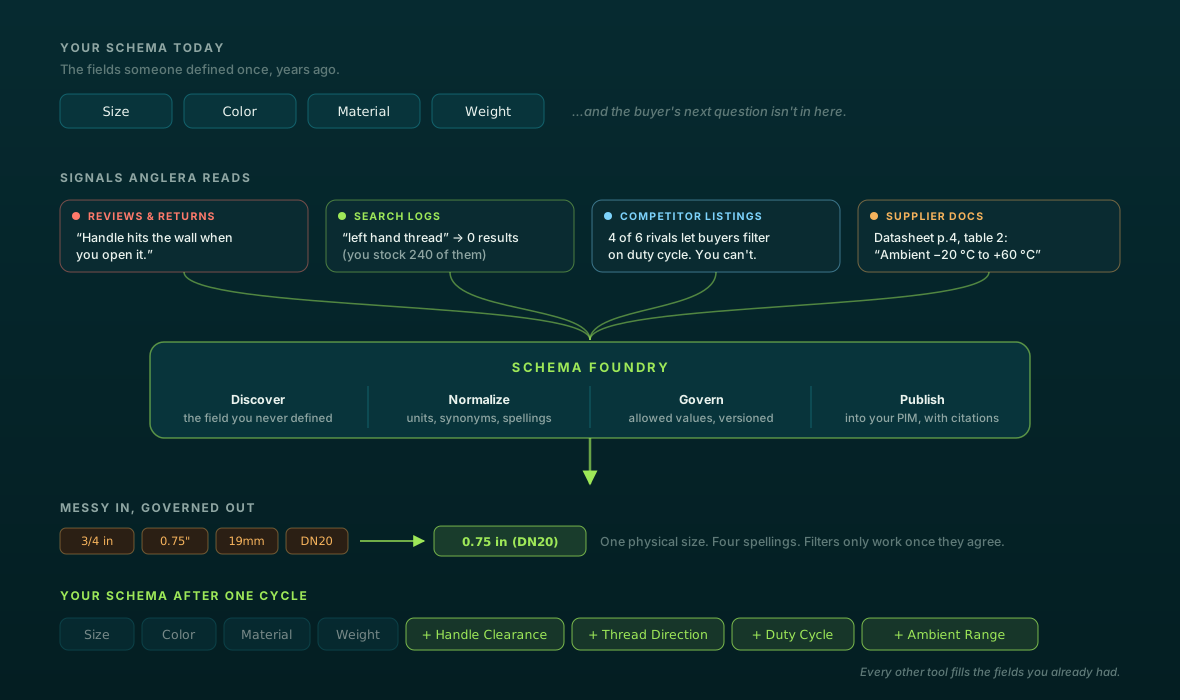
Anglera is the layer that does that work. It crawls manufacturer sites, distributor catalogs, and specification sheets to gather raw data; normalizes attributes to your taxonomy; scores completeness against buyer signals (the attributes that actually drive add-to-cart and quote requests); and writes the enriched record back to whichever system holds the master data — Plytix, Unilog CX1, or both.
The result is that every Plytix feed goes out with richer, more complete data, and every Unilog catalog page renders with attributes that convert. Anglera does not replace either platform — it makes the platform investment pay off faster by handling the enrichment work both tools assume has already happened. Implementation runs in roughly 30 days and operates in parallel with whatever PIM or commerce project is already underway.
Frequently asked questions
Can Plytix replace Unilog CX1 for a B2B distributor?
Not directly. Plytix is a product content and syndication platform with no B2B commerce storefront, no ERP integration layer, and no managed vendor SKU library. A distributor who needs a customer-facing B2B ecommerce site synced to their ERP would need to build those layers separately if they chose Plytix. Unilog CX1 bundles all of those components together, which is why it is common among mid-market distributors.
Does Unilog CX1's content library mean I do not need a separate enrichment tool?
The 10M+ SKU library covers products from manufacturers who have submitted data to Unilog's network — primarily in electrical, industrial, plumbing, and HVAC. SKUs outside that library, private-label products, or items where the manufacturer data is incomplete still need enrichment work. Unilog sells custom enrichment services for this, but a tool like Anglera can handle it programmatically at scale and at lower per-SKU cost.
How does Plytix's AI content generation compare to structured enrichment?
Plytix's AI tools generate and translate marketing descriptions — useful for readability and SEO copy. Structured enrichment is different: it extracts and normalizes product attributes (dimensions, certifications, compatibility specs) from raw sources and maps them to a consistent taxonomy. Both matter; they address different parts of the product record. Anglera handles structured enrichment and completeness scoring; it works alongside Plytix's AI generation rather than replacing it.
What does Unilog CX1 implementation actually involve?
A full CX1 deployment is a multi-month project that typically includes ERP integration configuration, storefront setup and theming, taxonomy and category tree work, content migration or subscription setup, and user training. It is scoped by a Unilog implementation team and priced accordingly. Companies should budget time and project resources, not just software license costs.
Where does Anglera fit if we are still evaluating our PIM?
Anglera can run enrichment against your existing catalog data before your PIM choice is finalized — the enriched output writes back to whatever system you designate as the master record. This means you can use the enrichment project to clean and structure your data, which also makes the PIM implementation faster since you are loading higher-quality records from day one.