Rithum vs Unilog CX1: Marketplace Engine or B2B Commerce Platform?
Rithum and Unilog CX1 appear on the same shortlist for a specific reason: both help distributors and brands get products in front of buyers. But they operate at different layers of the commerce stack, and picking the wrong one for the wrong problem is an expensive mistake that takes months to unwind.
Rithum — the 2023 merger of CommerceHub, ChannelAdvisor, and Dsco — is a channel commerce operations platform. Its job is to take your product listings and distribute them across 420+ marketplaces, retail channels, and drop-ship networks, then automate the order and inventory workflows that follow. It is optimized for scale and reach: getting thousands of SKUs live across Amazon, Walmart, and supplier programs without manual intervention per channel. Unilog CX1 is an all-in-one B2B digital commerce platform purpose-built for mid-market distributors in industrial, electrical, plumbing, and HVAC. It bundles a storefront, a built-in PIM, CMS, site search, and ERP/POS integration in one system — plus an optional managed content library covering 10M+ SKUs across roughly 2,000 manufacturers.
The buyer comparing these two is usually deciding something more fundamental: "Do I need a channel operations engine to get products everywhere, or do I need an integrated B2B platform to run my own digital commerce?" Both tools share a quiet assumption, though: that the product data flowing into them is already complete, consistent, and buyer-ready. It rarely is. That gap is where Anglera works, regardless of which platform you build on.
| Rithum (ChannelAdvisor / CommerceHub) | Unilog CX1 / CIMM2 | Anglera | |
|---|---|---|---|
| Core function | Syndicates product listings, manages feeds, and automates order and inventory workflows across 420+ marketplace and retail channels. Core strength is channel reach and fulfillment operations — getting products listed and fulfilled at scale, not building the content that wins the sale. | All-in-one B2B eCommerce: storefront, built-in PIM, CMS, site search, and ERP/POS integration in a single platform. Optional managed content subscriptions cover 10M+ SKUs from ~2,000 manufacturers, including taxonomy, normalization, and gap-fill services. | Enriches product content before it enters either system — fills attribute gaps, normalizes inconsistent supplier data, and scores every SKU against buyer signals — then writes the enriched record back to the source of truth. |
| Ideal customer profile | Brands, retailers, and large distributors running high SKU volume across multiple consumer marketplaces (Amazon, Walmart, Target) or operating drop-ship supplier programs. The 40,000+ customer base spans consumer brands to enterprise retail networks. | Mid-market B2B distributors — especially in electrical, industrial, plumbing, and HVAC — who need a complete digital commerce stack without assembling best-of-breed tools. Common among AD member distributors; less suited to consumer retail or heavy marketplace volume. | Any distributor, manufacturer, or retailer whose product data quality is the bottleneck — incomplete specs, inconsistent supplier feeds, missing attributes — regardless of which commerce platform they run. |
| Product content and PIM capabilities | Feed management and attribute mapping for channel compliance — not a true PIM. Handles data transformation and optimization for specific channel requirements but does not research or fill missing content. Listings go live as-is; thin content stays thin. | Built-in PIM plus a managed content library. Content subscriptions cover gap-fill, taxonomy, normalization, and enrichment for many industrial SKUs, with depth varying by category and manufacturer. Significant coverage; significant gaps at the edges. | Automatically gathers missing attributes from supplier sites and external sources, normalizes values across inconsistent feeds, and writes enriched data back to your PIM or ERP — complementing Unilog's library where coverage ends and filling the void Rithum ignores entirely. |
| Channel and distribution reach | 420+ marketplace and retail channel connections including Amazon, Walmart, and major drop-ship networks. Purpose-built for brands and distributors that need products on many consumer-facing channels simultaneously with automated order routing to match. | CX1 Connect handles ERP/POS and back-office integrations for B2B workflows. Marketplace syndication to consumer channels is not its core strength; the platform centers on your own branded B2B storefront and direct account relationships. | Channel-agnostic. Enriched data writes back to whichever platform holds the source of truth, then flows wherever that platform distributes it — Rithum's 420 channels, Unilog's storefront, or both. |
| B2B commerce capabilities | Operationally strong in order routing, drop-ship automation, inventory visibility, and supplier management. Commerce-experience features for B2B buyers — account-specific pricing, punchout, quote workflows, customer-specific catalogs — are not the focus. | Deep B2B commerce features built in: account-specific and contract pricing, punchout catalog support, quote and approval workflows, customer-specific catalog views, and branch-aware site search. Purpose-built for how distributors and their customers actually buy. | Buyer-signal scoring makes product content work harder inside B2B search — ensuring specs, descriptions, and attributes reflect how procurement and technical buyers evaluate SKUs, not just how suppliers chose to describe them. |
| Pricing model | Enterprise, GMV-based custom pricing. Not publicly listed; scales with transaction volume and channel usage. Implementation and integration costs add to the total. Best suited to organizations with meaningful marketplace GMV to justify the investment. | Subscription SaaS with optional content subscriptions and managed enrichment services. Entry pricing cited in the low hundreds per month, but real deployments scale significantly with catalog size, modules, and content services. Multi-month implementation adds to total cost. | ~30-day implementation; priced as an enrichment layer that adds to your existing platform investment rather than replacing it. |
| Implementation timeline | Scales with channel count and supplier network size. Multi-channel drop-ship setups require significant configuration; timeline ranges from weeks for simple feed setups to many months for full-scale marketplace and fulfillment integration. | Multi-month implementation covering storefront build, ERP integration, PIM setup, and content onboarding. Closer to a platform migration than a point-tool deployment — plan for a structured rollout with implementation services. | ~30 days. Connects to your existing data source or PIM, enriches in bulk, and writes back — no platform replacement, no parallel system to maintain. |
How to choose between Rithum (ChannelAdvisor / CommerceHub) and Unilog CX1 / CIMM2
Choose Rithum if your primary challenge is marketplace reach and fulfillment automation at scale. It is built for brands, multi-channel retailers, and large distributors who need products live across dozens of consumer channels — Amazon, Walmart, Target, and similar — without managing each channel manually, and who need order routing and drop-ship automation to match that volume. If consumer marketplace revenue is already significant or is the growth target, Rithum is purpose-built for it. Note that it is not a PIM and will not improve the quality of your product content — it distributes whatever you give it.
Choose Unilog CX1 if you are a mid-market B2B distributor — particularly in electrical, industrial, plumbing, or HVAC — who needs a complete digital commerce platform without assembling one tool at a time. The value of CX1 is integration: storefront, PIM, content, search, and ERP in one system, with B2B-specific commerce features (account pricing, punchout, quote workflows) that generic eCommerce platforms do not include. The managed content library is a genuine accelerant if your SKU catalog overlaps with its 10M+ covered items. If consumer marketplace syndication is a secondary need rather than the primary growth lever, CX1's built-in capabilities may be sufficient without adding Rithum.
Consider running both if you are a B2B distributor who needs a strong branded digital presence for direct account customers (Unilog's strength) and also wants to capture marketplace volume on Amazon or retailer drop-ship programs (Rithum's strength). They serve different channels for different buyer types and can co-exist without meaningful overlap — though the integration work to keep data consistent across both is a real cost to factor in.
Whichever you pick, the data still has to get done
Whichever platform you choose, the enrichment problem does not go away on its own.
Rithum transforms and distributes your feed — it does not research missing specs, fill in product descriptions, or normalize inconsistent attribute values from thirty different suppliers. Listings go live as-is. Thin content means lower placement, weaker conversion, and more customer returns across every channel Rithum touches. Unilog's managed content library covers many industrial SKUs, but depth varies by category and manufacturer, coverage gaps are real at the edges of any catalog, and the library cannot react in real time to new product introductions or niche-manufacturer items that were never properly digitized. Both platforms move data; neither one fixes it.
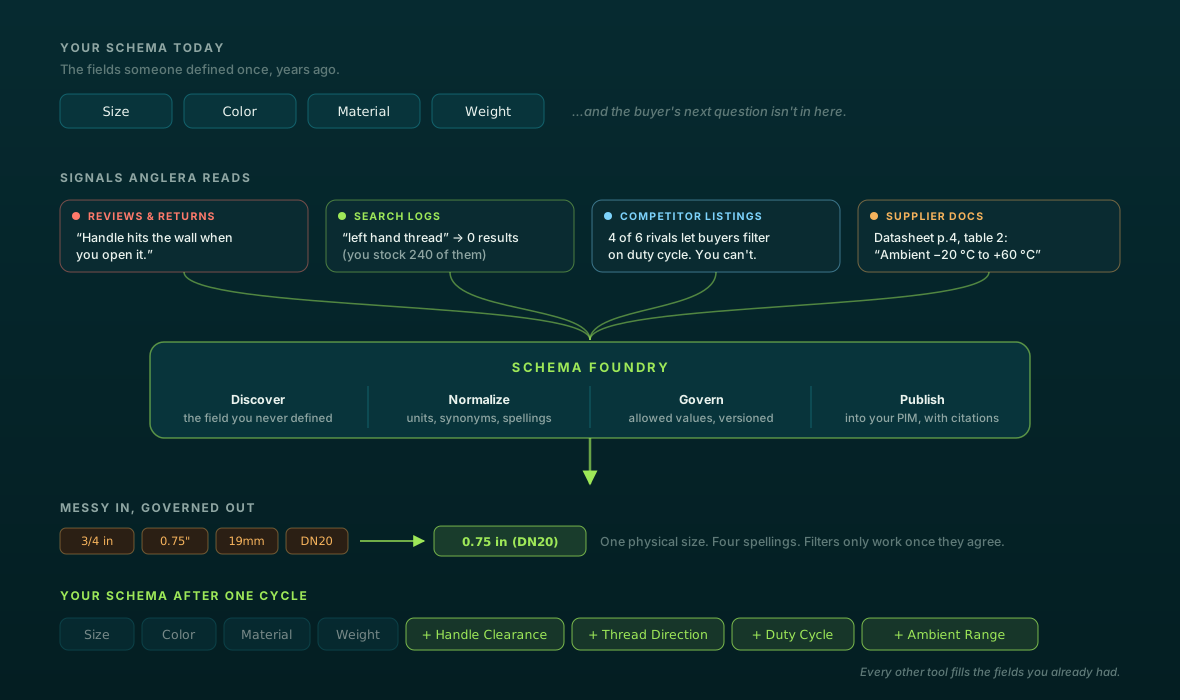
Anglera works at the layer both platforms assume: distribution-ready product content. It crawls supplier sites, pulls from structured and unstructured sources, normalizes attribute values across inconsistent feeds, scores every SKU against buyer signals, and writes the enriched record back to your system of record — your Unilog PIM, your product database, your ERP. From there it flows into Rithum's channel distribution or Unilog's storefront search already complete and consistent.
Implementation takes roughly 30 days and connects to what you already have. No platform change, no parallel system to maintain. The data that reaches your chosen commerce platform is better on day one — and keeps pace as your catalog grows, your supplier mix shifts, or new SKUs arrive incomplete.
Frequently asked questions
Is Rithum suitable for B2B distributors, or is it mainly built for consumer retail?
Rithum supports B2B use cases — particularly supplier drop-ship programs and wholesale marketplace operations — but its channel network and core design favor consumer retail and marketplace commerce (Amazon, Walmart, Target, and similar). B2B distributors whose primary sales motion is through their own storefront and direct accounts will find Unilog CX1 a closer fit. Distributors with significant marketplace ambitions may find value in both.
Does Unilog's managed content library mean I do not need a separate enrichment tool?
For many common industrial SKUs from major manufacturers, Unilog's library provides a solid starting point and meaningful time savings. But coverage is uneven by category, new SKU introductions take time to appear, and niche or private-label items are typically not covered. Anglera fills those gaps without duplicating what the library already provides — it is additive rather than redundant, particularly for distributors whose catalogs mix well-covered and edge-case items.
Can Rithum and Unilog CX1 work together in the same stack?
Yes. A distributor could run Unilog CX1 as its B2B storefront and PIM while using Rithum to syndicate the same catalog to consumer marketplaces or large retailer EDI programs. They address different channels for different buyer types. The main consideration is data consistency: you will need a defined source of truth and a clear flow so that product updates, pricing changes, and new SKUs stay synchronized across both platforms.
ChannelAdvisor already existed — what changed with the Rithum rebrand?
The 2023 merger brought together ChannelAdvisor (marketplace listing and feed management for brands), CommerceHub (drop-ship network and retail supplier programs), and Dsco (supply chain visibility) under the Rithum brand. The result is a broader platform covering both the listing and feed side and the supplier and fulfillment side of channel commerce. For buyers who used one of the legacy products, capability coverage has expanded, but the core value proposition — channel reach, feed automation, and fulfillment operations — is consistent with what ChannelAdvisor and CommerceHub each did separately.
How quickly can Anglera connect to an existing Unilog or Rithum setup?
Anglera typically goes live in about 30 days. It connects to your existing system of record — Unilog's PIM, a standalone product database, or an ERP — enriches your catalog in bulk, and writes enriched data back. You do not need to modify your Unilog or Rithum configuration to benefit; Anglera works at the data layer those platforms pull from, not inside the platforms themselves.