
7-Eleven: From a Dallas Ice Dock to 85,000 Stores Worldwide
7-Eleven ranks #20 on NRF's Top 100 Retailers 2026 with $25.30B in U.S. sales. The ice-dock origin story behind the world's biggest convenience chain.
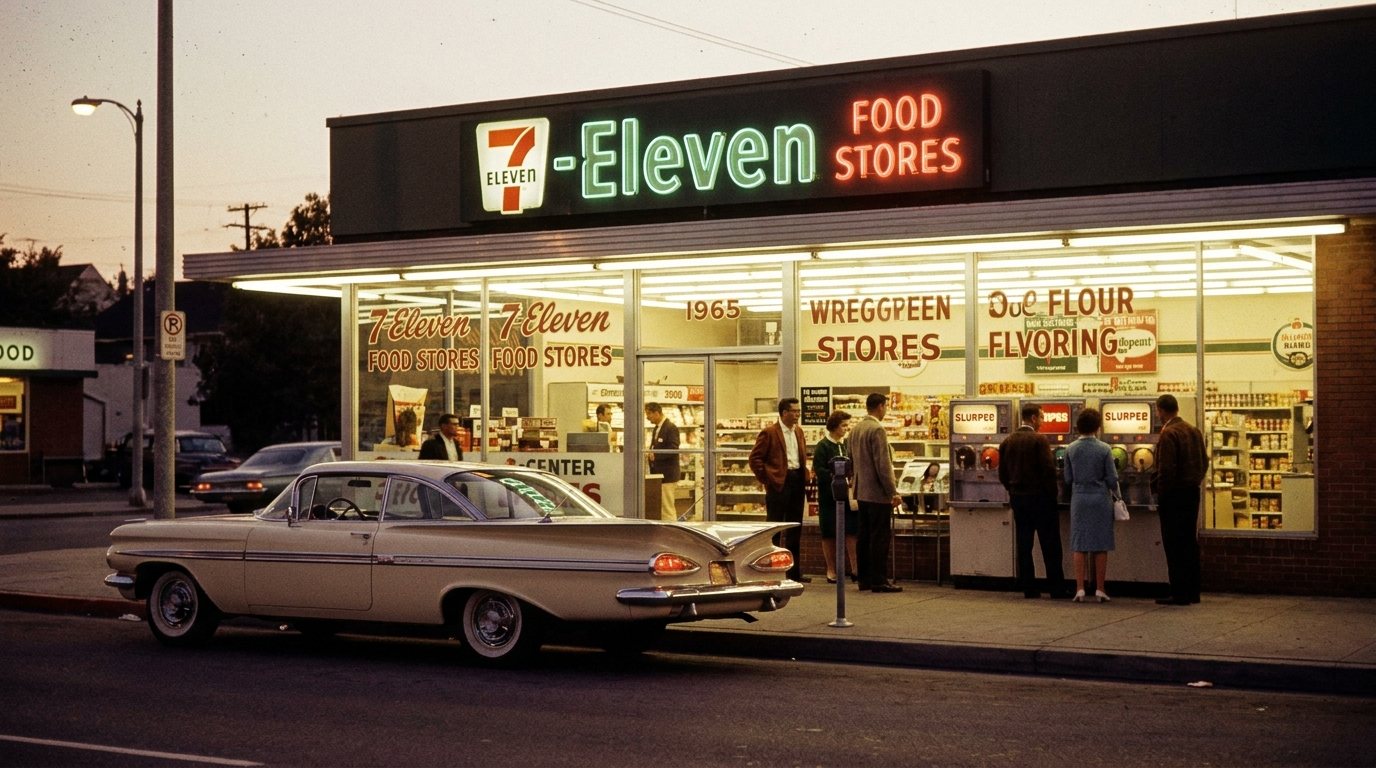
Part of Retailer Playbooks — history-first profiles of every company on the NRF Top 100 Retailers list.
7-Eleven lands at #20 on the National Retail Federation's Top 100 Retailers 2026 list, compiled with Kantar, with $25.30 billion in 2025 U.S. retail sales. That number describes a chain of roughly 13,000 U.S. stores. It says nothing about the stranger fact underneath it: the company that invented the American convenience store nearly died in 1990, was bought by the overseas licensee it had trained a decade earlier, and spent the 1990s importing its own idea back from Japan.
An Ice Dock in Dallas
The story starts in 1927, not with a store but with ice. Southland Ice Company ran a chain of ice docks around Dallas, and one dock manager, John Jefferson Green, started stocking milk, bread, and eggs alongside the ice blocks so customers didn't have to make a separate trip to the grocer. Founder Joe C. Thompson Sr. noticed the sideline was working and turned it into policy across the company's docks. It was, by most retail historians' accounting, one of the first convenience stores in the country, built on a simple insight: people would pay a little more to buy a little less, a little closer to home.
A year later a store manager named Jenna Lira staked an Alaskan totem pole outside her location as a promotional gimmick. It caught on enough that Southland rebranded its dock-stores as Tote'm Stores in 1928, the name playing on customers "toting" their purchases home. The company survived a bankruptcy of its own during the Depression in 1931, restructured under Thompson's leadership, and by 1939 had grown to 60 Tote'm locations across the Dallas-Fort Worth area, per FundingUniverse's company history.
The Hours Became the Name
In 1946 Southland renamed the chain again, and this time the name was the pitch: 7-Eleven, for the store hours, 7 a.m. to 11 p.m., seven days a week. Keeping a store open sixteen hours a day, every day, was not standard retail practice in postwar America, and the hours alone became the brand's reason for being.
Joseph Thompson's son, John P. Thompson, joined the board in 1948 and was named the company's second president in 1961 with a mandate to take Southland from $100 million to $1 billion in sales within a decade. The company hit $1 billion in sales by 1971, a year ahead of schedule. Along the way it picked up the moves that still define the chain: it acquired 100 SpeeDee Mart stores in 1963 to get into franchising, opened its first 24-hour location in Austin, Texas that same year after a store simply never closed because customers kept showing up, introduced the Slurpee in 1966, and rolled out the Big Gulp in 1976. By 1969 the chain counted 3,537 stores across the U.S. and Canada; the 5,000th store opened in 1974, fittingly built on the site of the original ice dock.
The License Deal That Ate Its Parent
Here is the turn most people miss. In 1973, flush with domestic growth, Southland granted an area license to sell 7-Eleven stores in Japan to a mid-sized general merchandiser called Ito-Yokado. It looked like a minor international footnote at the time, a licensing fee and a royalty stream from a market Southland had no intention of operating directly.
Ito-Yokado's convenience-store unit, run by an executive named Toshifumi Suzuki, didn't just copy the American format. Suzuki built a proprietary inventory and ordering system tuned to small-lot, high-frequency deliveries, matching what each individual store sold hour by hour against what its truck brought next. Seven-Eleven Japan became more disciplined about single-store profitability than the American original had ever been.
Southland, meanwhile, spent the 1980s on riskier ground: it bought Citgo Petroleum for $780 million in 1983 to lock up gasoline supply, then sold half of it back to Venezuela's state oil company in 1986 to raise cash. In July 1987 the Thompson family took the company private in a leveraged buyout that loaded on roughly $4 billion in debt right before a stock market crash and a wave of competition from oil companies opening their own convenience stores at the pump. Southland defaulted on $1.8 billion in public debt and filed for Chapter 11 bankruptcy in October 1990.
The rescue came from the licensee. IYG Holding, jointly owned by Ito-Yokado and Seven-Eleven Japan, acquired 70 percent of Southland's common stock for $430 million as part of the reorganization, and the company emerged from bankruptcy in under five months, in March 1991, according to Wikipedia's account of the restructuring. The company that had licensed its name and format to Japan in 1973 now answered to the business it had created.
Running the Playbook It Exported
What followed was less a rescue than a reverse import. Southland exited distribution and food processing in 1992 to focus solely on running 7-Eleven stores, completed a chainwide remodel by 1996, and in 1994 began rolling out a retail information system modeled directly on the one Seven-Eleven Japan had spent two decades refining. The American parent was now studying its former student's operating manual. By April 1999 the company retired the Southland name entirely and became 7-Eleven, Inc., and it logged eight straight quarters of same-store sales growth heading into the millennium. Seven-Eleven Japan took full ownership in 2005, folding into the newly formed Seven & i Holdings later that year.
The scale kept compounding. In 2021, Seven & i closed a $21 billion acquisition of Speedway from Marathon Petroleum, adding nearly 3,900 fuel-and-convenience stores across 36 states and making 7-Eleven, in combination with Speedway and its Stripes chain, one of the largest fuel retailers in the country. Today the network runs to roughly 85,000 stores across 20 countries, per Wikipedia, most of them independently franchised, still selling the same basic idea Joe Thompson Sr. noticed at an ice dock a century ago: a little more convenience, worth a little more money.
The unglamorous throughline of 7-Eleven's story is data before it was fashionable to call it that: knowing exactly what a single store needs on a single day, and getting it there. That discipline, born out of a near-death experience and imported from an overseas licensee, still runs every shelf in the chain.
This profile is part of Anglera's Retailer Playbooks series, chronicling the companies that built American retail.