
Save A Lot: The Cardboard-Box Grocer That Stopped Owning Stores
How Save A Lot went from a 1977 St. Louis discount grocer stacking cans in shipping boxes to a fully licensed wholesale network with 720 stores.
Part of Retailer Playbooks — history-first profiles of every company on the NRF Top 100 Retailers list.
Save A Lot ranks #100 on the National Retail Federation's Top 100 Retailers 2026 list, compiled with Kantar, with $4.06 billion in 2025 U.S. retail sales. That number alone is unremarkable next to the giants above it. What is remarkable is that almost none of it comes from stores Save A Lot itself operates.
A grocery store built out of shipping cartons
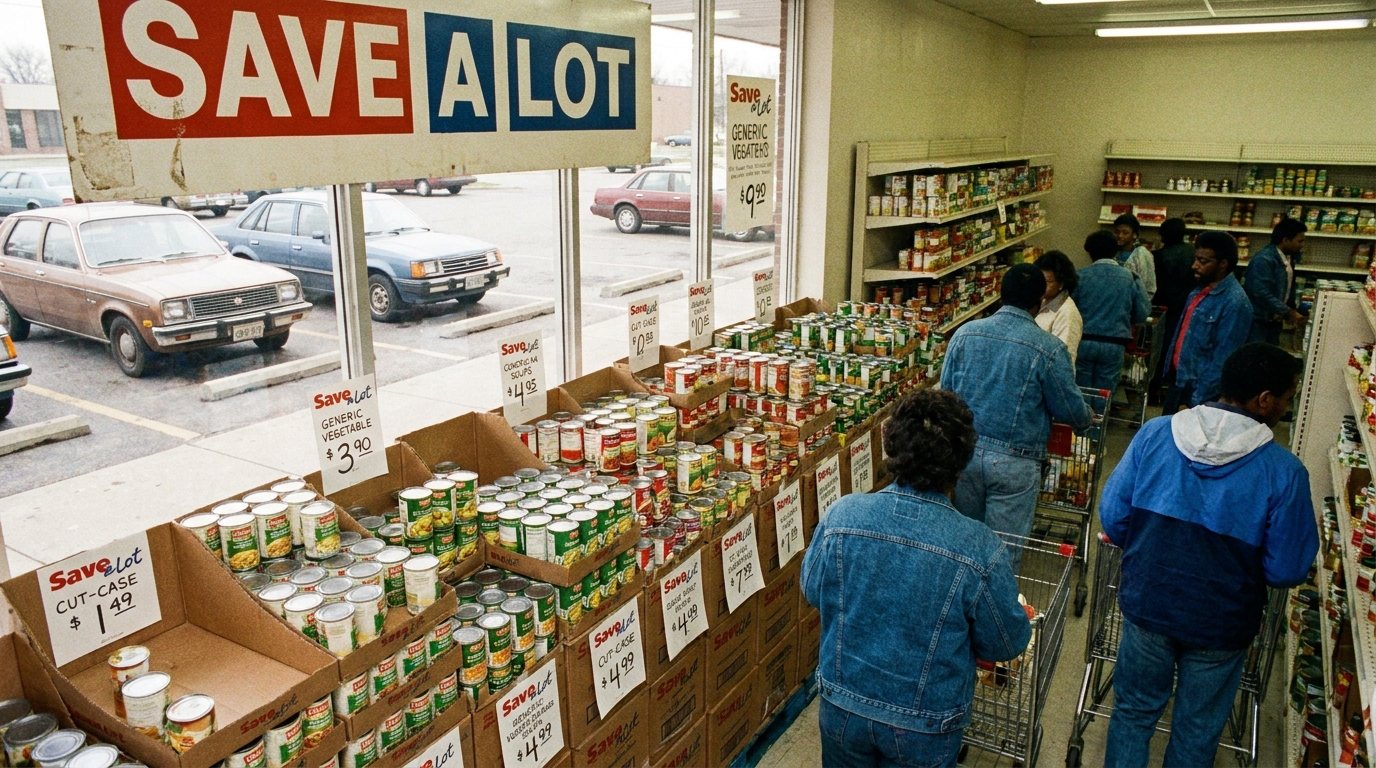
In 1977, Bill Moran opened a grocery store in Cahokia, Illinois, just across the river from St. Louis, that broke nearly every rule of the supermarket format his competitors were racing to perfect. Where rivals were adding deli counters, wider aisles, and thousands of SKUs, Moran's store did the opposite: about 15,000 square feet, a tight assortment of fast-moving staples, and product displayed right in the cardboard cases it shipped in rather than stocked onto shelves. The idea, drawn from the hard-discount grocery concepts already working in Europe, was that a shopper doesn't need thirty mustards. She needs one good one, at a low price, and she'll forgive the unglamorous packaging if the register total makes it worth the trip.
It worked. Moran's company, later organized as Moran Foods, grew the format through the St. Louis region starting in 1978, then pushed into the Mid-South, adding 50 stores in a single year in 1980 and opening a warehouse in Jackson, Tennessee, to feed them. By the end of the 1970s the chain had roughly 30 stores; a decade later it was a regional force, and in 1984 it bought 75 similarly formatted Jewel T stores and two distribution centers from Jewel, nearly doubling its footprint and its supply chain in one move.
Getting bought by the people who'd have to compete with it
Save A Lot's next chapter is a lesson in how discount formats get absorbed rather than defeated. In 1987, Wetterau Inc., a conventional St. Louis food wholesaler and retailer, bought the chain outright. Then in 1994, Supervalu, itself a wholesale grocery giant, acquired Wetterau and inherited Save A Lot along with sister chain Shop 'n Save. Rather than fold the discount format into its conventional banners, Supervalu let it keep growing on its own terms, expanding into Southern California in 1996 with the purchase of 21 Sav U Foods stores and buying a distribution center from Fleming Companies that same year.
Under Supervalu, Save A Lot experimented outside its core lane too. In 2002 it acquired the Deal$ discount variety chain, grew it to 138 stores by 2006, then sold it to Dollar Tree for $30.5 million plus inventory when the retail-arbitrage math stopped favoring a grocery parent running a general-merchandise sideline. The core banner kept adding stores through the 2000s, including nearly 100 new locations in 2010, and briefly tested international licensees in the Caribbean and Central America starting in 2009 (those licenses were wound down by 2018).
The buyout, the rescue, and the quiet reinvention
By 2016, Save A Lot had grown large enough, and Supervalu's wholesale business had shifted enough, that Supervalu sold the chain to private equity firm Onex Corporation for $1.37 billion. It's the moment the company's ownership stopped being a grocery operator and started being a financial sponsor betting on a licensing model rather than a store network.
That bet needed a rescue first. In April 2020, Save A Lot completed a recapitalization that canceled roughly $500 million in debt and injected $350 million in new capital, the kind of balance-sheet reset that usually follows a bankruptcy filing rather than substituting for one. What Save A Lot did next is the part worth studying closely, because it's not the standard playbook for a discount grocer that survives a debt crisis.
Between 2020 and 2023, Save A Lot systematically sold off the stores it still operated directly to independent retailers and franchisees, converting itself from a chain that owns boxes to a company that licenses a brand, a supply chain, and an operating format to owners who put up their own capital and carry their own store-level risk. By August 2023, with Leevers Supermarkets buying the last 18 corporate locations, the transition was complete: Save A Lot became a 100 percent licensed network, with the parent company (still Moran Foods, LLC, per its own site) acting as wholesaler and brand steward to roughly 720 independently owned stores across 32 states.
The insight that doesn't show up on the About page
Most retail histories describe a company's format innovation and then its ownership churn as two separate stories: what the founder built, and who bought it later. Save A Lot's is unusual because the ownership churn became the format innovation. The company didn't just survive a leveraged buyout and a debt crisis; it used that crisis as cover to complete a structural transformation that most grocery chains never attempt while healthy, exiting store ownership almost entirely while keeping the brand and the supply relationships that made the format work in the first place. Aldi, its closest peer in the hard-discount playbook, still owns essentially every store it operates. Save A Lot bet that the real asset was never the real estate. It was the box.
Save A Lot's arc, from a single cardboard-carton store outside St. Louis to a wholesale license on 720 independent operators' doors, is a reminder that the plumbing behind a grocery aisle, the warehouse, the assortment discipline, the label on the box, often outlasts whoever happens to own the register.