
Ingles Markets: How a Grocer Became Its Own Landlord and Dairy
Ingles Markets ranks #94 on the NRF Top 100 Retailers. How a 1963 Asheville grocery startup grew by owning its stores, its milk supply, and its Appalachian niche.
Part of Retailer Playbooks — history-first profiles of every company on the NRF Top 100 Retailers list.
Ingles Markets lands at #94 on the NRF Top 100 Retailers 2026, with $4.50 billion in 2025 U.S. retail sales, a ranking the National Retail Federation compiles annually with Kantar. It is one of the smallest chains on that list by store count, and one of the strangest by balance sheet. Read the filings and you find a supermarket operator that also happens to be a working dairy and a substantial commercial landlord.
A Grocer's Son Gets His 4,000 Square Feet
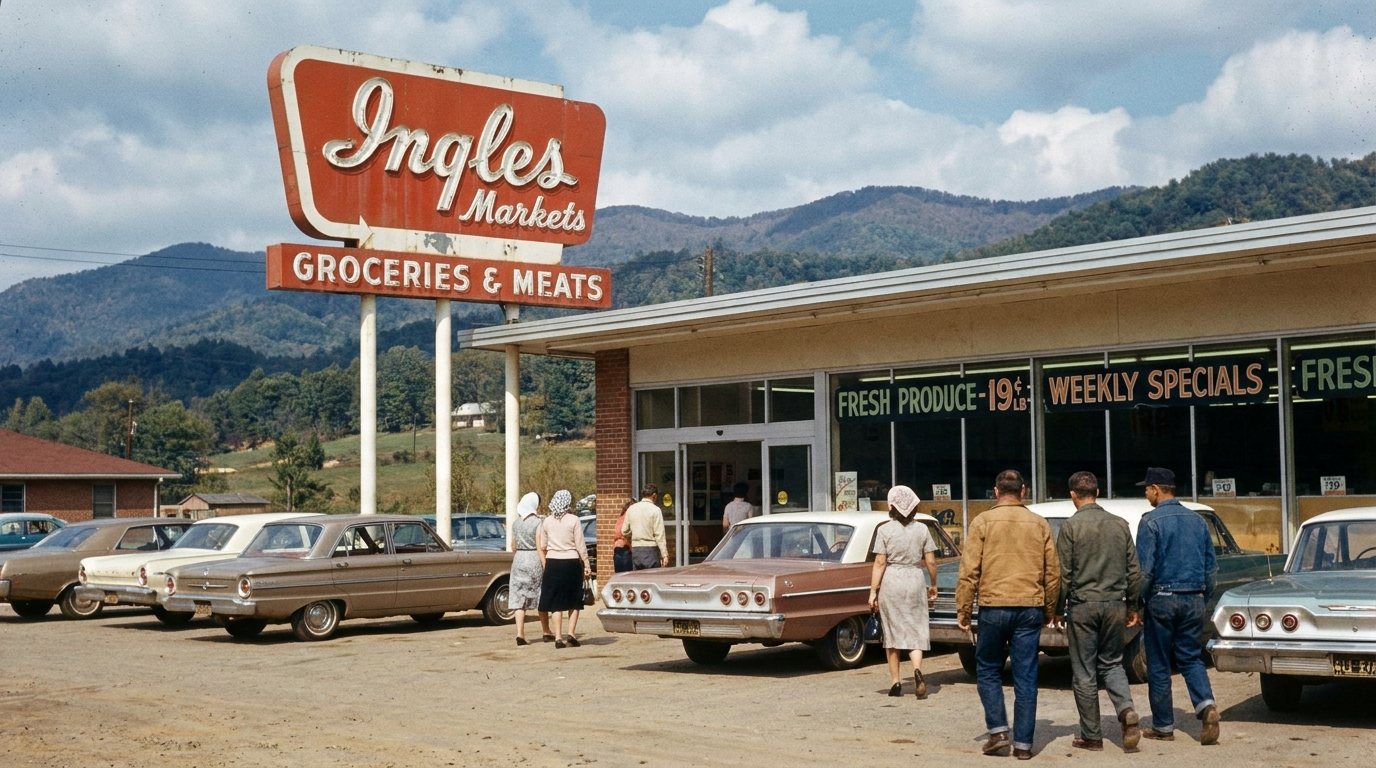
Robert P. Ingle grew up in his father's grocery business in western North Carolina, and by the account preserved in company histories, he wanted to build something bigger than the family store. His father resisted the idea. Ingle waited until his uncle died in the 1950s before he moved, and in 1963, at 29, he opened the first Ingles store on Hendersonville Road in Asheville, North Carolina, financed with his mother's and sister's savings and a mortgage on the family home, according to a history compiled by FundingUniverse. The company incorporated in 1965 and picked up six Colonial supermarkets by 1967, giving it an immediate foothold beyond the original store.
The early strategy was narrow by design. Ingles partnered with Merchant Distributors, Inc. for frozen foods and produce so the young company could concentrate on running stores rather than building a supply chain from scratch, per the same account. That patience showed up again and again over the next five decades: Ingle grew by inches into places nobody else wanted, then locked in the ground underneath what he built.
Building a Dairy to Feed the Stores
In 1978, Ingles opened a 450,000-square-foot distribution center outside Asheville to support stores across North Carolina and neighboring states, according to Wikipedia. Four years later came the move that still defines the company's operating model: in 1982, Ingles bought a milk processing plant from Sealtest and turned it into Milkco, Inc., a wholly owned subsidiary.
That single acquisition is the unique thread in the Ingles story, and it rarely makes it into coverage of the chain. By 1996, Milkco was the second-largest milk processor in North Carolina, supplying roughly 90 percent of the fluid milk sold in Ingles stores. But the more telling number is what Milkco did with its spare capacity: two-thirds of its business eventually went to food-service distributors across 17 states, per FundingUniverse, meaning Ingles' own dairy plant was selling milk to grocers who compete directly with Ingles on the shelf. A vertical-integration move built to secure one company's supply chain quietly became a regional wholesale business in its own right.
Financing Growth by Selling the Real Estate, Then Buying It Back
Ingles went public in September 1987, listing on NASDAQ under IMKTA at $13 a share, with Robert Ingle retaining roughly three-quarters ownership through Class B shares, a structure that still gives the Ingle family effective control today. The IPO gave the company capital, but its most instructive real estate maneuver came around it. In 1986, Ingles sold 23 of its shopping centers to IRT Property Company for $50 million, above book value, and leased them back, freeing up cash while keeping the stores running. By 1992, with the balance sheet healthier, Ingles bought those same properties back for $55.6 million.
That round trip is worth sitting with. Most retailers treat real estate as something to shed under pressure and never revisit. Ingles used a sale-leaseback as a financing bridge, not a retreat, and reversed it the moment it could afford to own its footprint outright again. Today the company owns the large majority of the roughly 200 supermarkets it operates across six southeastern states, North Carolina, South Carolina, Georgia, Tennessee, Virginia and Alabama, according to Wikipedia, which makes Ingles as much a holder of Appalachian commercial real estate as it is a grocer.
Finding the Gaps the Giants Left Behind
Ingles never tried to out-discount the national chains expanding into its territory. Former CFO Jack Ferguson put it plainly in comments preserved by FundingUniverse: the company found "our niche in the market" in rural counties and small towns where larger competitors like Food Lion had thin coverage, rather than fighting them store for store in the suburbs. That discipline let Ingles cross $1 billion in annual sales by fiscal 1990 and keep growing through a decade when many regional grocers got bought or squeezed out. In the 1990s, Ingles introduced "MegaStores" of 54,000 to 59,000 square feet with expanded delis, rotisserie chicken, fresh pizza and sit-down cafes, and by fiscal 1996 posted record results of $1.473 billion in sales and $20.7 million in net income.
A Rough Patch, Handled Quietly
Not every chapter was clean. In 2005, Ingles restated financial results for fiscal years 2002 and 2003 and the first three quarters of 2004. The SEC issued a Wells Notice in January 2006, and the matter settled in April 2006 without a monetary penalty, per Wikipedia's summary of company filings. It is a small, resolved footnote in a five-decade run, notable mainly because it barely slowed anything down. Long-serving president Landy Laney had already retired in December 1996, handing daily operations to Vaughn Fisher while Robert Ingle stayed on as chairman and CEO into his 70s.
Passing the Company, Not Selling It
Robert P. Ingle died in March 2011 at age 77. His son, Robert P. Ingle II, who had spent years in operations at the company, became CEO. The Ingle family's Class B shares kept control in the family rather than opening the door to an outside buyer or a private equity roll-up, the path many regional grocers took once their founders stepped away.
Ingles today runs close to 200 stores, more than a hundred in-store pharmacies, over a hundred fuel stations, and the Milkco dairy operation alongside them, per Wikipedia and the company's own investor materials. It is a grocer that never stopped thinking like a landlord and a dairyman first.
The infrastructure behind a grocery aisle, whether it is a truck route, a milk plant, or the deed to the shopping center, tends to matter more than the storefront itself, and Ingles built its whole run on understanding that early.