
Schnucks: From a Meat Wagon and Candy Shop to Grocery Empire
Schnucks grew from a St. Louis meat wagon and candy shop into a 164-store grocer, then built 1939 Group to hold Festival Foods and Hometown Grocers too.
Part of Retailer Playbooks — history-first profiles of every company on the NRF Top 100 Retailers list.
Schnucks lands at #98 on NRF's Top 100 Retailers 2026 list, the National Retail Federation's annual ranking compiled with Kantar, with $4.10 billion in 2025 U.S. retail sales. That figure is the freshest chapter in an 87-year story that started with two separate family hustles a few miles apart in north St. Louis, one selling meat and one selling candy.
A Meat Wagon and a Confectionery
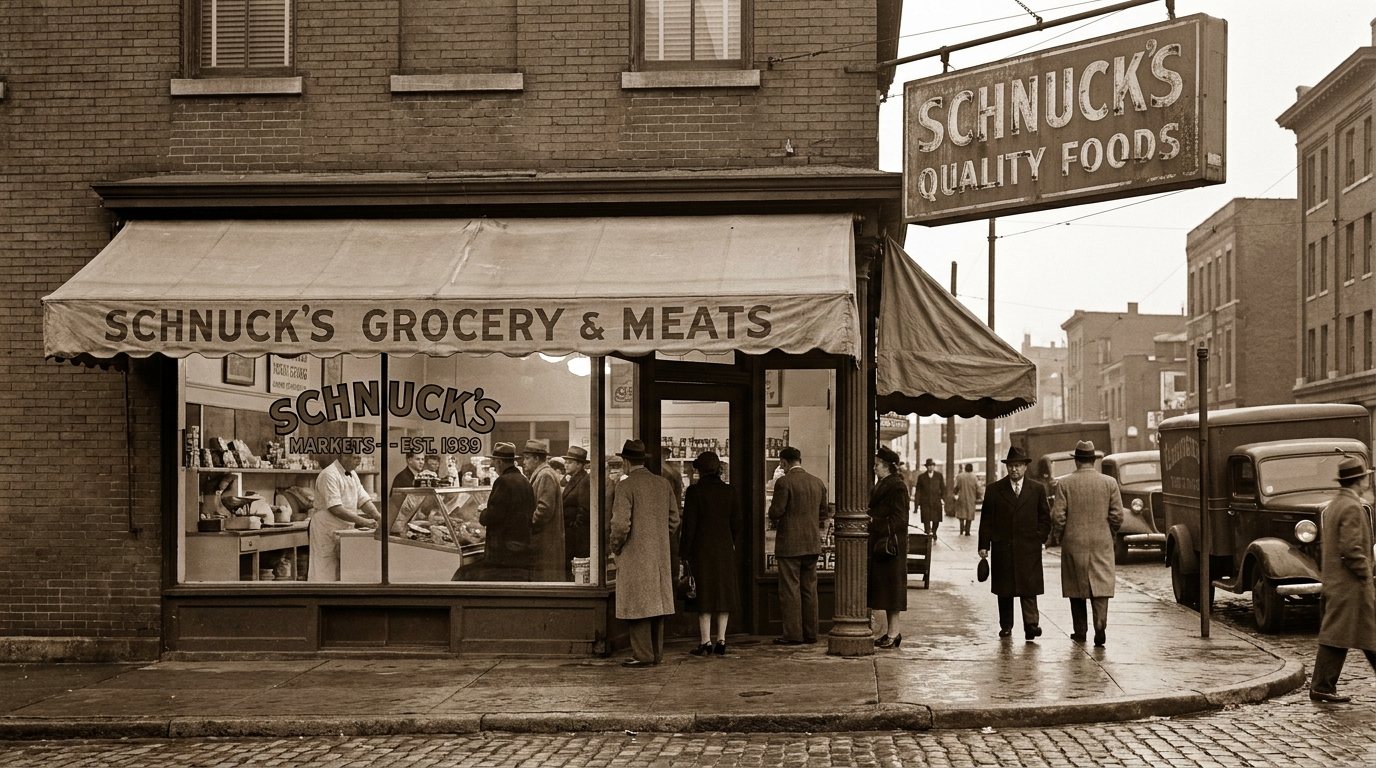
In 1937, Edwin Schnuck started a wholesale meat business. Two years later, his wife Anna Donovan Schnuck opened a confectionery store in the same corner of St. Louis. Neither venture looked like the seed of a regional grocery chain. But their children turned both into storefronts: son Edward opened a corner grocery, daughter Annette and her husband Raymond launched two more locations, and son Donald and his wife Doris opened another after Donald came home from naval service in World War II, according to the company's own history on schnucks.com.
By 1947, four branches of the same family were running seven separate grocery stores, all keeping the same buying practices and the same unwritten philosophy even though nothing bound them on paper. Edwin and his sons formalized that informal alliance in 1952, incorporating as Schnuck Markets, Inc. around two anchor stores in Manchester and Brentwood. Given the family's roots, the trade press took to calling them "The Meat Masters."
Ditching the Stamps
Every grocery chain in America ran a trading-stamp program by the early 1960s, the Green Stamps and Plaid Stamps that customers pasted into books and redeemed for toasters. Schnucks broke from the pack with what it called "The Price Revolution": drop the stamps, cut the prices instead. The saluting soldier logo the chain still uses today came out of that campaign, alongside the slogan "The Friendliest Stores In Town," adopted in 1961.
It was a bet that price transparency would beat the gamification of loyalty, years before every economist agreed that stamp programs were a tax customers paid without realizing it. Schnucks was right early.
Growing by Outlasting
Much of Schnucks' expansion through the late 20th century came less from outmaneuvering competitors than from simply still being there after they left. A&P pulled out of the St. Louis market in the 1970s. Kroger abandoned the region entirely in 1986. Both retreats handed Schnucks shelf space and customer habit it didn't have to fight for, per Wikipedia's account of the company's history.
Schnucks did plenty of fighting too. The 1970 acquisition of the Bettendorf-Rapp chain doubled its store count in one move and came bundled with Medi Mark, an in-store pharmacy format the company describes as the first combination food-and-drug store in its market. In 1995, Schnucks bought 57 stores from National Supermarkets, absorbing what had been its largest local competitor. The company crossed into Illinois for the first time in 1998 with the acquisition of Rockford-based Logli Supermarkets, then added seven more Illinois stores in 2011 through Hilander. A 2018 deal for 19 Shop 'n Save locations, once owned by SuperValu, filled out its Missouri and Illinois footprint further.
First in Line for Robots
In 2021, Schnucks became what it describes as the first grocery chain in the world to deploy autonomous inventory robots, nicknamed Tally, across its entire store fleet rather than as a pilot in a handful of locations. The same year, it opened its first "Schnucks Fresh" format store in Jasper, Indiana, a smaller footprint built around perishables and prepared food rather than a full traditional grocery floor plan. The company has since been named a U.S. Best Managed Company for three consecutive years, 2022 through 2024.
The 1939 Group
The most telling move in Schnucks' recent history isn't a store count. In September 2025, the Schnuck family created a new holding entity called 1939 Group, Inc., named for the year Anna Donovan Schnuck opened her confectionery store. Through that entity, the family bought 51 Wisconsin grocery stores: 42 Festival Foods locations and 9 Hometown Grocers stores, adding more than 8,000 employees to the organization, and the entity now shows up in the company's own leadership announcements on its news releases page.
Here's the part worth sitting with. Every acquisition in Schnucks' history up to this one, National Supermarkets, Logli, Hilander, Shop 'n Save, eventually got folded into the Schnucks banner. Festival Foods and Hometown Grocers did not. Both keep their own names, their own store identities, under a parent company that isn't called Schnucks at all. A family that spent 86 years building one of the most recognized regional grocery names in the Midwest just built a second structure specifically so it wouldn't have to erase the names it bought. That's a deliberate bet that Wisconsin shoppers' loyalty to Festival Foods is worth more intact than converted, and it turns Schnucks from a single-banner consolidator into something closer to a multi-banner house of brands, a structural shift most coverage of the deal treated as a footnote rather than the headline it actually is.
Every grocery chain eventually has to decide what to do with a name it didn't build. Schnucks just answered that question by building a bigger house to keep both names standing.