
Weis Markets: The Pennsylvania Grocer That Never Took Debt
Weis Markets ranks No. 92 on the NRF Top 100 with $4.69B in 2025 U.S. sales. Here's how a debt-averse, family-run grocer from Sunbury built a century-long moat.
Part of Retailer Playbooks — history-first profiles of every company on the NRF Top 100 Retailers list.
Weis Markets ranks No. 92 on the NRF Top 100 Retailers 2026, the National Retail Federation's annual sales ranking compiled with Kantar, with $4.69 billion in 2025 U.S. retail sales. That's a modest number next to the chains above it, and that's the point. Weis has spent 114 years proving a regional grocer can stay independent, stay profitable, and stay family-run in an industry that has swallowed almost everyone else who tried.
A Notions Store, Then a Grocery Bet
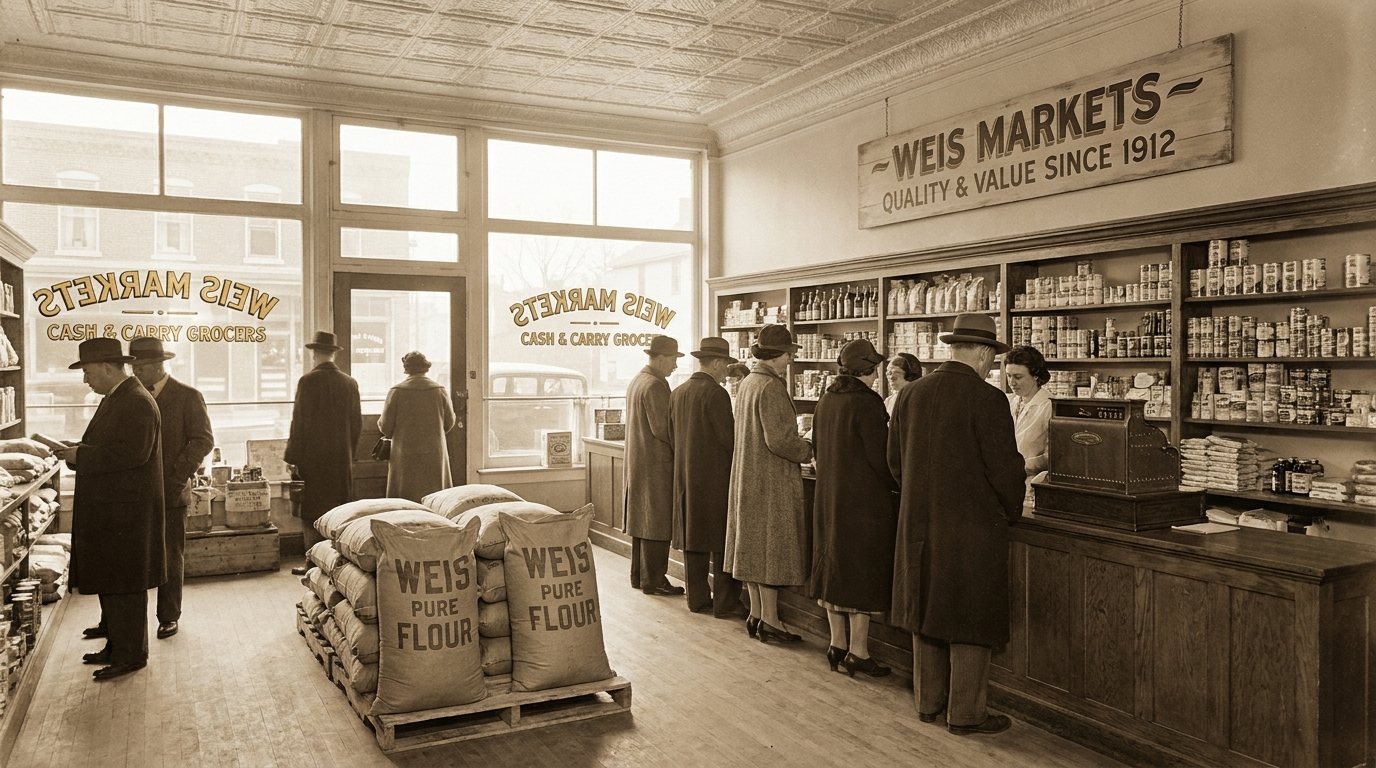
The name traces back further than the supermarkets do. Sigfried Weis, a German immigrant who landed in New York in 1867, built a "notions and fancy goods" store in Selinsgrove, Pennsylvania into the county's largest mercantile operation, according to FundingUniverse's company history. It was his sons, Harry and Sigmund Weis, who made the pivot that mattered: in 1912 they opened Weis Pure Foods in Sunbury, betting that groceries, not dry goods, were the future of small-town retail. A second store followed in Harrisburg in 1915, per Wikipedia.
The brothers built fast. By 1933, Weis Pure Foods ran 115 stores across 15 mid-state Pennsylvania counties, all on a cash-only model that FundingUniverse credits with letting the chain undercut competitors' prices by as much as 25 percent. No credit accounts, no float, no risk of a bad debt cycle taking the company down. That instinct, refusing leverage even when it slowed growth, would define Weis for the next century.
Surviving the Depression by Getting Smaller Stores Bigger
Most of the 115 Depression-era locations were small corner groceries, the format the whole industry had grown up on. Starting in 1938, Weis began consolidating them into larger, self-service supermarkets, riding the same format shift that built Kroger, Safeway, and A&P into national names. By 1955 the company had pared down to 35 full supermarkets, a smaller store count carrying far more volume than the 115 corner shops ever had.
Expansion resumed methodically rather than explosively: York in the 1950s, Lancaster in 1960, Maryland in 1967, then New Jersey, New York, Virginia, and West Virginia through the following decades. The 1967 purchase of five-store Albany Public Markets, done entirely in cash, set the pattern for how Weis would grow for the rest of its history: buy, don't borrow.
The Discipline That Became a Moat
Weis went public in 1965, but going public never meant giving up the family's control or its aversion to debt. By the mid-1990s, FundingUniverse reports, the company was sitting on roughly $457 million in cash, more than half its total assets, even while running "the most ambitious growth program in its 83-year history." Jonathan Weis, the fourth generation to run the company, put the philosophy plainly at the time: "I think our fundamentals would do well to stay the same. But we're always changing."
That balance sheet discipline paired with an unusual amount of vertical integration for a regional grocer. Weis operated its own dairy, ice cream plant, meat processing facility, and truck fleet, and it owned much of its own real estate rather than leasing it. It launched private-label products in the 1920s and by the 1990s ran three tiers, Weis Choice, Weis Quality, and Big Top, covering a quarter of total sales. A dedicated quality-control lab, opened in 1964, tested every private-label item before it reached a shelf. Few chains this size controlled that much of their own supply chain.
Buying What Others Couldn't Keep
The clearest evidence of the debt-free strategy paying off is what Weis did when rivals stumbled. Instead of Weis becoming an acquisition target, the way dozens of regional chains did as Ahold, Kroger, and Albertsons rolled up the industry, Weis kept absorbing smaller, distressed operators on its own terms.
| Year | Acquisition | What it added |
|---|---|---|
| 1967 | Albany Public Markets | 5 stores, first New York footprint |
| 1993 | Mr. Z's (IGA) | 14 stores in the Poconos and Lehigh Valley |
| 1994 | King's Supermarkets | 6 stores around Allentown |
| 2009 | Giant Markets | 11 stores in New York's Southern Tier |
| 2012 | Genuardi's locations | 3 Philadelphia-area stores from Safeway |
| 2016 | Food Lion stores | 38 stores across Maryland, Delaware, and Virginia |
The 2016 Food Lion deal is the sharpest example. Ahold Delhaize was pruning underperforming Food Lion locations after its own merger, and Weis picked up 38 of them in one move, its largest single expansion in decades, funded the same debt-averse way it had funded everything since 1912.
Fourth Generation, Same Playbook
Jonathan Weis still serves as chairman, president, and CEO, and the Weis family retains roughly 65 percent ownership of the company, per Wikipedia, a rarity among grocers of this scale. Today Weis runs close to 200 stores across Pennsylvania, Maryland, New York, New Jersey, West Virginia, Virginia, and Delaware, employing more than 23,000 people.
The unique thread here, the thing that doesn't show up on a company timeline, is that Weis's century of financial conservatism is precisely why it never had to become someone else's acquisition. Regional grocers that borrowed to grow fast usually ended up owned by whoever could out-leverage them. Weis grew slowly enough, and held enough cash, to be the buyer instead of the bought. Recent results extend the pattern: Supermarket News reported the company posting a 42.5 percent jump in first-quarter profit and a strong fourth quarter driven by e-commerce and pharmacy growth, evidence that the old discipline still shows up in modern categories, not just cash reserves.
A grocery chain's real infrastructure was never just the stores. It was the trucks, the private-label recipes, the land held for years before a shovel ever broke ground, and, in Weis's case, the balance sheet that let all of it stay in one family's hands for four generations.