
Abercrombie & Fitch: The Brand That Died Twice and Won
How a Manhattan gun-and-tackle outfitter for presidents and explorers became a teen mall giant, went bankrupt, and reinvented itself twice under one name.
Part of Retailer Playbooks — history-first profiles of every company on the NRF Top 100 Retailers list.
Abercrombie & Fitch lands at No. 99 on the NRF Top 100 Retailers 2026 list, with $4.09 billion in 2025 U.S. retail sales, a ranking the National Retail Federation compiles annually with Kantar. Most shoppers picture a mall storefront selling jeans and cologne to teenagers. The company started as something else entirely: an outfitter of elephant guns, canoe paddles, and safari kit for presidents, aviators, and novelists. It went bankrupt trying to stay that company, and it came back as something almost unrelated. Twice.
The Greatest Sporting Goods Store in the World
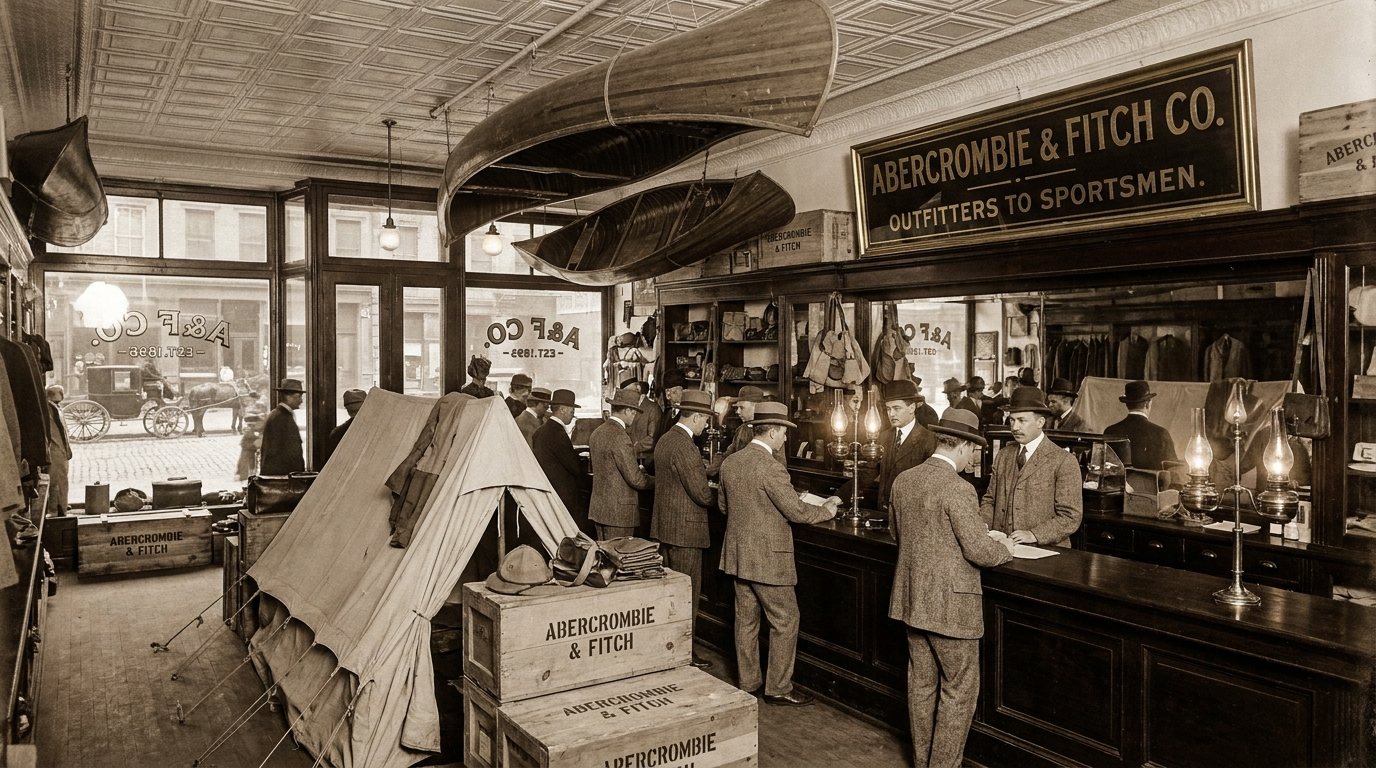
David T. Abercrombie, a former prospector and surveyor, opened a small camping and fishing-tackle shop in lower Manhattan in 1892. Ezra Fitch, a Kingston lawyer with a passion for the outdoors, bought into the business and eventually took it over; by 1900 it carried both their names. The two men clashed constantly over how big the store should get, and Abercrombie walked away from the partnership in 1907, leaving Fitch to run it alone.
Fitch's boldest bet came in 1909: he mailed 50,000 copies of a 456-page mail-order catalog, a production run so expensive it nearly sank the company before a single order shipped. It worked. By 1917 the firm had outgrown its space and moved into a twelve-story flagship on Madison Avenue at 45th Street, complete with a log cabin display and an indoor casting pool where clerks tested fishing rods for customers.
The client list read like a roster of the century's boldest names. Theodore Roosevelt outfitted his African safari there. Ernest Hemingway bought firearms across the counter. Amelia Earhart and Charles Lindbergh both shopped its aisles. By 1939 the store held what it called the world's largest firearms collection and 15,000 fishing flies, spread across eight specialized floors for hunting, skiing, archery, and golf. Management's own tagline was blunt and, for a few decades, true: "The Greatest Sporting Goods Store in the World."
Boom, Bust, and a Slow Refusal to Change
Net sales hit a record $6.3 million in 1929. The Depression gutted that almost immediately, sales fell to $2.6 million by 1933 with a loss of more than $500,000, but the business recovered enough to post an all-time record profit of $682,894 in 1947, and net sales reached $16.5 million in 1960.
Then the culture the store served started to disappear. A 1968 warehouse sale tried to clear out inventory nobody wanted anymore, and when the company finally ran its first television commercials in 1969, its own executives doubted the medium would work. Losses topped $1 million in a single year, and in August 1976 Abercrombie & Fitch filed for Chapter 11; the flagship closed for good in November 1977. Trade observers at the time put it plainly: the company had failed to move from outfitting "fat-cat sportsmen of the old school" to serving the skiers, bikers, and backpackers who had replaced them.
Sold for Parts, Then Sold Again
In 1978, Houston-based Oshman's Sporting Goods bought the Abercrombie & Fitch name and mailing list, not the stores or the inventory, for roughly $1.5 million, and relaunched it as a sporting-goods chain starting with a Beverly Hills store in 1979, growing to 26 locations by 1986. Forbes was skeptical at the time, warning that "sometimes it is better to bury the dead than to try reviving them."
The magazine wasn't entirely wrong. In January 1988, The Limited, Leslie Wexner's mall-apparel empire, bought the 25-store chain for about $45 million. Under president Sally Frame-Kasaks, the guns and hunting gear disappeared and apparel took the floor space. The pivotal decision came in 1992, when The Limited installed Mike Jeffries as chief executive with a mandate to rebuild the brand from nothing but its name. He decided it would become, in his words, "the retailer of choice for American youth."
| Year | Turn |
|---|---|
| 1892 | David Abercrombie opens a camping and tackle shop in Manhattan |
| 1909 | Ezra Fitch's 456-page catalog gamble, nearly bankrupts the firm, then succeeds |
| 1929 | Record $6.3M in sales at the sporting-goods peak |
| 1976 | Chapter 11; flagship closes for good in 1977 |
| 1978 | Oshman's buys the name and mailing list for ~$1.5M |
| 1988 | The Limited buys the 25-store chain for ~$45M |
| 1992 | Mike Jeffries hired, reinvents it as a teen apparel brand |
| 2017 | Fran Horowitz named CEO, drives a broader-customer turnaround |
A Teenager Built From a Trademark
Jeffries's reinvention had nothing to do with the old business except the name over the door. Revenue went from $85 million in 1992 to $111 million in 1993 to $165 million in 1994, and the chain grew to 67 stores by early 1995. He launched A&F Quarterly, a catalog-magazine built around Bruce Weber's photography that drew as much parental complaint as teen devotion, took the company public in 1996, and spun out Abercrombie Kids in 1998 and Hollister Co. in 2000. The Limited spun the whole company off in February 1999, headquarters moved to Reynoldsburg, Ohio, and by 2000 teenagers ranked it the sixth-coolest brand in America, ahead of Nintendo and Levi's. Jeffries ran the company for 22 years before departing in December 2014.
The Quiet Second Reinvention
Fran Horowitz joined in 2014 as president of Hollister, became chief merchandising officer in 2015, and took the CEO title in February 2017, the first new chief executive in over two decades. Her changes to merchandising, marketing, and store operations steered the company toward a wider range of customers than the exclusivity-driven Jeffries years had courted. By 2021 the company reported $3.71 billion in revenue across more than 780 stores, and it now operates four brands, Abercrombie & Fitch, Abercrombie Kids, Hollister, and YPB, per its own corporate site.
The Insight the About Page Skips
Most retailers either survive or they don't. Abercrombie & Fitch's name survived commercial death twice, and each resurrection had almost nothing to do with what came before it. A trademark and a mailing list, sold for scrap value in 1978, became a sporting-goods chain, then an apparel empire with no overlap in product, customer, or culture with the firearms-and-fly-fishing institution that built the name. The brand outlived the business under it, twice, a stranger and rarer thing in retail than most case studies acknowledge.
The 456-page catalog that nearly bankrupted Ezra Fitch in 1909 and the store reset that defines a mall retailer's calendar today are the same discipline underneath: getting the right goods in front of the right buyer before someone else does.