Urban Outfitters: From a Class Project to a Retail Empire
How a $5,000 class project at Penn became Urban Outfitters, a wholesale label that birthed Anthropologie, and a $4.63B apparel business on NRF's Top 100.
Part of Retailer Playbooks — history-first profiles of every company on the NRF Top 100 Retailers list.
Urban Outfitters lands at #93 on the NRF Top 100 Retailers 2026, the National Retail Federation's annual ranking compiled with Kantar, with $4.63 billion in 2025 U.S. retail sales. That figure understates the story. The company behind it, URBN, is really four retail brands and a rental subscription service built on top of a single idea two college students had in 1970: buy a cheap building, fill it with things students actually wanted, and let the staff decide what sells.
A $5,000 bet near Penn's campus
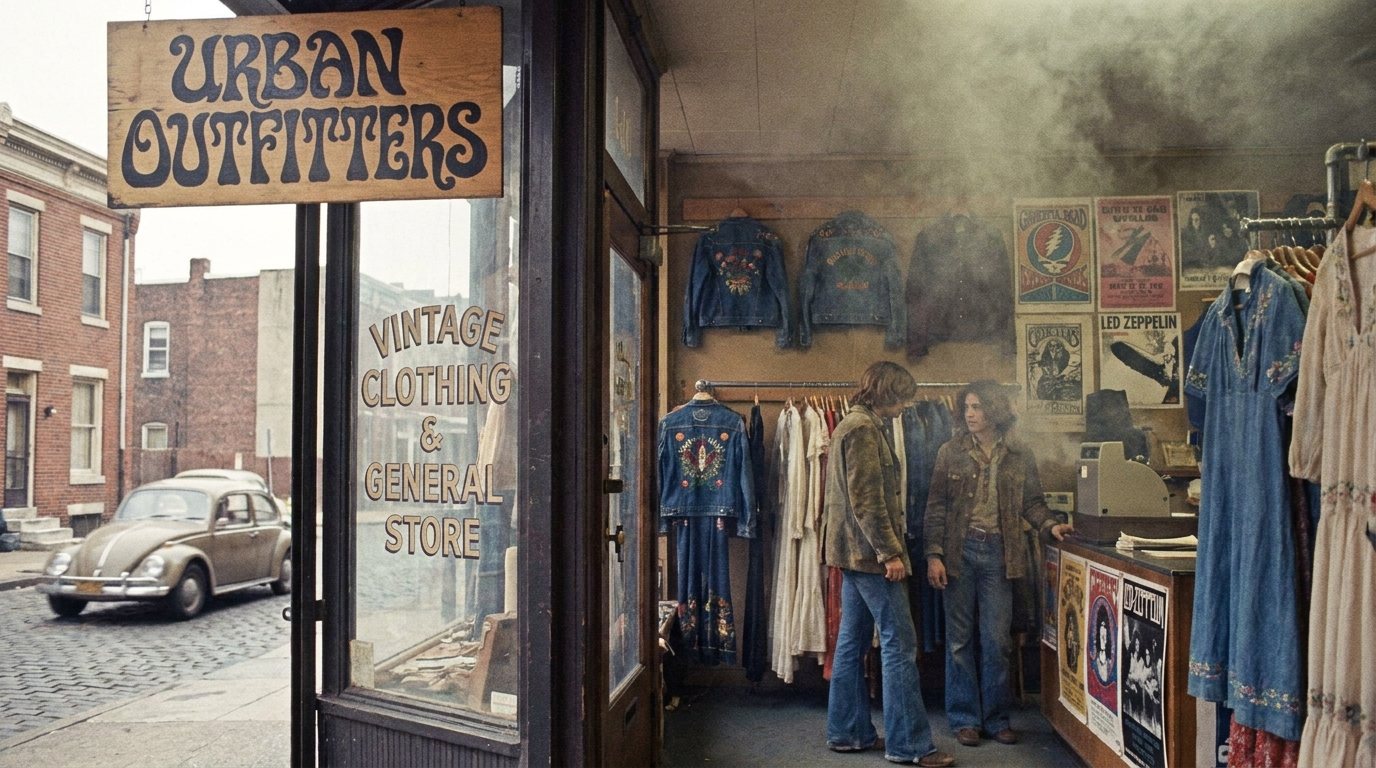
Richard Hayne, an anthropology graduate and former VISTA volunteer, and Scott Belair, a Wharton student, put up $5,000 to open a 400-square-foot shop near the University of Pennsylvania. Judy Wicks joined as a founding partner. The store was called the Free People Store, and it was, by Hayne's own account, a project for an entrepreneurship class. It sold secondhand clothing, Indian fabrics, scented candles, and ethnic jewelry, staged among packing crates and worn furniture rather than store fixtures, according to FundingUniverse's company history.
Hayne's insight wasn't the merchandise. It was who sold it. He hired staff who were the target customer, then let them shape what the store carried and how it looked. "Everyone associated with the store was that market," he told researchers years later. That single habit, hiring the shopper rather than a merchandising department, became the operating principle for every brand URBN would build over the next five decades.
Renovated buildings as brand strategy
In 1976, Hayne moved to larger quarters, renamed the business Urban Outfitters, and incorporated it. By 1980 the chain had grown to $3 million in sales and a second store in Cambridge, Massachusetts. A 1987 capital infusion, arranged after CFO Kenneth Cleeland tightened the company's financial controls, funded six more locations.
What set the expansion apart was real estate. Hayne refused to build to a standard box. Stores went into a former Woolworth's in Washington, D.C., a converted theater in Ann Arbor, and other buildings with history already baked into their walls. "We use an existing space to enhance our image," Hayne said. "None of our stores look alike." Decades before "experiential retail" became a category, Urban Outfitters had already turned the unglamorous cost center of commercial leasing into its most visible brand asset, and it did so by picking oddly shaped, previously occupied buildings that a more conventional chain would have passed over.
The chain planted itself deliberately near college towns: Madison, Ann Arbor, Minneapolis, Seattle, Boston, Chicago, Portland. Each store doubled as a farm system for reading its own customer, since the staff Hayne hired were students at the schools next door.
The wholesale arm that built Anthropologie
The pivotal, least-told chapter in Urban Outfitters' history is its wholesale division, created in 1984 to design and produce private-label merchandise at higher margin than anything bought from outside vendors. By 1990 that division was running three house labels aimed at different customers: Ecote, a casual rayon line; Free People, reviving the original store's name as a sixties-inspired collection; and Anthropologie, aimed at young women's knitwear.
Wholesale sales grew fast: up 50 percent from $10 million in 1989 to $15 million in 1990, then 76 percent and 56 percent in the two years after, per FundingUniverse. That wholesale muscle is what let Hayne open the first Anthropologie store in October 1992 in a converted auto dealership in Wayne, Pennsylvania, under new president Glen Senk, targeting an entirely different customer: suburban women 30 and older, shopping for home goods and clothing at once, in a store with its own espresso bar.
This is the unique insight most retail retrospectives skip past: Anthropologie wasn't dreamed up as a new store concept and then stocked. It was a wholesale label first, tested against outside retail buyers for years, before URBN ever built a store around it. The company had de-risked an entire second retail chain using its own supply chain as a proving ground, years before "test and learn" was a phrase anyone used in retail.
Going public, then a hard decade
Urban Outfitters went public in November 1993 at $18 a share, raising just over $13 million, and used the capital to keep opening stores at a steady clip. By the mid-1990s the company was ranked #76 on Businessweek's hot-growth list, selling over $500 per square foot for the first time, with total sales past $110 million, according to Wikipedia and FundingUniverse.
The next quarter century added the brands that make up URBN today: Free People grew from a house label into its own standalone chain and now rivals Urban Outfitters itself in scale, alongside home-and-garden concept Terrain and BHLDN for weddings. But growth wasn't a straight line. By the mid-2010s the flagship Urban Outfitters brand was posting declining same-store sales and foot traffic, the same mall-traffic erosion that hit most apparel chains of that era. URBN's answer, announced in the fourth quarter of 2015, was to acquire the Vetri Family restaurant group, a signal that the company was willing to diversify well outside apparel to keep its real estate producing revenue.
Betting on rental instead of another store format
The bet that actually worked came in 2019: Nuuly, a subscription clothing rental service, followed later by Nuuly Thrift, a resale marketplace for URBN labels and outside brands. Rather than opening another store chain to chase the same mall customer, URBN built a logistics-and-subscription business that monetizes clothing after the point of sale, competing with the resale and rental economy that had emerged partly in reaction to fast fashion, the very category Urban Outfitters had once been lumped into.
Today URBN runs eight brands, Urban Outfitters, Anthropologie, Free People, FP Movement, Anthropologie Weddings, Terrain, Menus & Venues, and Nuuly, out of its Philadelphia headquarters, with roughly 700 stores across the U.S., UK, Canada, Western Europe, and the Middle East. Richard Hayne, now in his seventh decade of running the business he started as a class assignment, still owns close to a fifth of the company.
Every category on this list eventually gets asked the same question retailers have faced for a century: what happens when the storefront stops being the only place customers show up. Urban Outfitters answered it first with buildings nobody else wanted, then with a wholesale label nobody had tested, then with a rental subscription nobody expected from a mall brand. This series will keep tracking how that question gets answered, one company at a time.