
American Eagle Outfitters: The Side Brand That Saved It
American Eagle Outfitters ranks #90 on NRF's Top 100 Retailers 2026 list. Here's how a camping-gear chain became a mall staple, then let its underdog brand lead.
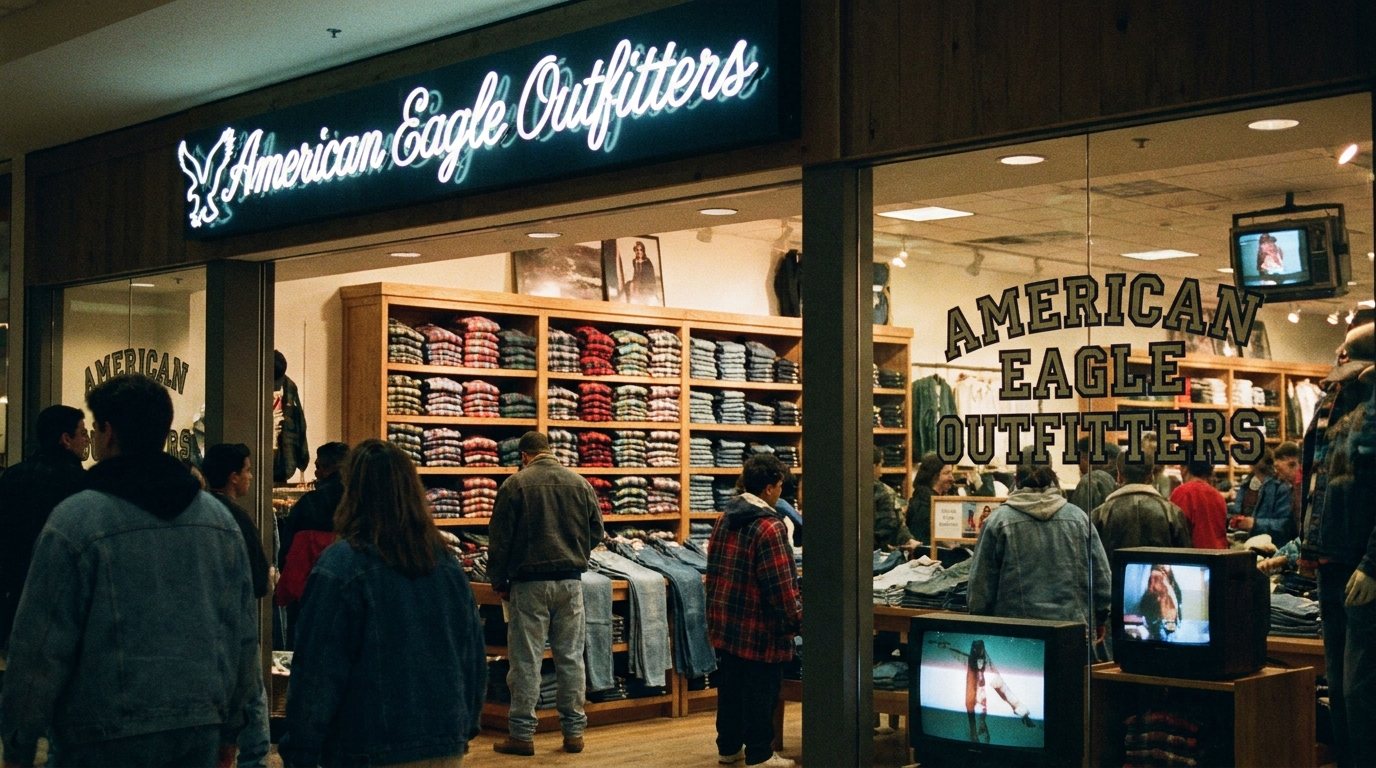
Part of Retailer Playbooks — history-first profiles of every company on the NRF Top 100 Retailers list.
American Eagle Outfitters ranks #90 on the NRF Top 100 Retailers 2026, the National Retail Federation's annual ranking compiled with Kantar, with $4.70 billion in 2025 U.S. retail sales. The name still evokes eagle-logo hoodies and jeans walls, but the company's most instructive chapter isn't the flagship brand at all. It's the intimates label nobody expected to matter.
A Camping Outfitter That Never Sold Camping Gear for Long
American Eagle opened its first store in 1977 at Twelve Oaks Mall in Novi, Michigan, a division of Silvermans Menswear, a Pennsylvania family retailer that traced back to 1904. Brothers Jerry and Mark Silverman built it as "a proprietor of brand-name leisure apparel, footwear, and accessories," pitched squarely at hikers, climbers, and campers, going head to head with L.L. Bean and Lands' End on outdoor gear rather than fashion, according to FundingUniverse's company history.
That positioning didn't last. In 1980 the Silvermans sold half the business, renamed Retail Ventures, Inc., to the Schottenstein family of Ohio, owners of Value City Department Stores. By 1989, Retail Ventures had shed its other retail concepts and was down to American Eagle alone: 137 stores, $125 million in sales, and no clear identity. The Schottensteins bought out the Silvermans entirely in 1991, installed Jay Schottenstein as CEO and Roger Markfield as chief merchant, and made the call that actually built the company people recognize today: drop the outdoor branding, drop the third-party labels, and go all-in on private-label casual wear for 16-to-34-year-olds.
The Bet That Turned a Regional Chain Into a Public Company
The repositioning worked fast. By fiscal 1994 the reinvented American Eagle posted $199.7 million in sales and $11.9 million in net income, up from a company that had been treading water three years earlier. April 1994 brought the NASDAQ listing, with 167 stores across 34 states at IPO, per Wikipedia's account of the company's history. The chain kept expanding through the decade, crossed $1 billion in revenue by 2000, and opened its first Canadian store the same year. Mid-decade leadership shifted the target demographic again, this time toward university and high school students specifically, cementing the mall-brand identity that carried American Eagle through the 2000s.
The headquarters move tells you how the company feels about that origin story. When American Eagle relocated to Pittsburgh's SouthSide Works in 2007, it set its address at 77 Hot Metal Street, a number chosen to echo the 1977 founding. Companies that are embarrassed by their past don't encode it into their street address.
Two Brands the Company Was Willing to Kill
Not every bet paid off, and American Eagle's willingness to walk away from bad ones is part of the story. Martin + Osa, a more upscale concept aimed at 25-to-40-year-olds, launched in the mid-2000s and closed in 2010 after roughly $44 million in losses. The 77kids children's line followed a similar arc, sold off in 2012 to Ezra Dabah, the former Children's Place CEO, after running at an annual loss near $24 million. Both closures happened without much drama and without threatening the core business, which is its own kind of discipline: knowing quickly when a concept isn't working and exiting before it drains resources from what is.
The Underdog Brand That Got There First
The more interesting story sits inside a sub-brand most competitors underestimated for years. Aerie launched in 2006 as a lingerie line for 15-to-22-year-old women, expanding into a standalone chain with its first freestanding store opening that August in Greenville, South Carolina. For its first several years it was a modest complement to the main label, playing against Victoria's Secret in a category American Eagle had no obvious authority in.
Then Aerie made a decision that looks obvious in hindsight and wasn't at the time: it stopped retouching the models in its bra and swimwear ads. The AerieREAL campaign, built around the promise that its marketing images were unaltered, put real bodies in the catalog years before "authenticity" became standard retail marketing language, with model Iskra Lawrence serving as the brand's global face. It was a strategy born of necessity as much as vision. Aerie couldn't out-glamour Victoria's Secret, so it competed on trust instead, and it worked well enough that Aerie now runs alongside the flagship as a full growth engine rather than a niche add-on, a rare case of a retailer's second-string brand out-innovating the one that built the company. That's the detail worth noticing here: the flagship brand's most durable idea didn't come from the flagship.
Where the Company Sits Now
Jay Schottenstein, the same executive who oversaw the 1991-94 turnaround, returned as CEO in 2014 and today serves as both executive chairman and chief executive, according to the company's own leadership page. The portfolio has grown to include Aerie, the activewear label OFFLINE, Todd Snyder, and Unsubscribed alongside the original American Eagle nameplate, plus a 2021 acquisition of logistics provider Quiet Logistics to bring fulfillment closer in-house. The company that once tried to sell hiking boots to mall shoppers now runs one of the more durable multi-brand apparel operations in American retail, forty-nine years and several identity changes later.
Every brand on this list eventually has to decide what it actually sells and to whom, and American Eagle's answer changed twice before it stuck. The infrastructure behind that answer, the catalogs, the supply chains, the product data that makes millions of SKUs findable, rarely gets the credit the storefronts do.