
How Coach's Glove-Leather Trick Grew Into Tapestry, Inc.
Coach began as a six-person loft workshop making wallets. Now parent Tapestry ranks #95 on NRF's Top 100, after an FTC fight reshaped its future.
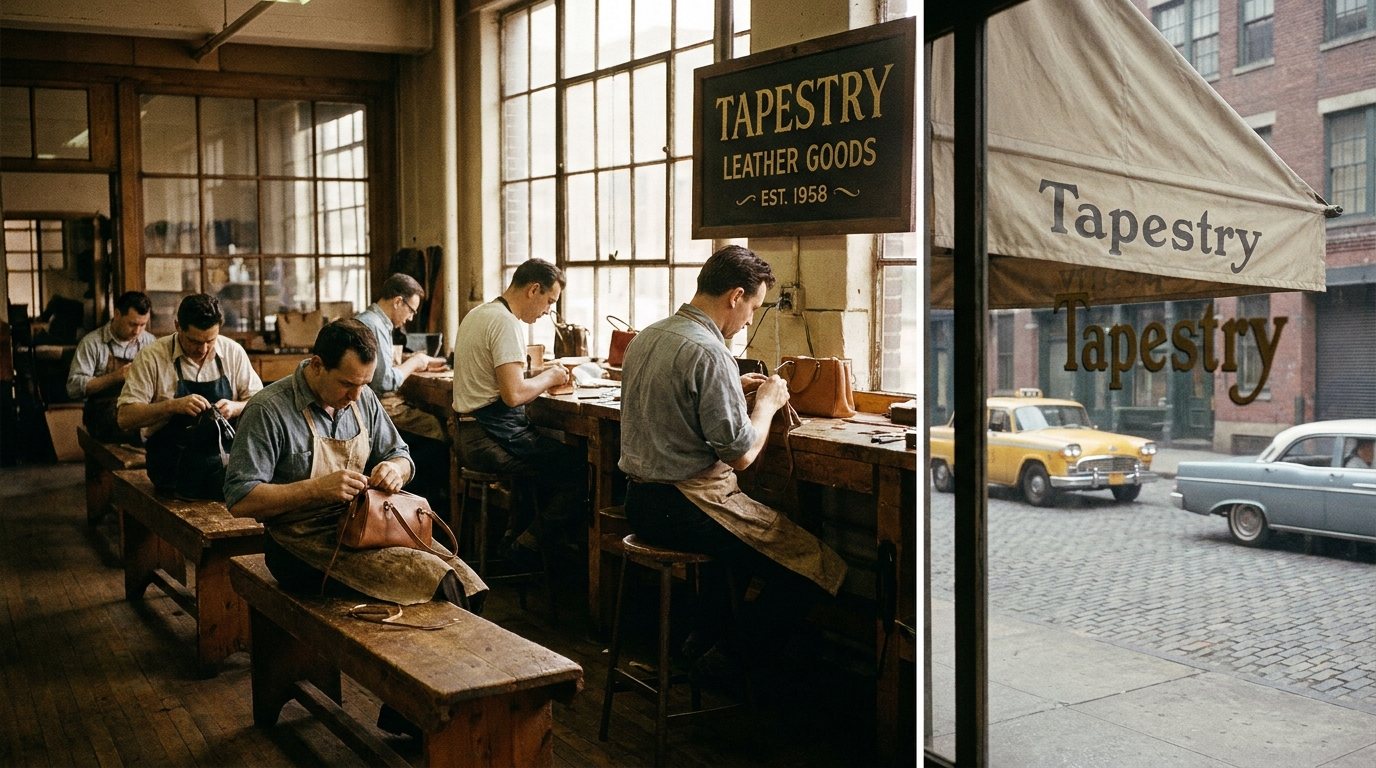
Part of Retailer Playbooks — history-first profiles of every company on the NRF Top 100 Retailers list.
Tapestry, Inc., the house that owns Coach, lands at #95 on NRF's Top 100 Retailers 2026, the National Retail Federation's annual ranking compiled with Kantar, with $4.44 billion in 2025 U.S. retail sales. The company most people still just call "Coach" started in a Manhattan loft with six leather workers and a stack of wallets. Getting from there to a publicly traded conglomerate meant surviving a leveraged buyout, a corporate parent that wanted out, a logo it had to un-sell to the public, and, most recently, a federal antitrust lawsuit that killed its biggest deal in decades.
Six People, One Loft, No Handbags
Coach began in 1941 as a small leatherworking shop on West 34th Street in New York, producing wallets and billfolds for department stores. It was not glamorous and it was not yet Coach in any recognizable sense. Miles Cahn joined the operation in 1946 and by 1950 was running it day to day. The pivotal insight, according to the company's own account and corroborated by outside histories, came when Cahn noticed that baseball glove leather grew softer and more supple with wear rather than cracking. He reverse-engineered that quality into a proprietary tanning and dyeing process that produced leather rich enough in color and sturdy enough to hold its shape without the cardboard-and-thin-hide shortcuts common among competitors, per Wikipedia's history of the brand and FundingUniverse's company history.
It was Cahn's wife, Lillian, who pushed the idea into women's handbags rather than staying in small leather goods. The Cahns bought the business outright in a 1961 leveraged buyout, then hired designer Bonnie Cashin as creative director from 1962 to 1974. Cashin is the reason a Coach bag looks like a Coach bag: she added exterior pockets for a woman who needed her hands free, brighter colors than the industry's brown-on-brown default, and a brass toggle closure she borrowed, deliberately, from the roof latch of a convertible car. None of that was inevitable. It was a specific set of design choices layered onto a specific manufacturing trick, and together they turned a wallet shop into a category.
Sold to a Meat Company, Then Spun Back Out
By the early 1980s Coach occupied four floors of its 34th Street building, paid skilled workers premium wages, and still could not make bags fast enough for department stores, who had to ration allocations. Rather than compromise on manufacturing, the Cahns opened their own specialty stores and started a mail-order catalog. In July 1985, ready to devote themselves to a specialty cheese venture, they sold Coach to Sara Lee Corporation for roughly $30 million, according to FundingUniverse's account.
Under Sara Lee, and under executive Lew Frankfort, who had joined in 1979 and became CEO in 1996, Coach expanded aggressively: stores in England and Japan by 1988, sales that quintupled to $100 million by 1989, and a repositioning from "leather goods company" to "Coach the brand." The manufacturing side flipped just as dramatically. Coach outsourced roughly 25 percent of production in 1998; by 2000 that figure was near 80 percent, completing a shift from garment-district manufacturer to designer-marketer. Sara Lee took Coach public in October 2000, then fully spun it off to shareholders in April 2001. Reed Krakoff, hired in 1997, is widely credited with turning that newly independent company into the global brand Coach became through the 2000s.
When the Logo Got Too Big
Coach's post-independence growth ran largely on its Signature "Double C" canvas and a network of outlet stores, and by the mid-2010s that same engine was working against the brand. Heavy outlet discounting and logo saturation cut against the "affordable luxury" positioning Coach had spent decades building, opening space for rivals selling a cleaner, less logo-forward look. The company's response was a design reset: Stuart Vevers arrived in 2013 from Loewe to become creative director, pushing Coach toward more considered leather goods and further away from outlet-driven volume, alongside newer sustainability-linked lines like Coachtopia, per Wikipedia's entry on the brand.
At the same time, the company decided the safest way to de-risk a single-brand business was to stop being a single-brand business. It bought Stuart Weitzman in 2015 for $574 million and Kate Spade New York in 2017 for $2.4 billion, then renamed the whole holding company Tapestry, Inc. on October 31, 2017, changing its ticker from COH to TPR, per Wikipedia's Tapestry entry. The name change was a small thing with a real intention behind it: Coach the brand would stay Coach, while Coach the corporation would stop being conflated with any one label.
The Deal a Federal Judge Wouldn't Let Happen
The unique wrinkle in Tapestry's story, and the part its own About page will not walk you through, is a fight it lost in public. In August 2023 Tapestry agreed to buy Capri Holdings, owner of Michael Kors, Versace, and Jimmy Choo, for $8.5 billion, a deal that would have made Tapestry the dominant force in what the industry calls "accessible luxury" handbags. The Federal Trade Commission sued to block it in April 2024, arguing Coach and Michael Kors were each other's closest real competitors and that the merger would let the combined company push through price increases with less fear of losing shoppers to a rival. A federal judge sided with the FTC in October 2024, and Tapestry walked away in November, per Wikipedia's account of the merger.
The lawsuit is worth reading in full because it is one of the few public records where a fashion company's own competitive self-image gets tested under oath rather than asserted in a press release. Tapestry argued its real competition was designer luxury and fast fashion alike; the government argued, and won, that the handbag market has a distinct middle tier where losing Michael Kors as a rival to Coach would genuinely hurt shoppers. Coach's own pricing and assortment strategy became evidence in a federal courtroom about exactly how replaceable it thinks its bags are.
Tapestry's answer to losing that scale play was not to chase another one. In August 2025 it divested Stuart Weitzman entirely, leaving Coach and Kate Spade as its full portfolio and returning the company to something closer to the two-brand focus it had before the Capri detour, guided by what it now calls its "Amplify" strategy. A company that spent forty years alternating between craft-shop discipline and conglomerate ambition just chose discipline again, in public, with the receipts to prove it tried the other way first.
Retail history keeps circling back to the same unglamorous ingredients: a workshop, a supply chain, a catalog, and the discipline to know which one actually built the brand.