
The Army & Air Force Exchange Service: A Retailer With No Owners
The Army & Air Force Exchange Service ranks #60 on NRF's Top 100 Retailers 2026. Its history reveals a retailer built to have no profit motive at all.
Part of Retailer Playbooks — history-first profiles of every company on the NRF Top 100 Retailers list.
The Army & Air Force Exchange Service, known to millions simply as the Exchange, lands at #60 on the National Retail Federation's Top 100 Retailers 2026 list, with $7.48 billion in 2025 U.S. retail sales compiled by NRF and Kantar. Almost none of that revenue touches a civilian. The Exchange runs more than 5,500 stores and facilities in over 30 countries, and by its own count it is among the 50 largest retailers in America, yet you cannot shop there unless you carry a military ID. It is also, structurally, unlike any other name on the list: it has no shareholders and was never built to turn a profit.
The problem the Exchange was invented to solve
Before there was a Post Exchange, there were sutlers. A sutler was a licensed civilian merchant who followed an army into the field and sold soldiers what the quartermaster didn't provide: tobacco, coffee, sugar, liquor, small comforts. Sutlers held something close to a legal monopoly at each post, and with a captive customer base and no real competition, prices climbed and quality slipped. It was a good business to be a sutler and a bad deal to be a private.
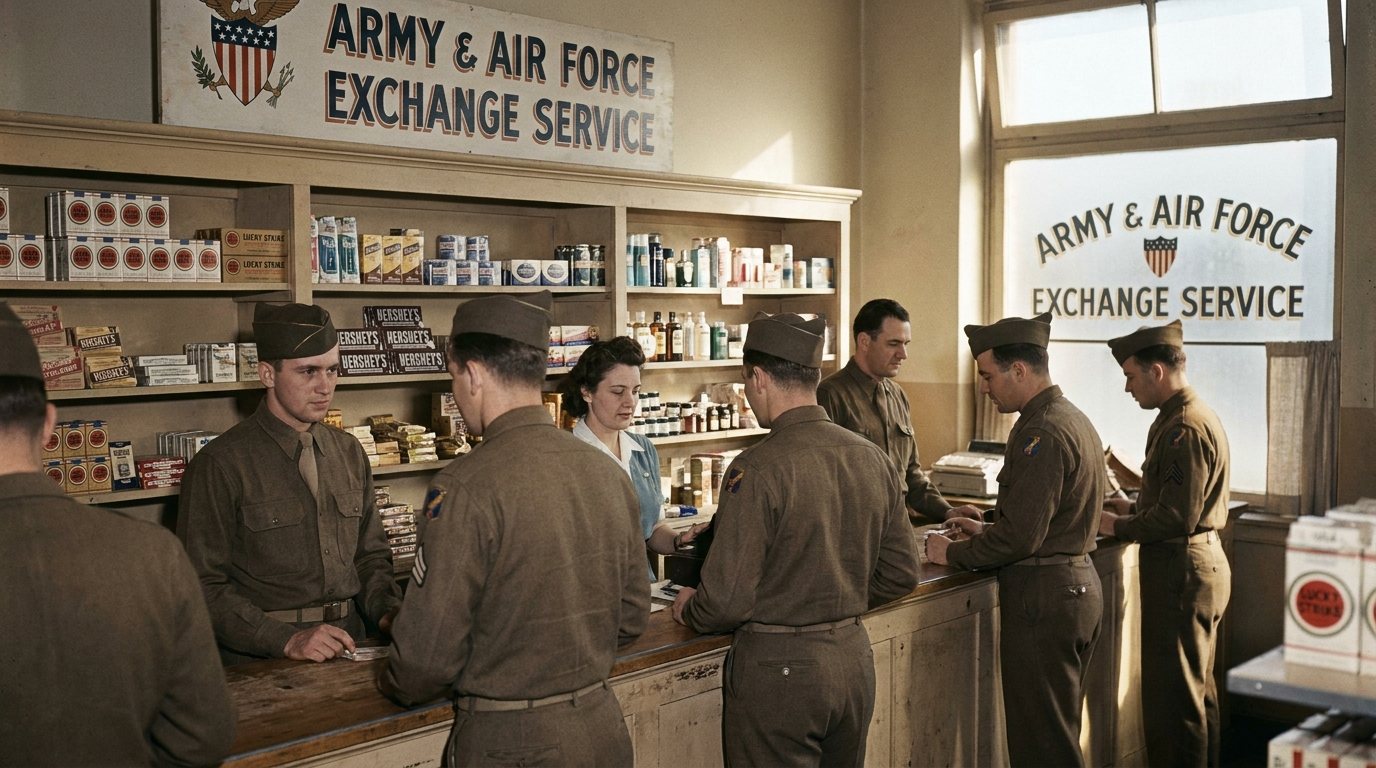
The Army's answer was to compete with itself out of existence. The first military-run canteen opened at Vancouver Barracks in 1880, run by soldiers for soldiers, selling goods near cost. In 1892 those canteens were rebranded "post exchanges," a deliberate distancing from the canteen's boozier reputation. Then in 1895 the War Department made it official Army-wide with General Orders No. 46, directing post commanders to stand up exchanges at their installations. The mission was never to build a retail empire. It was to strip the profit margin out of selling to soldiers.
From post-by-post canteens to a single command
For nearly half a century, exchanges stayed local: each post ran its own store, its own books, its own rules. World War II forced consolidation. Millions of troops needed to be supplied wherever they were sent, and a patchwork of independent post stores couldn't scale to a global war. The Army formally centralized the system as the Army Exchange Service on June 6, 1941, six months before Pearl Harbor, giving the operation a single command structure just as it was about to be tested at a scale no one had planned for.
The name most people would recognize came seven years later. When the Air Force split off as its own service branch in 1947, the exchange system followed the reorganization, and on July 26, 1948, the Army Exchange Service became the Army & Air Force Exchange Service, one retailer serving two branches under a shared board answerable to both service secretaries.
A retailer that measures success in dividends, not margin
Here is the detail that separates the Exchange from every other company on the NRF list, and it's the piece a shopper would never guess by walking the aisles: AAFES is a non-appropriated fund activity. Congress doesn't fund its operations and doesn't collect its profits. The Exchange buys, prices, and sells goods like any retailer, tax-free to the customer, and whatever margin is left over is not distributed to owners because there are no owners to distribute it to. Over the last decade the Exchange has returned $2.4 billion in dividends back into military quality-of-life programs, MWR funds, youth activities, and family support services on the very bases where the money was earned. A retailer with an 8 percent earnings margin that plows the proceeds back into the community it serves is not a metaphor here. It is the entire legal design of the company.
That is the unique insight worth sitting with: most retailers exist to convert customer spending into shareholder value, and the org chart, incentive structure, and quarterly rhythm all point toward that goal. The Exchange was engineered, from the sutler-replacement logic of 1880 forward, to point the other way. It is a company whose founding problem was profit itself, extracted from a population that couldn't shop elsewhere, and its entire subsequent history is the institutional memory of trying to make sure that never happens again.
Staying relevant to a shrinking, changing customer base
The Exchange's core customer, the active-duty service member, has shrunk for decades as the U.S. military has gotten smaller and more automated. AAFES adapted by widening who's allowed to walk through the door. In 2017 it opened online shopping to all honorably discharged veterans, not just retirees, a major expansion of the eligible population. In 2020 it extended in-store shopping privileges to disabled veterans and Purple Heart recipients. Both moves kept the Exchange's mission current without changing its structure: still tax-free, still self-sustaining, still recycling its own margin into the community that generates it.
Today the Exchange employs roughly 24,000 associates, more than 80 percent with a military connection themselves, and has hired more than 67,000 veterans and military spouses since 2013. It still outfits new uniforms at cost, still runs theaters and food courts on remote installations, and still sends associates into combat zones, more than 4,800 deployed since 9/11 to keep stores open where the Army and Air Force go.
Retail history usually rewards the company that figures out how to capture more value from the customer. The Exchange's founding trick was the opposite: figure out how to capture as little as possible, permanently, and call that the business model. Every catalog, warehouse, and supply chain in this series exists to move goods to people. The Exchange is a reminder that who profits from that movement was always a choice, not a law of retail physics.