
Academy Sports + Outdoors: A Tire Shop's Long Reinvention
Academy Sports + Outdoors ranks #76 on NRF's Top 100 with $6.02B in 2025 sales. Here's how a San Antonio tire shop became a sporting-goods giant.
Part of Retailer Playbooks — history-first profiles of every company on the NRF Top 100 Retailers list.
Academy Sports + Outdoors lands at #76 on the NRF Top 100 Retailers 2026, the National Retail Federation's annual ranking compiled with Kantar, with $6.02 billion in 2025 U.S. retail sales. That number describes a sporting-goods superstore chain. It says nothing about the fact that Academy spent its first three decades selling tires and Army surplus, and only became a sporting-goods retailer because one family kept rebuilding the business underneath its own name.
A Tire Shop Across From a Catholic School
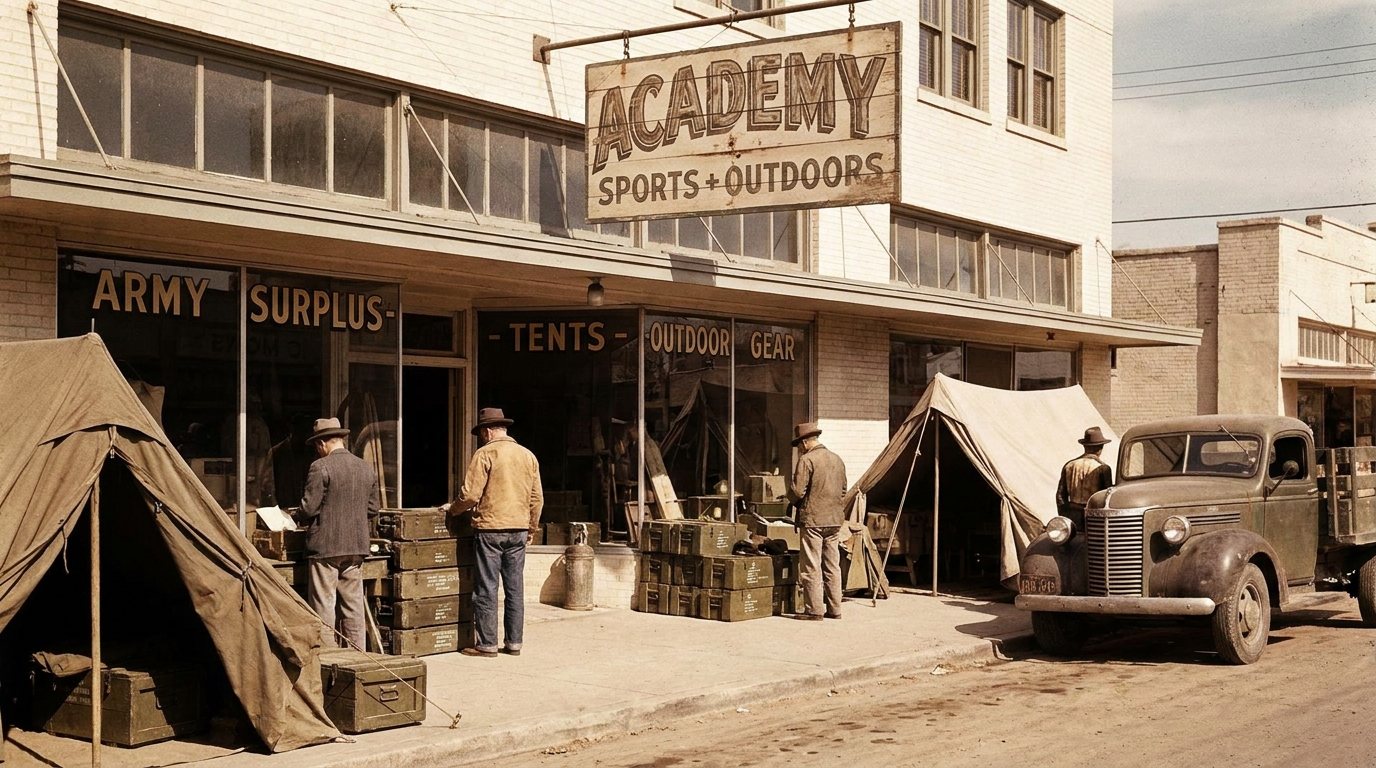
The store opened in 1938 in San Antonio, Texas. Max Gochman set up shop across from St. Henry's Academy, a Catholic high school, and called it Academy Tire Shop, according to Wikipedia. Gochman soon started stocking Army-Navy surplus alongside tires, riding the huge postwar glut of military goods that stocked similar stores across Texas.
His son Arthur, a practicing attorney, bought six failing surplus stores in Houston in 1970 with a partner, then bought the partner out in 1973 and renamed the operation Academy Corp., after his father's Austin stores, according to FundingUniverse. For years Arthur ran Academy on the side while keeping his law practice. The surplus business was still the business.
The Pivot Nobody Puts on a Timeline
Arthur went all in on Academy in 1978, and the moment he did, he killed the product line that had defined the company for forty years. Military surplus demand was drying up as consumer tastes shifted toward athletic wear and name-brand sporting equipment, and Academy stopped selling surplus goods entirely, converting fully to sporting goods, per FundingUniverse. When Max Gochman died in 1985, Arthur inherited his father's four Austin stores and refitted them as sporting-goods megastores rather than keeping them as they were.
This is the detail that does not show up on Academy's own About page: the company most people know as a sporting-goods chain has already reinvented its core product line twice, first from tires to surplus, then from surplus to sportswear, before it ever became "Academy Sports." Longevity here did not come from protecting a legacy business. It came from a family willing to abandon one.
Arthur's other bets compounded through the 1980s and 1990s. He noticed through customer surveys that men dominated Academy's shopper base and pushed into women's athletic and casual wear, a category that grew from 30 percent of sales to 44 percent between 1995 and 1997. He adopted an "EveryDay Low Pricing" model in 1986, rejecting the promotional-discount cycle most of the industry ran on. And Academy leaned hard into regional identity, stocking Western wear other chains ignored. By 1990, Academy was selling more cowboy boots than any competitor in the country, per FundingUniverse.
A Name Built for Texas, Rebuilt for the Country
Arthur's son David joined the company in 1995 and became CEO in 1996, at 30, holding a law degree from the University of Texas and a master's from Harvard in East Asian Studies, an unusual résumé for a sporting-goods chain. Academy remained a Texas-only chain until 1994, when it opened its first out-of-state stores in Edmond, Oklahoma, and Lafayette, Louisiana. As it pushed further into new states, "Academy" alone risked confusion with schools and dance studios that had nothing to do with sporting goods, so the company renamed itself Academy Sports & Outdoors for markets that had never heard of St. Henry's, per Wikipedia. It grew from 44 stores in 1998 to 200 by 2015.
Ownership Changes Hands After 74 Years
In May 2011, KKR acquired Academy, ending 74 years of Gochman family ownership, according to Wikipedia. The company launched e-commerce almost immediately after the deal closed. Nine years later, in October 2020, Academy went public on NASDAQ under the ticker ASO, pricing below $13 a share and climbing toward $40 by mid-2021 as pandemic-era demand for outdoor gear, firearms, and home fitness equipment surged.
| Era | Pivotal move |
|---|---|
| 1938 | Max Gochman opens Academy Tire Shop in San Antonio, adds Army-Navy surplus |
| 1973 | Arthur Gochman buys out his partner, renames the chain Academy Corp. |
| 1978 | Academy exits surplus entirely, converts to sporting goods |
| 1986 | Company adopts EveryDay Low Pricing |
| 1996 | Renamed Academy Sports & Outdoors under CEO David Gochman |
| 2011 | KKR acquires Academy, ending 74 years of family ownership |
| 2020 | IPO on NASDAQ (ASO) during the pandemic outdoor-gear boom |
Where That Leaves the Company Now
Academy now runs roughly 300-plus stores concentrated in the South, Southwest, and Midwest, headquartered near Katy, Texas, with around 22,000 employees. It trades at a market capitalization near $3 billion with trailing annual revenue around $6.1 billion, per Forbes. Steve Lawrence now leads the company as CEO. The chain still runs the same basic format Arthur Gochman built in the 1980s: a large-box, one-stop store carrying everything from athletic apparel to hunting, fishing, and camping gear, priced consistently rather than promotionally.
Academy's history is a reminder that the retailers built to last are rarely the ones that protect their original product. They're the ones that notice, correctly and early, when the product has stopped mattering and the format still does.
This profile is part of an ongoing series on the companies that shape American retail, told through the ledgers, warehouses, and store aisles that rarely make the headlines.