
Bass Pro Shops: From a Liquor Store Counter to $7.56B
How an 8-square-foot bait counter in a Springfield liquor store grew into Bass Pro Shops, the No. 58 retailer on NRF's 2026 Top 100 Retailers list.
Part of Retailer Playbooks — history-first profiles of every company on the NRF Top 100 Retailers list.
Bass Pro Shops ranks No. 58 on NRF's Top 100 Retailers 2026, the National Retail Federation's annual ranking compiled with Kantar, with $7.56 billion in 2025 U.S. retail sales. It got there without ever going public, without a single quarterly earnings call, and without much changing about the founder's original instinct: sell people the gear for the trip, then sell them the trip.
Eight square feet in the back of a liquor store
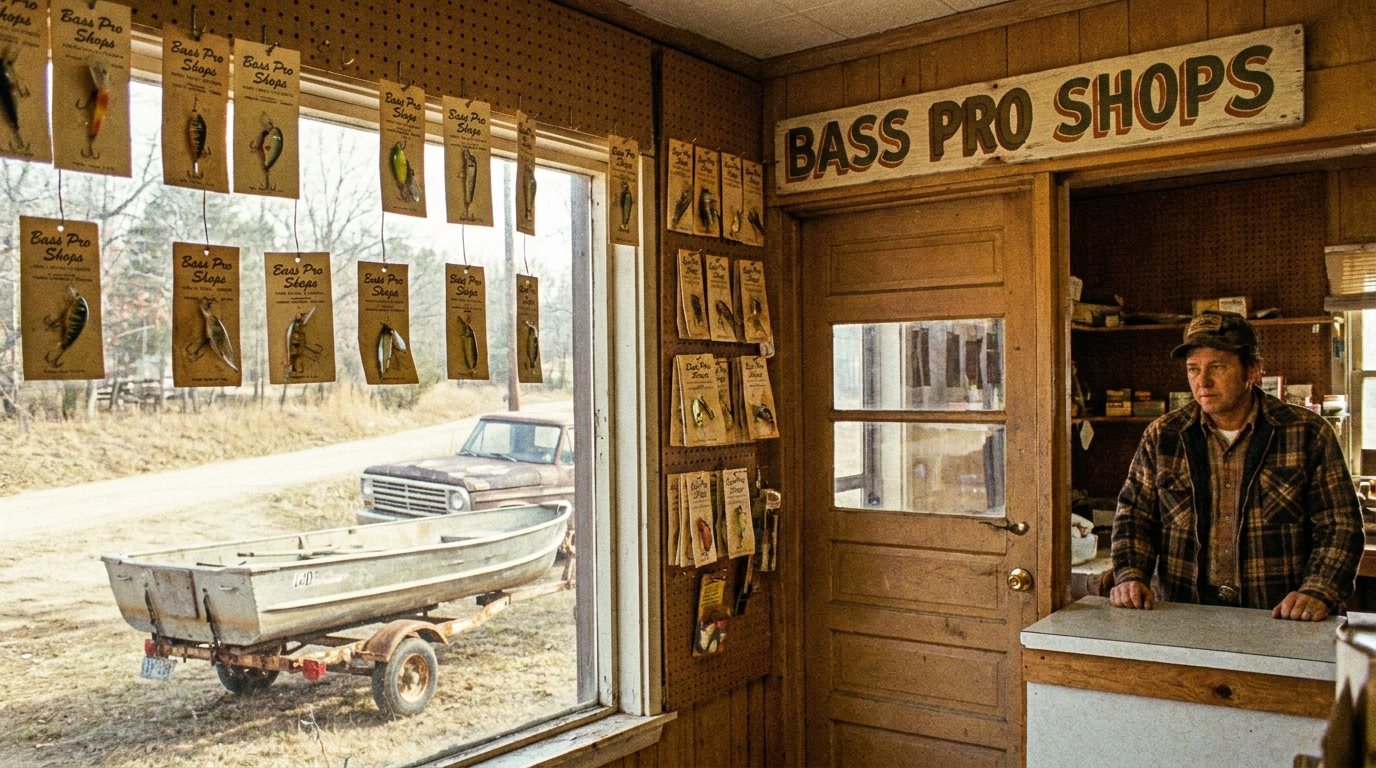
In 1972, 24-year-old Johnny Morris talked his father into letting him stock a handful of fishing lures in a corner of the family's Brown Derby Liquor Store in Springfield, Missouri. Morris's father was a World War II veteran who'd passed his love of the outdoors down to his son, and the son turned that inheritance into a business plan: local anglers kept asking him what was actually working on Table Rock Lake that week, and he kept having an answer, according to the account preserved on Wikipedia.
The bait counter outgrew its liquor-store host fast. When customers who'd moved away kept calling Morris for tackle recommendations, he did the obvious thing for 1974: he printed a mail-order catalog. That catalog, not the storefront, is arguably the real founding document of Bass Pro Shops. It turned a regional bait shop into a national distribution business a full two decades before anyone was calling this "omnichannel."
The bet nobody else made: build the boats
The pivotal decision came in 1978, and it's the one most shoppers walking into a Bass Pro today never think about. Morris introduced Tracker Boats, the first boat-motor-trailer package built specifically for bass fishermen, according to Wikipedia's history of the company. It was a manufacturing bet layered on top of a retail business, and it grew into White River Marine Group, which today builds Tracker, Nitro, Tahoe, and Ranger boats among other brands.
This is the detail that doesn't show up on a typical About page: Bass Pro Shops isn't just America's biggest outdoor retailer, it's also one of the largest boat manufacturers in the world by unit volume. That vertical integration did two things a pure retailer couldn't. It gave Bass Pro margin and control over its highest-ticket category instead of just reselling someone else's hull. And it made the business far harder to disrupt with a website, because nobody was ever going to get a bass boat delivered by a marketplace seller in two days. While the rest of retail spent the 2010s bracing for e-commerce to hollow out its stores, Bass Pro had already built a chunk of its business around a product category that Amazon structurally couldn't touch.
The first standalone Bass Pro Shops store opened in Springfield in 1981. Growth stayed patient through the 1990s, a second location in Duluth, Georgia didn't arrive until 1995, and Big Cedar Lodge opened on Table Rock Lake in 1988, planting the flag on a second business line: destination hospitality. Then, starting around 2005, the company shifted into a faster gear, opening seven to nine stores a year through 2008.
Turning stores into destinations
By the time Bass Pro built its Memphis flagship inside the old Memphis Pyramid in 2015, the strategy had a name even if the company never used it that way: the store as attraction. The Pyramid location packed in a cypress swamp, an alligator habitat, a hotel, restaurants, a bowling alley, a 28-story elevator, and retail, all under one roof. Two years later, in 2017, Morris opened the Wonders of Wildlife National Museum and Aquarium next to the Springfield headquarters, a facility that now holds roughly 35,000 animals across more than 800 species and has been voted America's Best Aquarium in the years since.
That's not decoration. It's a moat built from square footage nobody can replicate in a browser tab, and it's the same instinct that separated Bass Pro from category peers that didn't make it through the 2010s and 2020s retail shakeout. A store you can drive to and spend four hours inside is a different competitive animal than a store you visit only to check a price before buying online.
Buying the rival that couldn't quite keep up
The largest single move in company history came in 2016, when Bass Pro agreed to acquire Cabela's, the Nebraska hunting-and-fishing chain that Dick and Mary Cabela had started in 1961 out of a $45 magazine ad for fishing flies, according to Wikipedia's account of Cabela's. The deal, valued at roughly $4.5 billion, cleared FTC review in July 2017 and closed that September, consolidating the two biggest names in outdoor retail into one company. Sidney, Nebraska, Cabela's hometown headquarters, lost roughly 2,000 jobs in the integration, a hard chapter for a small town that had built its identity around the company for decades. Most Cabela's stores were eventually rebranded Bass Pro Shops, though close to 50 locations still carry the Cabela's name today, a deliberate choice to keep some regional loyalty intact rather than erase it entirely.
| Year | Move | What it did |
|---|---|---|
| 1972 | Bait counter in a liquor store | Started the company |
| 1974 | First mail-order catalog | Made it a national business |
| 1978 | Tracker Boats launched | Made it a manufacturer, not just a retailer |
| 1988 | Big Cedar Lodge opens | Started the hospitality arm |
| 2017 | Cabela's acquisition closes | Consolidated the outdoor-retail category |
Still privately held
Nearly 54 years in, Bass Pro Shops has never taken outside capital to the point of losing control, and Johnny Morris still owns the company. That's unusual for an operation this size in a category, sporting goods, where several national chains have gone bankrupt, been taken private by activist buyers, or been absorbed into larger conglomerates over the past two decades. Bass Pro's answer to that pressure was never a stock buyback or a store-count contraction. It was to keep building things a screen can't sell: a boat you can put a hand on, an aquarium you can walk through, a lodge you can spend a weekend at.
The company now runs 181 combined Bass Pro and Cabela's locations across the U.S. and Canada and employs about 40,000 people, per Wikipedia's summary of company operations, still run out of Springfield, Missouri, not far from where the bait counter used to sit.
Retail history keeps circling back to the same lesson: the companies that last are the ones that figured out, early and specifically, what a shelf, a catalog, or a store could do that nothing else could.