
Camping World: How Two 1966 Startups Built One RV Giant
Camping World ranks #69 on NRF's Top 100 Retailers 2026 with $6.37B in U.S. sales. Here is how a Kentucky camping-supply store built the industry.
Part of Retailer Playbooks — history-first profiles of every company on the NRF Top 100 Retailers list.
Camping World ranks #69 on the NRF Top 100 Retailers 2026 list, with $6.37 billion in 2025 U.S. retail sales, according to the National Retail Federation's annual ranking compiled with Kantar. It is now the largest retailer built around a single, oddly specific American obsession: the recreational vehicle. Getting there took two separate companies, founded in the same year, that didn't actually become one business until 45 years later.
A loan, an amusement park, and a line of campers
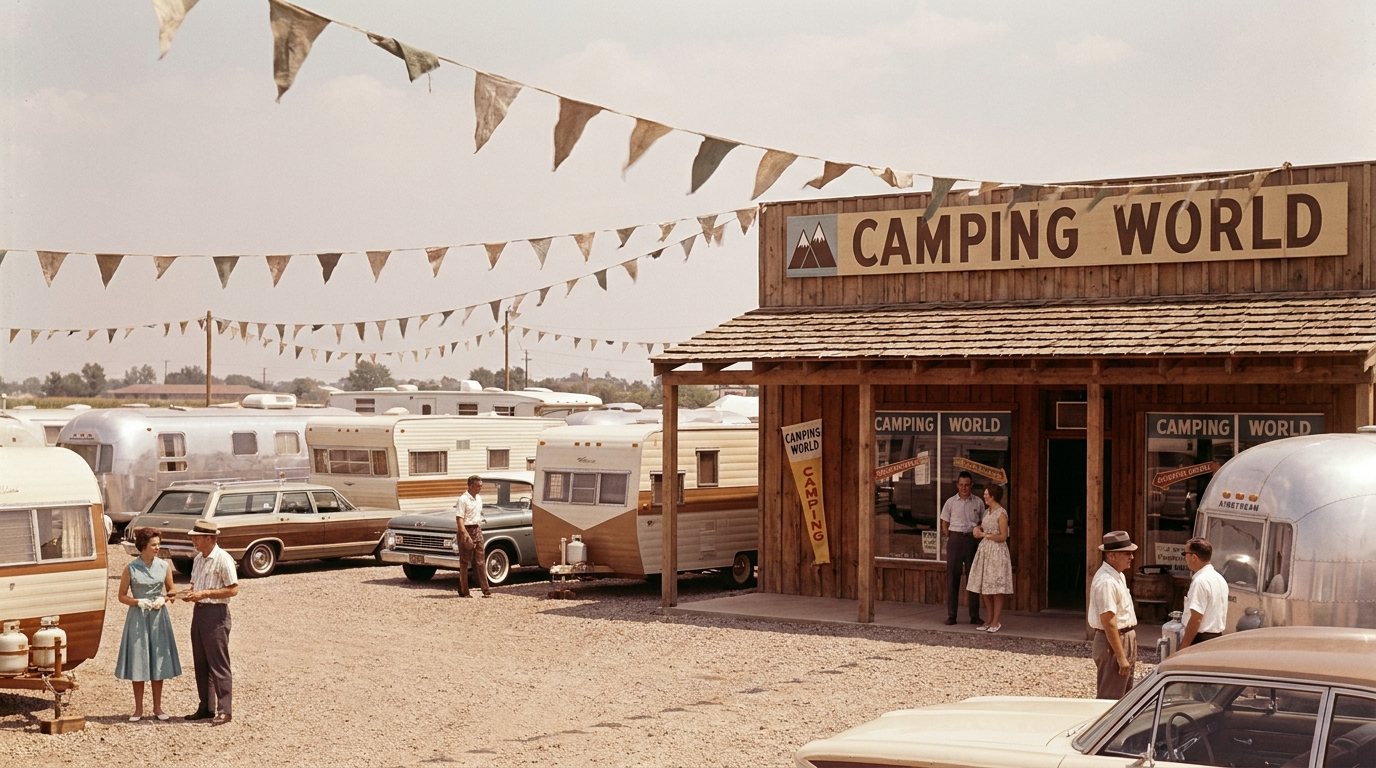
In 1966, David Garvin ran a small store at Beech Bend Park, an amusement park near Bowling Green, Kentucky, that his father owned. Campers pulling into the park kept asking where they could buy basic gear, so Garvin took out a loan and opened a shop to sell it to them, according to Camping World's own history as compiled by Wikipedia. It was a concession stand answer to a supply problem, not a grand retail vision.
The real growth engine came later, when Garvin added a mail-order catalog. Long before e-commerce, that catalog let a single Kentucky storefront sell parts and accessories to RV owners who might never set foot in Bowling Green. It turned a seasonal, regional business into something with year-round, national reach, and it funded the store expansion that followed. By 1997, Garvin had built enough of a company that he sold it to Affinity Group, a California-based holding company that would later rename itself Good Sam Enterprises.
The other 1966 company
Here is the detail that gets lost in most write-ups of Camping World: 1966 was also the year Art Rouse founded the Good Sam Club, a membership organization for RV owners built around roadside help, camping discounts, and a sense of belonging borrowed from the parable of the Good Samaritan, per Wikipedia's account of the club's history. Rouse and his sons took over full ownership in 1968 and spent decades building it into what is now billed as the world's largest RV owners' organization, with more than 2 million members.
Garvin's camping-supply retailer and Rouse's owners' club were unrelated companies, started the same year, serving the same customer from opposite directions: one sold the RV lifestyle's stuff, the other sold its safety net. They didn't merge until 2011, when Camping World combined with Good Sam Enterprises under Marcus Lemonis. Two institutions with the same birth year spent 45 years as strangers before becoming one balance sheet. That's the kind of coincidence a company's own About page has no reason to mention, because nobody there experienced it as a coincidence. It happened one holding-company deal at a time.
Lemonis and the roll-up decade
Lemonis's path into Camping World ran through the unglamorous work of consolidating a fragmented industry. He ran Holiday RV Superstores from 2001 to 2003, then co-founded FreedomRoads to keep buying up independent RV dealerships, according to Wikipedia's summary of his career. In 2006, FreedomRoads merged with Camping World itself, and Lemonis took the CEO seat. Five years later came the Good Sam Enterprises merger, folding the retailer, the dealership network, and the owners' club under one roof for the first time.
That combination is the real architecture of the modern company: a dealership network selling and servicing RVs, a retail and catalog business selling the parts and gear to run them, and a club selling the membership services, insurance, and roadside assistance that keep owners paying long after the vehicle purchase closes. Three revenue lines, one customer, tied together by four decades of separate histories.
Going public, then going wider
Camping World listed on the NYSE in October 2016, pricing at $22 a share and raising roughly $251 million, a milestone that gave the RV industry its first pure-play public retailer of real scale. The following year the company moved outside RVs entirely, buying the Gander Mountain name (relaunched as Gander Outdoors, alongside the boating and watersports retailer Overton's) and The House, a boardshop and outdoor-gear chain, after Gander Mountain's 2017 bankruptcy left its brand available. It was the same instinct Garvin had at the amusement park: sell what the outdoor customer standing in front of you actually wants next.
The scale today
Camping World now runs 206 locations across 44 states, employing more than 13,000 people, and describes itself as the world's largest supplier of RV parts and supplies. Lemonis is stepping back from the CEO role on January 1, 2026, handing the title to president Matthew Wagner and moving into a special advisor position, a transition point for a company whose entire modern identity was built around one operator's roll-up strategy.
The unique thread worth naming plainly: Camping World's brand reads as a single, decades-old American institution, but it is really a 2011 merger of two separate 1966 companies that happened to share a birth year and a customer, brought together only when a third operator spent a decade buying up the fragmented pieces in between.
Every category has its own version of this story: a retailer whose tidy founding narrative turns out to be a later stitching-together of older, unrelated threads. RV supplies are just an unusually literal case of it.