
Dick's Sporting Goods: A $300 Bait Shop Built a Retail Giant
How a Binghamton tackle shop became the #27 retailer in the country, and why its riskiest decision came from a store aisle, not a boardroom.
Part of Retailer Playbooks — history-first profiles of every company on the NRF Top 100 Retailers list.
Dick's Sporting Goods ranks #27 on the NRF Top 100 Retailers 2026, with $20.20 billion in 2025 U.S. retail sales, according to the National Retail Federation's annual ranking compiled with Kantar. The company that now anchors that number started with a grandmother's savings and a rejected merchandising idea.
A rejected pitch and a $300 loan
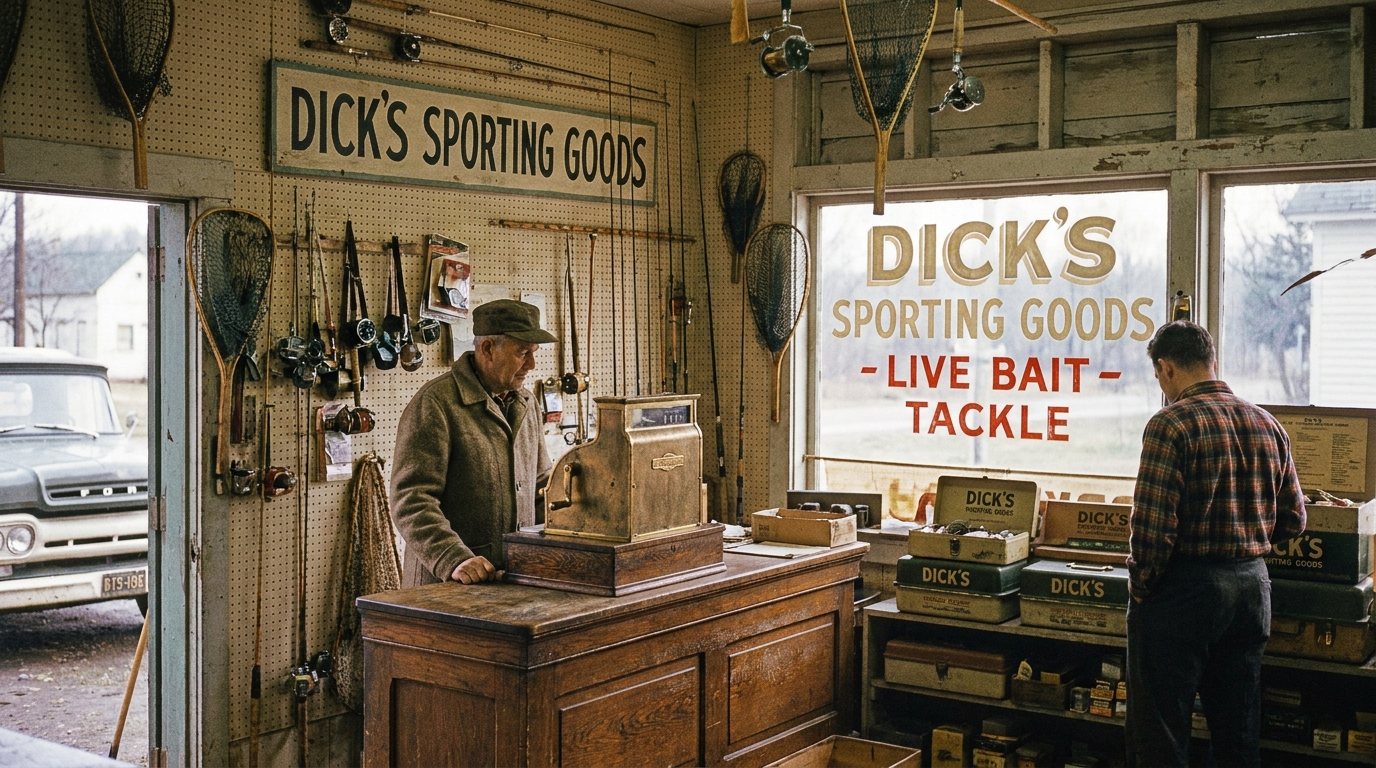
In 1948, 18-year-old Richard "Dick" Stack was working the counter at an Army-Navy surplus store in Binghamton, New York, when he proposed stocking a wider range of fishing tackle. His boss said no. His grandmother said yes, handing him $300 from her savings to open his own bait-and-tackle shop, according to FundingUniverse's company history. Within a decade, customer demand had pulled the shop past bait and lures into a full sporting-goods assortment.
For nearly thirty years, that was the whole company: one store, then two, both in Binghamton. Dick Stack ran it as a regional specialty shop, not a chain. The transformation into a national retailer didn't come from him. It came from his son.
The superstore bet
Edward Stack, a certified public accountant, joined the family business in 1977 after his father's emergency heart surgery pulled him in. When Dick retired in 1984, Edward took over as chairman and CEO of a two-store operation and immediately made a bet his father never made: the superstore. Dick's began opening 35,000- to 45,000-square-foot locations built around shops-within-shops and merchandise-testing areas, according to FundingUniverse.
The expansion math was blunt. By early 1997, Dick's had over 50 stores generating an estimated $10 to $12 million in sales apiece, ahead of rival The Sports Authority's roughly $7.7 million average per store. Headquarters moved to Pittsburgh in 1994. The company renamed itself Dick's Sporting Goods in 1999, launched e-commerce on Super Bowl Sunday that same year, and went public on the NYSE in October 2002 at $12.25 a share. Revenue had grown from $728 million in 1999 to $1.1 billion by the IPO, across 134 stores in 24 states.
Acquisitions filled out the map and the assortment over the following two decades:
| Year | Move | Why it mattered |
|---|---|---|
| 2004 | Galyan's | Added big-box footprint in new markets |
| 2006 | Golf Galaxy ($225M) | First major category-specific chain |
| 2007 | Chick's Sporting Goods | Entry into Southern California |
| 2016 | Golfsmith (bankruptcy auction) | Consolidated golf retail further |
| 2023 | Moosejaw (from Walmart) | Outdoor/apparel specialty brand |
| 2025 | Foot Locker ($2.4B) | 2,400 stores, 20 countries, footwear scale |
The decision that had nothing to do with retail math
Here's the part that doesn't show up in a straightforward "how we grew" narrative, and it's worth naming directly: Dick's made its single biggest brand-defining move by walking away from revenue, not chasing it.
After the Sandy Hook shooting in 2012, Dick's-branded stores quietly stopped selling assault-style weapons, though its Field & Stream subsidiary kept selling them. After the February 2018 Parkland shooting, Ed Stack went further and made it company-wide: no more assault-style rifles or high-capacity magazines anywhere, and no gun sales to anyone under 21, according to Wikipedia's entry on Ed Stack. The company destroyed roughly $5 million of assault-style rifle inventory rather than sell it through. Stack later became an active advocate for gun-control measures, engaging lobbyists and lawmakers directly, per Wikipedia.
Most retail histories treat that as a corporate-responsibility footnote separate from the "real" business story. It shouldn't be. Look at what came right after: Field & Stream locations, the gun-heavy banner, were phased out by 2023 and converted into Dick's flagship experiment, House of Sport, or standard Dick's stores, per Wikipedia. A company that had just proven it would absorb a real revenue hit on principle turned around and bet its next decade on an entirely different kind of risk: giant-format stores with turf fields, climbing walls, batting cages, and golf simulators, alongside Public Lands, a conservation-minded outdoor banner that commits 1% of its sales to habitat and access projects. The gun decision and the House of Sport pivot read like two separate stories. They're the same company making the same argument twice, that a category leader can walk away from a chunk of its existing business if it believes the replacement is worth more than the sales it gives up.
What the scale looks like now
Lauren Hobart became president and CEO on February 1, 2021, the company's first female chief executive, with Ed Stack shifting to executive chairman. By fiscal 2025 the company employed roughly 105,000 people and, with the Foot Locker acquisition folded in, operates north of 3,000 stores. The Cookie Jar & A Dream Studios content unit launched in 2025, its name a direct nod back to the grandmother's $300, now produces sports documentaries, closing a loop from bait shop to media property in one company's lifetime.
Every one of those stores, every SKU on every shelf, still runs on the same unglamorous machinery every retailer depends on: a catalog of products that has to be described, categorized, and kept current across a business that has changed shape more than once.