
Ahold Delhaize USA: One Company Built From Four Grocers
Ahold Delhaize USA ranks #13 on NRF's Top 100 with $59.83B in 2025 sales. The history behind Stop & Shop, Giant, Food Lion, and Hannaford, unified.
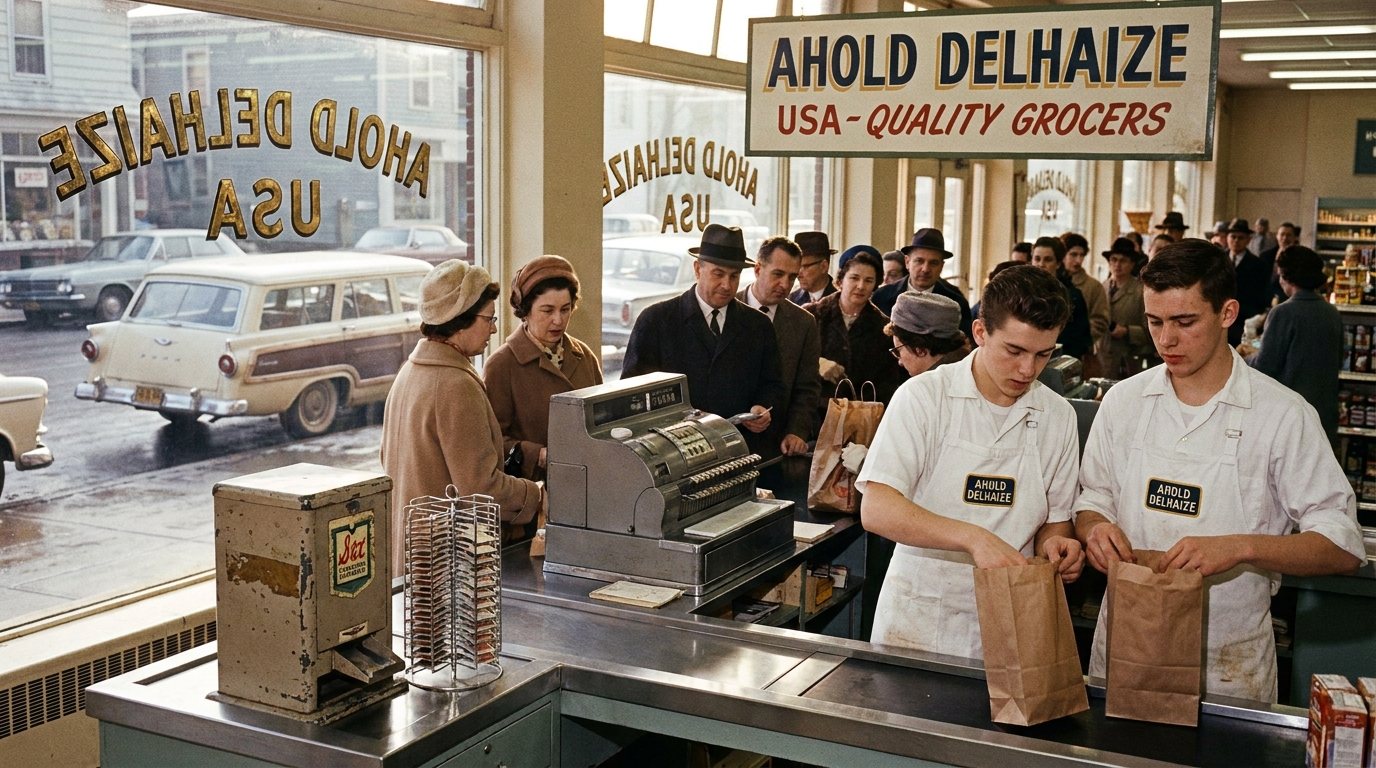
Part of Retailer Playbooks — history-first profiles of every company on the NRF Top 100 Retailers list.
Ahold Delhaize USA lands at #13 on NRF's Top 100 Retailers 2026 list, with $59.83 billion in 2025 U.S. retail sales. Almost none of that revenue rings up under the Ahold Delhaize name. It rings up as Stop & Shop, Giant Food, Food Lion, and Hannaford, four grocery chains that spent a century building fierce regional loyalty before a Dutch conglomerate and a Belgian one quietly bought their way into becoming America's fourth-largest grocer.
Two rivers, an ocean apart
The story starts in two countries that never planned to compete with each other in the United States.
In 1887, Albert Heijn took over his father's general store in Oostzaan, Netherlands, and built it into the country's dominant grocery chain, Albert Heijn N.V. Two decades earlier, in 1867, the Delhaize brothers opened a shop in Charleroi, Belgium, that would become Delhaize Group. Both companies grew into national champions in their home markets. Both eventually looked at the fragmented, wide-open American supermarket business and decided the fastest way in was to buy chains that already had the shelf space, the loyal customers, and the real estate, rather than build a brand from nothing.
Ahold built its US foothold through Stop & Shop, which traces back to 1892 as the Rabinowitz family's Greenie Store in Boston before formally organizing in 1914 as Economy Grocery Stores in Somerville, Massachusetts. It adopted self-service retailing early, following Piggly Wiggly's lead, and by 1946 had 86 stores and the Stop & Shop name. Ahold acquired it in 1996.
Ahold also bought Giant Food, founded December 15, 1936, by Nehemiah "N.M." Cohen, a rabbi who had emigrated from Jerusalem, and financial backer Samuel Lehrman, opening their first store at Georgia Avenue and Park Road in Washington, D.C. Giant went public in 1959, and in 1962 it opened the country's first in-store combination food-and-pharmacy location in Glen Burnie, Maryland, a format every grocer in America now takes for granted. Izzy Cohen ran it into a top-15 US chain before his death in 1995; Ahold bought it in 1998.
Delhaize took the Southern route. Food Town opened in Salisbury, North Carolina, in December 1957, founded by Wilson Smith and brothers Ralph and Brown Ketner. Ralph Ketner's weekly circulars advertising rock-bottom prices, an early bet on what the industry would later call everyday-low-price positioning, made the chain a regional force. Delhaize bought a controlling stake in 1974, and when the chain's expansion into Virginia and Maryland ran into a trademark fight with an unrelated "Foodtown," it rebranded as Food Lion in 1983. Delhaize America rounded out its US footprint in 2000 by acquiring Hannaford, a Maine wholesaler dating to 1883 that Arthur Hannaford started as a Portland waterfront produce stand.
Two near-death moments, told straight
Neither side got here without a scare.
Food Lion's came in 1992, when ABC's PrimeTime Live went undercover with hidden cameras and aired footage appearing to show employees re-dating and re-packaging spoiled meat. Same-store sales fell roughly 9.5 percent in the aftermath, and the chain retreated from markets it had aggressively entered in the Southwest and Midwest. It took years of remodeled stores and rebuilt supplier standards to win shoppers back.
Ahold's came a decade later, and it was bigger. In February 2003, the parent company disclosed that its US Foodservice subsidiary had overstated income tied to promotional allowances, with irregularities also surfacing at Tops Markets and its Argentine unit, Disco. CEO Cees van der Hoeven and CFO Michael Meurs resigned immediately, the stock lost roughly two-thirds of its value, and Standard & Poor's cut Ahold to junk. Dutch prosecutors eventually settled fraud charges for about 8 million euros, and Ahold paid $1.1 billion to settle a US securities class action in 2006. New CEO Anders Moberg's "Road to Recovery" plan sold off South American and Asian operations and, in 2007, divested US Foodservice itself for $7.1 billion, betting the company's future on the supermarket chains it already owned rather than the food-distribution business that nearly sank it.
The merger, and the choice that followed it
By 2015 both companies had spent that decade stabilizing rather than expanding, and a merger of equals made sense: Ahold and Delhaize combined that June, with Ahold shareholders holding 61 percent of the new Koninklijke Ahold Delhaize N.V. The US operations were folded into Ahold Delhaize USA, headquartered in Quincy, Massachusetts, running the American banners as one company on paper.
Here's the part that doesn't show up on the corporate history page: Ahold Delhaize never merged its banners the way most consolidators do. Kroger converts acquired chains to its own private-label systems and, eventually, often its own name. Ahold Delhaize instead left Stop & Shop, Giant, Food Lion, and Hannaford as fully distinct storefronts, distinct loyalty programs, distinct regional buying, running on shared back-end infrastructure that shoppers never see. It's a bet that a century of separately earned local trust is worth more than the efficiency of one national brand, and forty years after the first of these acquisitions, none of the four names has disappeared.
| Banner | Founded | Founders | Joined Ahold Delhaize |
|---|---|---|---|
| Stop & Shop | 1914 (Somerville, MA) | Rabinowitz family | 1996 (Ahold) |
| Giant Food | 1936 (Washington, D.C.) | N.M. Cohen, Samuel Lehrman | 1998 (Ahold) |
| Food Lion | 1957 (Salisbury, NC) | Ketner brothers, Wilson Smith | 1974 (Delhaize) |
| Hannaford | 1883 (Portland, ME) | Arthur Hannaford | 2000 (Delhaize) |
Four family grocery stores, none of them started with the idea of becoming part of a European retail conglomerate, now move enough product to rank thirteenth in the country. The chains kept their names. The pallets, the trucks, and the product data behind them are where the real merger happened.
Sources: Ahold Delhaize corporate history, Food Lion, Giant Food (Landover), Stop & Shop, Hannaford Brothers, Royal Ahold accounting scandal.
This is one entry in a series on the companies that built American retail: the founders, the near-misses, and the unglamorous supply chains still humming behind every storefront.