
How Airgas Fought Off One Buyer, Then Chose Another
Airgas lands on MDM's 2026 Top Distributors list at No. 3 in Industrial Supply. Its real lesson is a takeover it beat, then a deal it wanted.
Part of Distributor Playbooks — strategy teardowns of every company on the MDM Top Distributors lists.
Airgas shows up twice on Modern Distribution Management's 2026 Top Distributors report: No. 3 in Industrial Supply and No. 4 in Safety, on top of its home turf in Gases & Welding Supplies, where MDM lists it alongside an estimated $7.5 billion in 2024 revenue, the most recent figure disclosed. That home turf is the tell. Airgas did not become the biggest name in packaged gas by being the best gas company. It became the biggest name by winning a fight it wasn't supposed to win, then giving away the prize on its own terms five years later.
A law firm buys a gas company
Peter McCausland was a corporate attorney in Valley Forge, Pennsylvania, working for the German industrial gas producer Messer Griesheim, when he came across a small acquisition target: Connecticut Oxygen, an industrial gas distributor doing about $3 million in sales. He recommended his employer buy it. Messer Griesheim passed. McCausland quit, raised venture money, and bought it himself in 1982, according to Airgas's own company history and FundingUniverse's corporate history.
That single purchase became the template. Airgas went public in 1986, raised a secondary round in 1987, and spent the next two decades buying up the fragmented mom-and-pop welding and gas distributors that dotted every American industrial corridor. By McCausland's own count the company made more than 500 acquisitions on the way to becoming the largest packaged-gas distribution network in the country, per Wikipedia's sourced summary of the company's history. In 2002 it bought the U.S. packaged gas and welding supply arm of Air Products and Chemicals outright for $236 million, picking up 88 locations. That detail matters later.
The bid that wasn't supposed to fail
By 2009, Airgas was a member of the S&P 500 and the industry's consolidator of record. That made it a target instead of just a predator. Air Products, the very company whose U.S. packaged-gas business Airgas had bought seven years earlier, approached McCausland about a merger in October 2009. He said no. Air Products went hostile in February 2010, launching a tender offer directly to shareholders and a parallel board proxy fight.
What followed was one of the longest, most closely watched hostile takeover battles in Delaware corporate law. Air Products raised its bid three times over more than a year, from $60 a share to $65.50 to a final $70, and each time the Airgas board refused to redeem its shareholder rights plan, the mechanism known as a poison pill. Air Products sued to force the issue. On February 15, 2011, Chancellor William Chandler of the Delaware Court of Chancery sided with Airgas's board, ruling it could keep the pill in place even against an all-cash, fully financed offer it judged inadequate, a decision analyzed at the time by Jones Day and Gibson Dunn. Air Products withdrew days later. The ruling became a standard citation in every business-law casebook on takeover defense written since.
The insight: the board wasn't defending independence, it was defending arithmetic
Here is what gets lost when the Air Products fight is retold as a governance war story: Airgas's board never argued it should stay independent forever. It argued $70 a share undervalued the company, full stop. Five years later, when France's Air Liquide came calling with a friendly, board-approved offer, Airgas said yes at $143 a share, a deal worth $13.4 billion that closed in May 2016, according to Air Liquide's own completion announcement and contemporaneous coverage from Bloomberg. That is more than double the price the board had refused to accept from a different buyer in 2011.
Most companies that survive a hostile bid tell that story as a triumph of independence. Airgas's real lesson is narrower and more useful to any distributor being circled by a strategic acquirer: the board wasn't protecting a standalone future, it was pricing the asset correctly and waiting for a buyer willing to pay that price. It took the right offer from the right party, not the first offer from an aggressive one. That is a harder discipline to hold under a year of proxy fights and lawsuits than it sounds, and it is the reason the Airgas case study outlived the deal itself.
| Year | Event |
|---|---|
| 1982 | McCausland buys Connecticut Oxygen, founds Airgas |
| 1986 | IPO |
| 2002 | Buys Air Products' U.S. packaged gas business, $236M |
| 2010 | Air Products launches hostile bid, tops out at $70/share |
| 2011 | Delaware Chancery upholds poison pill; Air Products withdraws |
| 2016 | Air Liquide completes friendly acquisition at $143/share |
What the acquirer actually got
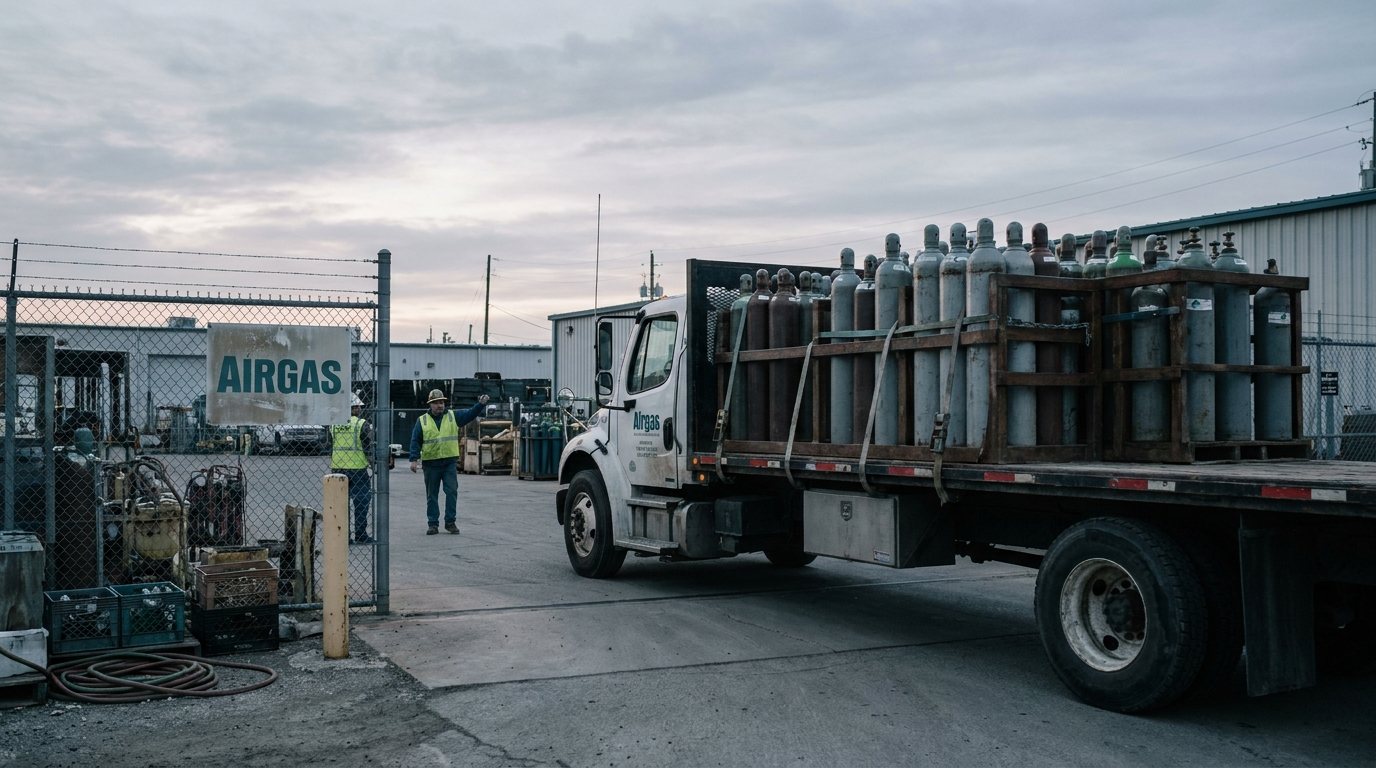
Air Liquide wasn't buying a defense case, it was buying reach. By the time the deal closed, Airgas ran roughly 1,400 locations, branches, cylinder fill plants, production sites, specialty gas labs, and regional distribution centers, feeding what Air Liquide itself called the most advanced multichannel distribution network in the U.S. industrial gas trade. MDM's current listing puts the retail branch count above 900. The network sells through outside sales reps, a strategic accounts team for large industrial customers, telesales, catalog, e-commerce, and an automated vending business that puts welding consumables and safety gear on the shop floor for round-the-clock, unmanned restocking, a channel Airgas has kept building out on its own Airgas Thinks blog.
Ten years into Air Liquide ownership, the roll-up muscle McCausland built in 1982 hasn't atrophied. Airgas kept acquiring independent welding and gas distributors through 2025, including Metroplex Weld and Excel Welding, according to Industrial Distribution, the same playbook of buying local density one distributor at a time that built the company Air Products wanted and Air Liquide got.
Behind every branch count and vending contract in this story sits a duller fact: someone has to keep 900-plus locations selling the correct cylinder, valve, and consumable to the correct account, every day, without the catalog drifting out of sync with the truck.