
How Red Ball Oxygen Stayed Family-Owned Through Consolidation
Red Ball Oxygen made MDM's 2026 Top Distributors list in Gases & Welding Supplies. How a Shreveport family business held its ground as the vertical rolled up.
Part of Distributor Playbooks — strategy teardowns of every company on the MDM Top Distributors lists.
In railroad slang, a "red ball" shipment was the one that jumped the queue: priority freight, moved fast, tagged for expedited handling. A Louisiana company borrowed the term in 1930 and has spent the better part of a century trying to live up to it. Red Ball Oxygen Co. shows up on the 2026 MDM Top Distributors list in Gases & Welding Supplies, one of twenty verticals Modern Distribution Management tracks across North America's largest wholesale distributors. MDM doesn't disclose a revenue figure for Red Ball, which is itself a data point: this is a private, family-run company that has never needed to court public investors, and its own history explains why.
The business it almost wasn't
Red Ball's 1930 incorporation is a technicality more than an origin story. The company that actually matters was born in 1969, when Craig and Lorena Kennedy bought a struggling outfit called Red Ball Battery and Oxygen. At the time it was a National Cylinder Gas distributor selling automotive batteries and tires, with four employees and a single location, according to a company history published by GAWDA's trade media arm. The batteries-and-tires business was not the future. Welding gas was.
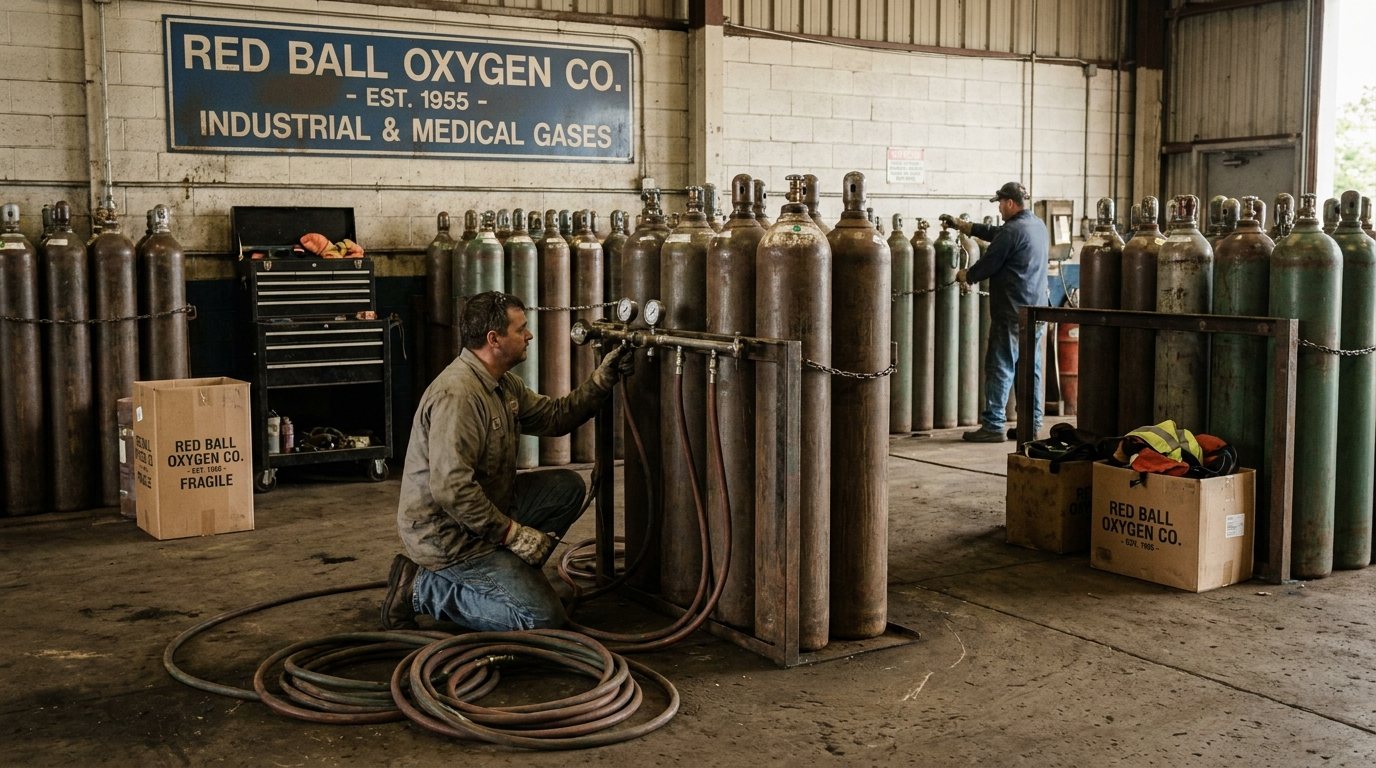
The Kennedys made the pivot: out of automotive retail, into industrial and specialty gas, cylinder fill, and welding supply. That single bet is the entire company today. By its 50th anniversary in 2019, Red Ball had grown to roughly 235 employees, three cylinder fill plants in Shreveport, Houston, and Dallas, two specialty gas plants, and 23 retail locations across a four-state footprint. The company's own about-us page puts the current network at more than 20 customer service locations and four fill plants spanning Louisiana, Texas, Arkansas, and Oklahoma, with a newly opened Port Arthur branch extending the map further into the Gulf Coast petrochemical corridor.
Three generations of Kennedys have now run the company. Alex Kennedy holds the chairman and CEO title; Larry Kennedy chairs the board; Bob Ewing serves as president. That succession, quietly executed across five decades, is the harder trick. Family-owned distributors routinely fail to make it past the second generation, let alone the third, especially in a category where scale keeps compounding for everyone else.
The tension the About page won't state directly
Here is the part of Red Ball's story that a reader would not get from its website: welding gas and industrial gas distribution has spent the last two decades consolidating hard, with multinational strategics absorbing independent regional players across the country. Red Ball has not followed that path. It is still Kennedy-owned, still headquartered in Shreveport, and still small enough that MDM doesn't even list a revenue figure for it, sitting on a Top Distributors ranking dominated by companies that report billions.
And yet the company's influence in its own trade association outstrips its balance sheet. Bob Ewing, Red Ball's president, has served as president of GAWDA, the Gases and Welding Distributors Association that represents the entire independent side of this channel, according to industry coverage and the company's own posts referencing him in both current and past-president capacities. That is a specific kind of leverage: a family firm too small to appear on MDM's revenue column has, at points, set the agenda for the trade group that speaks for its national peers. Staying independent didn't mean staying invisible.
What the operating model actually looks like
Red Ball describes itself as an "open-books, profit-sharing company," a structure that shares financial performance and upside with employees rather than concentrating it in family hands alone, per the company's own about-us materials. That framing matters in a labor-intensive, safety-sensitive business: cylinder handling, bulk gas delivery, and welding equipment service carry real injury risk, and the company has made safety a public metric rather than a private one. In 2025, the Compressed Gas Association gave Red Ball its Distributor Safety Award for companies logging more than 100,000 employee exposure hours, recognizing the greatest safety improvement over a two-year window, with CEO Alex Kennedy accepting at the GAWDA Annual Convention in Tampa.
The company also runs two specialty gas laboratories, in Shreveport and Houston, producing certified gas blends for national and international customers under the "Red Ball Technical Gas Services" banner, a business line that sells expertise rather than cylinders and travels well beyond the four-state delivery radius. That's the second half of the model: local branch density and 24/7/365 delivery for the core welding and industrial gas customer, paired with a specialty-chemistry lab business that competes on a completely different, higher-margin axis. Few regional gas distributors run both at once.
The bet, restated
Red Ball's whole existence rests on one decision made in 1969: get out of batteries and tires, get into gas. Everything since, the fill plants, the specialty labs, the safety record, the GAWDA presidency, the fourth state, is downstream of a single family deciding what business they were actually in. Fifty-six years later the industry around them has consolidated into a handful of giants, and Red Ball is still there, still Kennedy-run, still showing up on the list MDM builds every year to track who's actually moving the freight.
Every distributor on that list, family-owned or private-equity-rolled, wins or loses on the same unglamorous infrastructure: the branch network, the fill plant, the delivery truck, and the data that tells all three where to be next. This series looks at how different companies built that infrastructure, and what it cost them to keep it running.